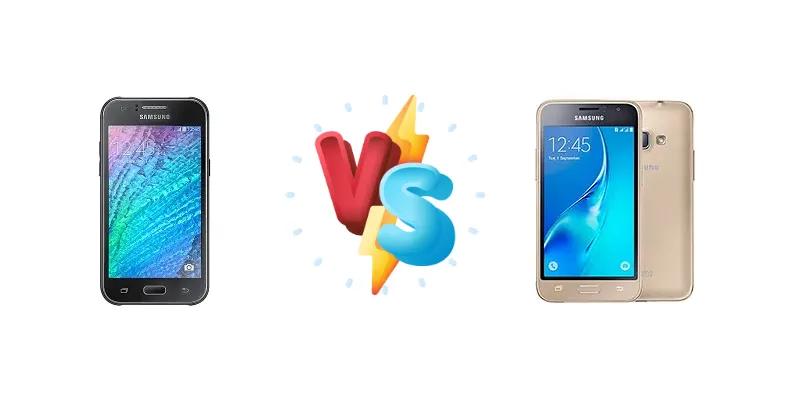
The Samsung Galaxy J1 series was a staple in the budget smartphone market. But with two iterations – the J1 4G and the J1 (2016) – which one reigns supreme? We're diving deep into their specs, performance, and features to help you decide.
🏆 Quick Verdict
The Galaxy J1 4G edges out the J1 (2016) thanks to its more modern Mediatek chipset and 4G connectivity. While both are budget devices, the J1 4G offers a slight performance boost and future-proofing, making it the marginally better choice.
| Network |
|---|
| 2G bands | GSM 850 / 900 / 1800 / 1900 - SIM 1 & SIM 2 (dual-SIM model only) | GSM 850 / 900 / 1800 / 1900 - SIM 1 & SIM 2 (dual-SIM model only) |
| 3G bands | HSDPA 850 / 900 / 2100 | HSDPA 850 / 900 / 1900 / 2100 - J120F |
| 4G bands | 1, 3, 7, 8, 20 | 1, 3, 5, 7, 8, 20 - J120F |
| Speed | HSPA 21.1/5.76 Mbps, LTE Cat4 150/50 Mbps | HSPA 21.1/5.76 Mbps, LTE Cat4 150/50 Mbps |
| Technology | GSM / HSPA / LTE | GSM / HSPA / LTE |
| | - | 1, 2, 3, 4, 5, 7, 12 - J120A |
| Launch |
|---|
| Announced | 2015, January. Released 2015, March | 2016, January. Released 2016, January |
| Status | Discontinued | Discontinued |
| Body |
|---|
| Build | Glass front, plastic back, plastic frame | Glass front, plastic back, plastic frame |
| Dimensions | 129 x 68.2 x 8.9 mm (5.08 x 2.69 x 0.35 in) | 132.6 x 69.3 x 8.9 mm (5.22 x 2.73 x 0.35 in) |
| SIM | Single SIM (Micro-SIM) or Dual SIM (Micro-SIM, dual stand-by) | Single SIM (Micro-SIM) or Dual SIM (Micro-SIM, dual stand-by) |
| Weight | 122 g (4.30 oz) | 131 g (4.62 oz) |
| Display |
|---|
| Protection | Corning Gorilla Glass 3 | - |
| Resolution | 480 x 800 pixels, 5:3 ratio (~217 ppi density) | 480 x 800 pixels, 5:3 ratio (~207 ppi density) |
| Size | 4.3 inches, 52.6 cm2 (~59.8% screen-to-body ratio) | 4.5 inches, 57.6 cm2 (~62.7% screen-to-body ratio) |
| Type | TFT | Super AMOLED |
| Platform |
|---|
| CPU | Quad-core 1.2 GHz | Quad-core 1.3 GHz Cortex-A7 |
| Chipset | Mediatek MT6761 Helio A20 (12 nm) | Spreadtrum SC9830 |
| GPU | PowerVR GE8320 | Mali-400 |
| OS | Android 4.4.4 (KitKat) | Android 5.1.1 (Lollipop), upgradable to Android 6.0.1 (Marshmallow) |
| Memory |
|---|
| Card slot | microSDXC (dedicated slot) | microSDXC (dedicated slot) |
| Internal | 4GB 768MB RAM | 8GB 1GB RAM |
| Main Camera |
|---|
| Features | LED flash | LED flash |
| Single | 5 MP, AF | 5 MP, f/2.2, AF |
| Video | 720p@30fps | 720p@30fps |
| Selfie camera |
|---|
| Single | 2 MP | 2 MP, f/2.2 |
| Video | | - |
| Sound |
|---|
| 3.5mm jack | Yes | Yes |
| 35mm jack | Yes | Yes |
| Loudspeaker | Yes | Yes |
| Comms |
|---|
| Bluetooth | 4.0, A2DP | 4.1, A2DP, LE |
| NFC | Yes | No |
| Positioning | GPS, GLONASS | GPS, GLONASS |
| Radio | FM radio, RDS, recording | FM radio, RDS, recording |
| USB | microUSB 2.0 | microUSB 2.0 |
| WLAN | Wi-Fi 802.11 b/g/n, Wi-Fi Direct, hotspot | Wi-Fi 802.11 b/g/n, Wi-Fi Direct, hotspot |
| Features |
|---|
| Sensors | Accelerometer, proximity | Accelerometer, proximity |
| Battery |
|---|
| Music play | - | Up to 39 h |
| Talk time | - | Up to 12 h (3G) |
| Type | Li-Ion 1850 mAh, removable | Li-Ion 2050 mAh, removable |
| Misc |
|---|
| Colors | White, Black, Blue | White, Black, Gold |
| Models | SM-J120G | SM-J120F, SM-J120H, SM-J120M, SM-J120M, SM-J120T, SM-J120G, SM-J120A, SM-J120FN, SM-J120AZ, SM-J120ZN, SM-J120W |
| Price | About 120 EUR | About 130 EUR |
| SAR | - | 1.58 W/kg (head) 1.18 W/kg (body) |
| SAR EU | - | 0.70 W/kg (head) 0.59 W/kg (body) |
Samsung Galaxy J1 4G
- 4G Connectivity
- More Modern Chipset (Helio A20)
- Slightly Better Performance
- 12nm Manufacturing Process (more efficient)
- Basic Camera Quality
- Low Resolution Display
- Limited Storage
Samsung Galaxy J1 (2016)
- Lower Price Point
- Compact Size
- Simple and Easy to Use
- Older Chipset (SC9830)
- No 4G Connectivity
- Slower Performance
- 28nm Manufacturing Process (less efficient)
Display Comparison
Both phones feature a 4.5-inch display with a resolution of 800 x 480 pixels. Expect similar viewing experiences – adequate for basic tasks but not ideal for media consumption. The J1 4G might have slightly better color reproduction due to its newer chipset, but the difference is minimal.
Camera Comparison
The J1 4G typically features a 5MP rear camera and a 2MP front camera. The J1 (2016) also has a 5MP rear camera, but the front camera varies by region (often 2MP). Image quality on both is basic, suitable for casual snapshots in good lighting conditions. Don't expect exceptional detail or low-light performance.
Performance
The J1 4G's Mediatek MT6761 Helio A20 chipset (12nm) offers a noticeable performance advantage over the J1 (2016)'s Spreadtrum SC9830 (28nm). The Helio A20's newer architecture and smaller manufacturing process contribute to better efficiency and slightly faster processing speeds. Expect smoother multitasking and app loading on the J1 4G.
Battery Life
Both devices are equipped with a 2050mAh battery. Battery life is comparable, offering roughly a day of moderate usage. The J1 4G's more efficient chipset might provide slightly better battery endurance, but the difference is unlikely to be significant.
Buying Guide
The Samsung Galaxy J1 4G is ideal for users needing basic smartphone functionality with 4G connectivity and a slightly smoother experience. The Galaxy J1 (2016) is a viable option for those seeking the absolute lowest price point and don't prioritize performance or 4G.
Frequently Asked Questions
❓ Is the Samsung Galaxy J1 4G worth the extra cost?
If 4G connectivity and slightly better performance are important to you, then yes. The J1 4G offers a more modern experience.
❓ Which phone is better for basic tasks like calling and texting?
Both phones are adequate for basic tasks. The J1 (2016) is a more budget-friendly option if you don't need 4G.