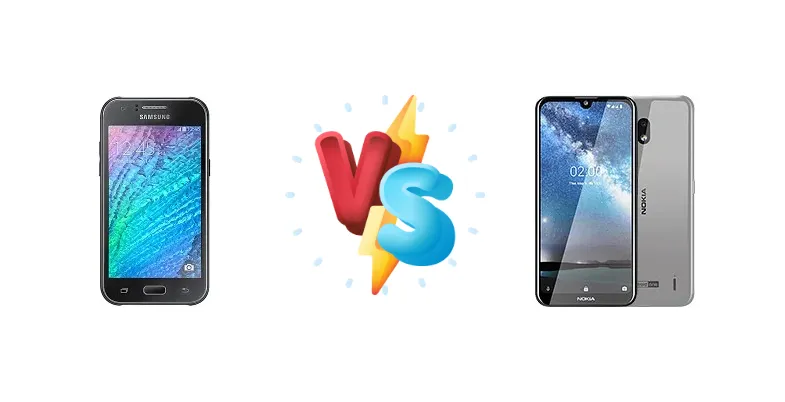
The budget smartphone market is fiercely competitive, offering incredible value for those seeking essential features without breaking the bank. Today, we pit two contenders against each other: the Samsung Galaxy J1 4G and the Nokia 2.2. Let's dive into a detailed comparison to see which phone emerges as the winner.
🏆 Quick Verdict
The Nokia 2.2 edges out the Galaxy J1 4G thanks to its faster processor, cleaner Android experience, and slightly better battery life. While both are budget options, the Nokia 2.2 provides a more modern and smoother user experience overall.
| Network |
|---|
| 2G bands | GSM 850 / 900 / 1800 / 1900 - SIM 1 & SIM 2 (dual-SIM model only) | GSM 850 / 900 / 1800 / 1900 |
| 3G bands | HSDPA 850 / 900 / 2100 | HSDPA 850 / 900 / 2100 - APAC, EMEA, India |
| 4G bands | 1, 3, 7, 8, 20 | 1, 3, 5, 7, 8, 20, 38, 40 - APAC, EMEA |
| Speed | HSPA 21.1/5.76 Mbps, LTE Cat4 150/50 Mbps | HSPA 42.2/5.76 Mbps, LTE Cat4 150/50 Mbps |
| Technology | GSM / HSPA / LTE | GSM / HSPA / LTE |
| | - | 1, 3, 5, 40, 41 - India |
| Launch |
|---|
| Announced | 2015, January. Released 2015, March | 2019, June 06. Released 2019, June 11 |
| Status | Discontinued | Discontinued |
| Body |
|---|
| Build | Glass front, plastic back, plastic frame | Glass front, plastic back, plastic frame |
| Dimensions | 129 x 68.2 x 8.9 mm (5.08 x 2.69 x 0.35 in) | 146 x 70.6 x 9.3 mm (5.75 x 2.78 x 0.37 in) |
| SIM | Single SIM (Micro-SIM) or Dual SIM (Micro-SIM, dual stand-by) | · Nano-SIM· Nano-SIM + Nano-SIM |
| Weight | 122 g (4.30 oz) | 153 g (5.40 oz) |
| Display |
|---|
| Protection | Corning Gorilla Glass 3 | - |
| Resolution | 480 x 800 pixels, 5:3 ratio (~217 ppi density) | 720 x 1520 pixels, 19:9 ratio (~295 ppi density) |
| Size | 4.3 inches, 52.6 cm2 (~59.8% screen-to-body ratio) | 5.71 inches, 81.4 cm2 (~79.0% screen-to-body ratio) |
| Type | TFT | IPS LCD |
| | - | Always-on display |
| Platform |
|---|
| CPU | Quad-core 1.2 GHz | Quad-core 2.0 GHz Cortex-A53 |
| Chipset | Mediatek MT6761 Helio A20 (12 nm) | Mediatek MT6761 Helio A22 (12 nm) |
| GPU | PowerVR GE8320 | PowerVR GE8320 |
| OS | Android 4.4.4 (KitKat) | Android 9.0 (Pie), upgradable to Android 11, Android One |
| Memory |
|---|
| Card slot | microSDXC (dedicated slot) | microSDXC (uses shared SIM slot) |
| Internal | 4GB 768MB RAM | 16GB 2GB RAM, 32GB 3GB RAM |
| | - | eMMC 5.1 |
| Main Camera |
|---|
| Features | LED flash | LED flash, HDR, panorama |
| Single | 5 MP, AF | 13 MP, f/2.2, 1/3.1", 1.12µm, AF |
| Video | 720p@30fps | 1080p@30fps |
| Selfie camera |
|---|
| Single | 2 MP | 5 MP |
| Video | | 1080p@30fps |
| Sound |
|---|
| 3.5mm jack | Yes | Yes |
| 35mm jack | Yes | Yes |
| Loudspeaker | Yes | Yes |
| Comms |
|---|
| Bluetooth | 4.0, A2DP | 4.2, A2DP, LE |
| NFC | Yes | No |
| Positioning | GPS, GLONASS | GPS, GLONASS, BDS |
| Radio | FM radio, RDS, recording | FM radio |
| USB | microUSB 2.0 | microUSB 2.0, OTG |
| WLAN | Wi-Fi 802.11 b/g/n, Wi-Fi Direct, hotspot | Wi-Fi 802.11 b/g/n |
| Features |
|---|
| Sensors | Accelerometer, proximity | Accelerometer, proximity |
| Battery |
|---|
| Charging | - | 10W wired |
| Type | Li-Ion 1850 mAh, removable | Li-Ion 3000 mAh, removable |
| Misc |
|---|
| Colors | White, Black, Blue | Steel, Tungsten Black |
| Models | SM-J120G | TA-1183, TA-1179, TA-1191, TA-1188 |
| Price | About 120 EUR | About 100 EUR |
| SAR | - | 0.43 W/kg (head) 1.37 W/kg (body) |
| SAR EU | - | 0.45 W/kg (head) 1.61 W/kg (body) |
Samsung Galaxy J1 4G
- Samsung Brand Recognition
- Compact Size
- Affordable Price
- Slow Performance
- Small Battery
- Basic Camera
- Outdated Software
Nokia 2.2
- Clean Android Experience
- Longer Battery Life
- Faster Processor
- Larger Display
- Android One Support
- Basic Camera
- Plastic Build
- 10W Charging
Display Comparison
Both phones feature relatively small, HD+ displays. The Galaxy J1 4G typically has a 5.0-inch screen, while the Nokia 2.2 boasts a 6.1-inch display. The Nokia 2.2's larger screen offers a more immersive viewing experience, though both displays are adequate for basic usage. Color accuracy and brightness are typical for budget devices.
Camera Comparison
The Galaxy J1 4G usually features a single rear camera, typically around 8MP. The Nokia 2.2 generally has a 13MP rear camera. While megapixels aren't everything, the Nokia 2.2's camera tends to produce slightly better images in well-lit conditions. Both struggle in low light. Video recording capabilities are basic on both devices.
Performance
This is where the Nokia 2.2 takes a clear lead. While both utilize a Mediatek Helio A20/A22 chipset, the Nokia 2.2's CPU clocks in at 2.0 GHz compared to the J1 4G's 1.2 GHz. This translates to noticeably faster app loading times and smoother multitasking on the Nokia 2.2. The J1 4G can feel sluggish at times.
Battery Life
The Nokia 2.2 generally has a larger battery capacity (around 4500mAh) compared to the Galaxy J1 4G (around 2300mAh). Coupled with its more efficient processor, the Nokia 2.2 offers significantly longer battery life, easily lasting a full day of moderate use. The J1 4G requires more frequent charging.
Buying Guide
The Samsung Galaxy J1 4G is best suited for users who prioritize Samsung's brand recognition and a very basic smartphone experience. The Nokia 2.2 is ideal for those seeking a clean Android experience, longer battery life, and a slightly more responsive performance for everyday tasks.
Frequently Asked Questions
❓ Which phone has the better software experience?
The Nokia 2.2 wins with its Android One program, guaranteeing timely updates and a clean, bloatware-free experience. The Galaxy J1 4G often runs older versions of Android with more pre-installed apps.
❓ Is the Nokia 2.2 worth the slight price difference?
Yes, the Nokia 2.2's improved performance, battery life, and software support make it a worthwhile upgrade over the Galaxy J1 4G, even if it costs a bit more.