
Samsung Galaxy Fold 5G vs. Motorola Razr 2022: A Deep Dive into Foldable Futures
| Phones Images | |||||
|---|---|---|---|---|---|
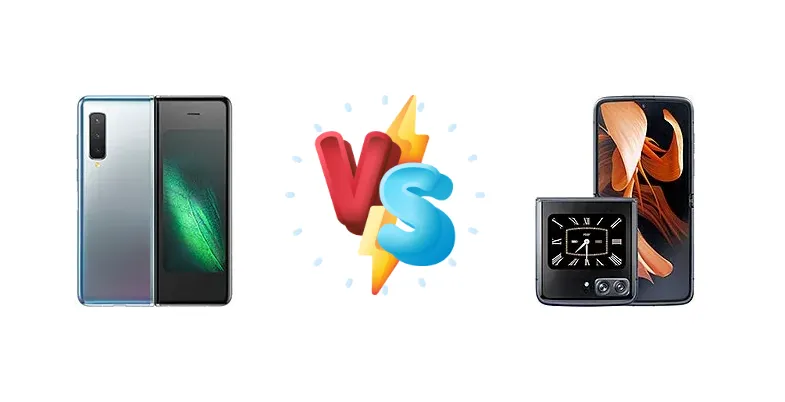
|
🏆 Quick Verdict
For the power user prioritizing multitasking and a larger screen real estate, the Samsung Galaxy Fold 5G remains the superior choice, despite its older chipset. However, the Motorola Razr 2022 delivers a compelling experience for those seeking a genuinely pocketable foldable with faster charging and a more modern processor.
| PHONES | ||
|---|---|---|
| Phone Names | Samsung Galaxy Fold 5G | Motorola Razr 2022 |
| Network | ||
|---|---|---|
| 2G bands | GSM 850 / 900 / 1800 / 1900 | GSM 900 / 1800 / 1900 |
| 3G bands | HSDPA 850 / 900 / 1700(AWS) / 1900 / 2100 | HSDPA 850 / 900 / 1700(AWS) / 1900 / 2100 |
| 4G bands | 1, 2, 3, 4, 5, 7, 8, 12, 13, 18, 19, 20, 25, 26, 28, 38, 39, 40, 41, 46, 66, 71 | 1, 2, 3, 4, 5, 7, 8, 12, 13, 14, 17, 18, 19, 20, 25, 26, 28, 34, 38, 39, 40, 41, 42, 43, 48, 66 |
| 5G bands | 78 NSA/Sub6 | 1, 2, 3, 5, 7, 8, 12, 20, 25, 26, 28, 38, 40, 41, 66, 77, 78, 79 SA/NSA/Sub6 |
| EDGE | No | - |
| GPRS | Class 12 | - |
| Speed | HSPA 42.2/5.76 Mbps, LTE (6CA) Cat18 1200/150 Mbps, 5G (2+ Gbps DL) | HSPA, LTE, 5G |
| Technology | GSM / HSPA / LTE / 5G | GSM / CDMA / HSPA / EVDO / LTE / 5G |
| HSDPA 850 / 1700(AWS) / 1900 / 2100 | CDMA2000 1xEV-DO | |
| Launch | ||
|---|---|---|
| Announced | 2019, February. Released 2019, September | 2022, August 11 |
| Status | Discontinued | Available. Released 2022, August 18 |
| Body | ||
|---|---|---|
| Build | Glass front (folded), plastic front (unfolded), glass back, aluminum frame | Plastic front (unfolded), glass front (folded, Gorilla Glass 5), glass back (Gorilla Glass 5), aluminum frame (7000 series), hinge (stainless steel) |
| Dimensions | Unfolded: 160.9 x 117.9 x 6.9 mm Folded: 160.9 x 62.9 x 15.5 mm | Unfolded: 167.0 x 79.8 x 7.6 mm Folded: 86.5 x 79.8 x 17 mm |
| SIM | Nano-SIM | Nano-SIM + eSIM |
| Weight | 276 g (9.74 oz) | 200 g (7.05 oz) |
| - | Water-repellent coating | |
| Display | ||
|---|---|---|
| Resolution | 1536 x 2152 pixels (~362 ppi density) | 1080 x 2400 pixels, 20:9 ratio (~393 ppi density) |
| Size | 7.3 inches, 162.6 cm2 (~85.7% screen-to-body ratio) | 6.7 inches, 108.4 cm2 (~81.3% screen-to-body ratio) |
| Type | Foldable Dynamic AMOLED, HDR10+ | Foldable AMOLED, 1B colors, 144Hz, HDR10+ |
| Cover display: Super AMOLED, 4.6 inches, 720 x 1680 pixels, 21:9 ratio | Second external AMOLED display, 2.7 inches, 573 x 800 pixels | |
| Platform | ||
|---|---|---|
| CPU | Octa-core (1x2.84 GHz Kryo 485 & 3x2.42 GHz Kryo 485 & 4x1.78 GHz Kryo 485) | Octa-core (1x3.19 GHz Cortex-X2 & 3x2.75 GHz Cortex-A710 & 4x1.80 GHz Cortex-A510) |
| Chipset | Qualcomm SM8150 Snapdragon 855 (7 nm) | Qualcomm SM8475 Snapdragon 8+ Gen 1 (4 nm) |
| GPU | Adreno 640 | Adreno 730 |
| OS | Android 9.0 (Pie), upgradable to Android 12, One UI 4 | Android 13, upgradable to Android 14 |
| Memory | ||
|---|---|---|
| Call records | Yes | - |
| Card slot | No | No |
| Internal | 512GB 12GB RAM | 128GB 8GB RAM, 256GB 8GB RAM, 512GB 12GB RAM |
| Phonebook | 1000 entries, Photocall | - |
| UFS 3.0 | UFS 3.1 | |
| Main Camera | ||
|---|---|---|
| Dual | - | 50 MP, f/1.8, (wide), 1/1.55", 1.0µm, PDAF, OIS 13 MP, f/2.2, 120˚ (ultrawide), 1/3.0", 1.12µm, AF |
| Features | LED flash, HDR, panorama | LED flash, panorama, auto HDR |
| Single | 2 MP | - |
| Triple | 12 MP, f/1.5-2.4, 27mm (wide), 1/2.55", 1.4µm, dual pixel PDAF, OIS 12 MP, f/2.4, 52mm (telephoto), 1/3.6", 1.0µm, AF, OIS, 2x optical zoom 16 MP, f/2.2, 12mm (ultrawide), 1/3.1", 1.0µm | - |
| Video | 4K@60fps, 1080p@60/240fps (gyro-EIS), 720p@960fps (gyro-EIS), HDR10 | 8K@30fps, 4K@30/60fps, 1080p@30/60/120fps, gyro-EIS |
| Selfie camera | ||
|---|---|---|
| Dual | 10 MP, f/2.2, 26mm (wide), 1/3", 1.22µm 8 MP, f/1.9, 24mm (wide), 1.22µm, depth sensor Cover camera: 10 MP, f/2.2, 26mm (wide), 1/3", 1.22µm | - |
| Features | HDR | Auto HDR |
| Single | - | 32 MP, f/2.4, 25mm (wide), 1/3.2", 0.7µm |
| Video | 4K@30fps, 1080p@30fps, gyro-EIS | 1080p@30/60fps |
| Sound | ||
|---|---|---|
| 3.5mm jack | No | No |
| 35mm jack | No | No |
| Loudspeaker | Yes, with stereo speakers | Yes, with stereo speakers |
| 32-bit/384kHz audio Tuned by AKG | - | |
| Comms | ||
|---|---|---|
| Bluetooth | 5.0, A2DP, LE, aptX HD | 5.2, A2DP, LE, aptX HD, aptX Adaptive |
| NFC | Yes | Yes |
| Positioning | GPS, GLONASS, GALILEO, BDS | GPS (L1+L5), GLONASS (L1), BDS (B1I+B1c+B2a), GALILEO (E1+E5a), QZSS (L1+L5) |
| Radio | No | No |
| USB | USB Type-C 3.1 | USB Type-C 3.1 |
| WLAN | Wi-Fi 802.11 a/b/g/n/ac/6, dual-band, Wi-Fi Direct | Wi-Fi 802.11 a/b/g/n/ac/6e, dual-band, Wi-Fi Direct |
| Features | ||
|---|---|---|
| Browser | WAP 2.0/xHTML | - |
| Games | Downloadable | - |
| Java | Yes, MIDP 2.0 | - |
| Messaging | SMS, MMS, Email | - |
| Sensors | Fingerprint (side-mounted), accelerometer, gyro, proximity, compass, barometer | Fingerprint (side-mounted), accelerometer, gyro, proximity, compass |
| ANT+ Bixby natural language commands and dictation Samsung DeX (desktop experience support) Samsung Pay (Visa, MasterCard certified) | - | |
| Battery | ||
|---|---|---|
| Charging | 15W wired 15W wireless 4.5W reverse wireless | 30W wired |
| Stand-by | Up to 350 h | - |
| Talk time | Up to 5 h | - |
| Type | Li-Po 4235 mAh, non-removable | Li-Po 3500 mAh |
| Misc | ||
|---|---|---|
| Colors | Space Silver, Cosmos Black | Satin Black |
| Models | SM-F907F, SM-F9007, SM-F907W, SM-F907U, SM-F907B, SM-F907N | XT2251-1 |
| Price | About 1400 EUR | About 670 EUR |
| SAR | 0.41 W/kg (head) 1.39 W/kg (body) | - |
| SAR EU | 0.49 W/kg (head) 1.58 W/kg (body) | - |
| Tests | ||
|---|---|---|
| Battery life | Endurance rating 90h | Endurance rating 64h |
| Camera | - | Photo / Video |
| Display | Contrast ratio: 185000:1 (nominal) | Contrast ratio: Infinite (nominal) |
| Loudspeaker | Voice 70dB / Noise 73dB / Ring 90dB | -25.4 LUFS (Very good) |
| Performance | Basemark OS II 2.0: 4527Basemark X: 45154 | AnTuTu: 965260 (v9) GeekBench: 3944 (v5.1) GFXBench: 76fps (ES 3.1 onscreen) |
Samsung Galaxy Fold 5G
- Exceptional battery endurance (90h)
- Large, high-contrast display for immersive viewing
- Versatile multitasking capabilities with book-style form factor
- Older Snapdragon 855 chipset
- Slower 15W charging
- Bulkier and less pocketable design
Motorola Razr 2022
- Modern Snapdragon 8+ Gen 1 chipset for superior performance
- Faster 30W wired charging
- Compact and pocketable clamshell design
- Shorter battery endurance (64h)
- Smaller internal display
- Potentially less refined software experience
Display Comparison
The displays represent a fundamental divergence in philosophy. The Galaxy Fold 5G boasts a larger, book-style display with a nominal contrast ratio of 185000:1, promising deep blacks and vibrant colors. Conversely, the Razr 2022 utilizes a clamshell design with a peak brightness of 1033 nits, making it more visible outdoors. While the Razr’s contrast ratio is listed as 'Infinite,' this is a marketing term; the Fold’s higher contrast ratio suggests superior image quality in controlled lighting. The Fold’s larger screen is ideal for split-screen multitasking, while the Razr’s smaller external display offers quick access to notifications and essential functions.
Camera Comparison
Both devices feature 'Photo / Video' capabilities, but the context data lacks specifics. Given Motorola’s recent focus on camera improvements, it’s reasonable to assume the Razr 2022 benefits from more advanced image processing algorithms. The Fold 5G, released earlier, likely relies on older software and potentially less sophisticated sensor technology. Without detailed sensor size or aperture information, it’s difficult to definitively declare a winner, but the Razr’s newer platform suggests a potential edge in image quality.
Performance
The Motorola Razr 2022 holds a significant advantage in processing power. Its Qualcomm Snapdragon 8+ Gen 1 (4nm) chipset is built on a more efficient node than the Galaxy Fold 5G’s Snapdragon 855 (7nm). This translates to better thermal management and sustained performance under load. The Razr’s CPU, featuring a Cortex-X2 prime core, will demonstrably outperform the Fold’s Kryo 485 cores in CPU-intensive tasks. While the Fold’s 90h endurance rating suggests efficient power management, the Razr’s newer chipset offers a more responsive and future-proof experience.
Battery Life
The Galaxy Fold 5G’s 90-hour endurance rating is impressive, indicating efficient power consumption despite its larger display. However, the Motorola Razr 2022 compensates for its lower 64-hour rating with significantly faster 30W wired charging, compared to the Fold’s 15W charging. This means the Razr can replenish its battery much quicker, mitigating the impact of its smaller capacity. The Fold also offers 15W wireless and 4.5W reverse wireless charging, features absent in the Razr, providing added convenience.
Buying Guide
Buy the Samsung Galaxy Fold 5G if you need a device that can effectively replace a tablet for productivity tasks, enjoy immersive media consumption on a large, high-contrast display, and value long battery endurance. Buy the Motorola Razr 2022 if you prioritize portability, appreciate the retro clamshell design, and want a phone that charges quickly with a more recent Snapdragon processor for smoother everyday performance.