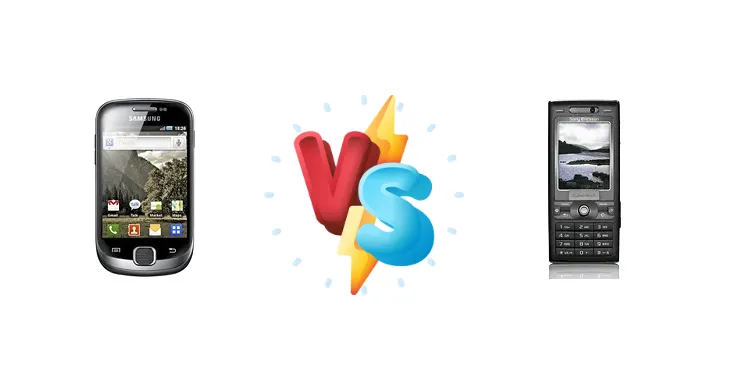
Remember a time before smartphones dominated our pockets? The Samsung Galaxy Fit S5670 and Sony Ericsson K800 represent that era, offering a glimpse into the evolution of mobile technology. This comparison dives deep into their features, performance, and overall value to determine which phone holds up best today.
🏆 Quick Verdict
The Samsung Galaxy Fit S5670 edges out the Sony Ericsson K800 due to its slightly more modern chipset and known contrast ratio. While the K800 boasts a legendary camera reputation, the lack of detailed specs makes a definitive comparison difficult. Both are relics of a bygone era, offering a nostalgic experience.
| Network |
|---|
| 2G bands | GSM 850 / 900 / 1800 / 1900 | GSM 900 / 1800 / 1900 |
| 3G bands | HSDPA 900 / 2100 | UMTS 2100 |
| Speed | HSPA 7.2/0.384 Mbps | Yes, 384 kbps |
| Technology | GSM / HSPA | GSM / UMTS |
| Launch |
|---|
| Announced | 2011, January. Released 2011, March | 2006, February. Released 2006, June |
| Status | Discontinued | Discontinued |
| Body |
|---|
| Dimensions | 110.2 x 61.2 x 12.6 mm (4.34 x 2.41 x 0.50 in) | 105 x 47 x 22 mm (4.13 x 1.85 x 0.87 in) |
| SIM | Mini-SIM | Mini-SIM |
| Weight | 108 g (3.81 oz) | 115 g (4.06 oz) |
| Display |
|---|
| Protection | Corning Gorilla Glass (unspecified version) | - |
| Resolution | 240 x 320 pixels, 4:3 ratio (~121 ppi density) | 240 x 320 pixels, 2.0 inch, 4:3 ratio (~200 ppi density) |
| Size | 3.3 inches, 33.7 cm2 (~50.0% screen-to-body ratio) | 2.0 inches, 30 x 40 mm, 12.4 cm2 (~25.1% screen-to-body ratio) |
| Type | TFT, 65K colors | TFT, 256K colors |
| | - | Wallpapers, screensavers |
| Platform |
|---|
| CPU | 600 MHz | - |
| Chipset | Mediatek MT6582M (28 nm) | - |
| GPU | Mali-400MP2 | - |
| OS | Android 2.2 (Froyo), upgradable to 2.3 (Gingerbread), TouchWiz UI 3 | - |
| Memory |
|---|
| Call records | - | 30 received, dialed and missed calls |
| Card slot | microSDHC (dedicated slot), 2 GB included | Memory Stick Micro (M2), up to 2 GB |
| Internal | 160MB 280MB RAM | 64MB |
| Phonebook | - | 1000 x 20 fields, Photo call |
| Main Camera |
|---|
| Features | LED flash | xenon flash |
| Single | 5 MP, AF | 3.15 MP, AF |
| Video | 320p@15fps | QCIF |
| Selfie camera |
|---|
| Single | 2 MP | VGA videocall camera |
| | No | - |
| Sound |
|---|
| 3.5mm jack | Yes | No |
| 35mm jack | Yes | No |
| Alert types | - | Vibration; Downloadable polyphonic, MP3 ringtones, composer |
| Loudspeaker | Yes | Yes |
| Comms |
|---|
| Bluetooth | 2.1, A2DP | 2.0, A2DP |
| Infrared port | - | Yes |
| NFC | No | - |
| Positioning | GPS, A-GPS | No |
| Radio | Stereo FM radio, RDS | Stereo FM radio, RDS |
| USB | microUSB 2.0 | 2.0 |
| WLAN | Wi-Fi 802.11 b/g/n, hotspot | No |
| Features |
|---|
| Browser | HTML | WAP 2.0/xHTML, HTML(NetFront) |
| Games | - | FotoQuestFishing, MiniGolf + downloadable |
| Java | - | Yes, MIDP 2.0 |
| Messaging | - | SMS, MMS, Email, Instant Messaging |
| Sensors | Accelerometer, proximity, compass | - |
| | MP4/H.264 player
MP3/WAV/eAAC+ player
Document viewer/editor
Photo/video editor | MP3/AAC/MP4 player
Predictive text input
Photo editor
Organizer
Voice memo/dial |
| Battery |
|---|
| Stand-by | Up to 642 h (2G) / Up to 421 h (3G) | Up to 350 h (2G) / Up to 350 h (3G) |
| Talk time | Up to 10 h 40 min (2G) / Up to 6 h 40 min (3G) | Up to 7 h (2G) / Up to 2 h 30 min (3G) |
| Type | Removable Li-Ion 1350 mAh battery | Removable Li-Po 900 mAh battery (BST-33) |
| Misc |
|---|
| Colors | Black, white | Velvet Black, Allure Brown |
| Models | GT-S5670 | - |
| Price | About 120 EUR | About 150 EUR |
| SAR | 0.75 W/kg (head) 0.89 W/kg (body) | - |
| SAR EU | 0.72 W/kg (head) | - |
| Tests |
|---|
| Audio quality |
Noise -82.7dB / Crosstalk -81.9dB | - |
| Camera |
Photo | - |
| Display |
Contrast ratio: 591:1 (nominal) | - |
| Loudspeaker |
Voice 70dB / Noise 69dB / Ring 72dB
| - |
Samsung Galaxy Fit S5670
- Slightly more modern chipset
- Known contrast ratio
- Compact and lightweight
- Limited information on camera capabilities
- Outdated performance by today's standards
- Lack of modern features
Sony Ericsson K800
- Legendary camera reputation
- Classic design
- Nostalgic appeal
- Missing detailed specs
- Difficult to find in working condition
- Outdated technology
Display Comparison
The Samsung Galaxy Fit S5670 has a reported contrast ratio of 591:1, which was decent for its time. The Sony Ericsson K800's display details are unavailable, but it likely used a typical LCD panel of the era, offering acceptable but not exceptional viewing angles and color reproduction. The Galaxy Fit's contrast gives it a slight advantage.
Camera Comparison
The Sony Ericsson K800 was renowned for its 8-megapixel camera with autofocus and a Xenon flash, a significant feature for its time. It was considered a top camera phone. The Samsung Galaxy Fit S5670 has a camera, but its capabilities are unknown beyond being a 'photo' camera. The K800 likely wins here due to its established reputation and superior hardware.
Performance
The Samsung Galaxy Fit S5670 is powered by a Mediatek MT6582M chipset with a 600 MHz CPU. While not powerful by today's standards, it was a reasonable performer for basic tasks. The Sony Ericsson K800's processor is unknown, but it likely used an ARM 11 architecture, which was common at the time. Performance would be comparable for simple tasks, but the Galaxy Fit's slightly newer chipset might offer a marginal edge.
Battery Life
Battery information for both devices is scarce. The Sony Ericsson K800 likely had a battery capacity around 910 mAh, providing a day's use with moderate usage. The Galaxy Fit's battery capacity is also unknown, but it was likely in a similar range. It's a draw without more data.
Buying Guide
The Samsung Galaxy Fit S5670 is for collectors and those interested in experiencing a simple, functional phone from the early smartphone transition. The Sony Ericsson K800 is ideal for camera enthusiasts seeking a classic point-and-shoot experience and a piece of mobile history, assuming one can be found in working condition.
Frequently Asked Questions
❓ Are these phones still usable today?
While technically usable, both phones are severely limited by today's standards. They lack modern features like 4G connectivity, app stores, and high-resolution displays. They are primarily of interest to collectors or those seeking a nostalgic experience.
❓ Where can I find these phones?
Finding these phones in working condition can be challenging. Online marketplaces like eBay and specialized retro phone retailers are your best bet. Be prepared to pay a premium for a well-preserved model.