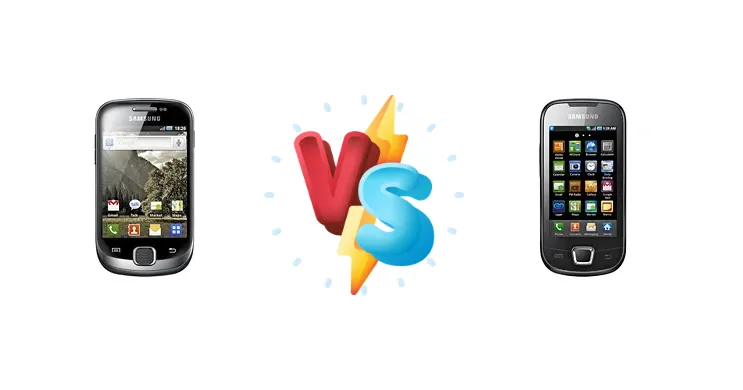
Reliving the era of budget Android phones, we're pitting two older Samsung devices against each other: the Galaxy Fit S5670 and the Galaxy 3 I5800. Both aimed to deliver a smartphone experience without breaking the bank, but how do they stack up today? Let's dive in and see which one holds up better.
🏆 Quick Verdict
The Samsung I5800 Galaxy 3 edges out the Galaxy Fit S5670 thanks to its slightly faster processor and generally better software support during its lifespan. While both are dated, the Galaxy 3 offers a marginally smoother experience and a more recognizable legacy.
| Network |
|---|
| 2G bands | GSM 850 / 900 / 1800 / 1900 | GSM 850 / 900 / 1800 / 1900 |
| 3G bands | HSDPA 900 / 2100 | HSDPA 900 / 2100 |
| Speed | HSPA 7.2/0.384 Mbps | HSPA 3.6/0.384 Mbps |
| Technology | GSM / HSPA | GSM / HSPA |
| Launch |
|---|
| Announced | 2011, January. Released 2011, March | 2010, June. Released 2010, July |
| Status | Discontinued | Discontinued |
| Body |
|---|
| Dimensions | 110.2 x 61.2 x 12.6 mm (4.34 x 2.41 x 0.50 in) | 113.5 x 55 x 12.9 mm (4.47 x 2.17 x 0.51 in) |
| SIM | Mini-SIM | Mini-SIM |
| Weight | 108 g (3.81 oz) | 109 g (3.84 oz) |
| Display |
|---|
| Protection | Corning Gorilla Glass (unspecified version) | - |
| Resolution | 240 x 320 pixels, 4:3 ratio (~121 ppi density) | 240 x 400 pixels, 5:3 ratio (~146 ppi density) |
| Size | 3.3 inches, 33.7 cm2 (~50.0% screen-to-body ratio) | 3.2 inches, 29.1 cm2 (~46.7% screen-to-body ratio) |
| Type | TFT, 65K colors | TFT |
| | - | Touch Wiz 3.0 |
| Platform |
|---|
| CPU | 600 MHz | Samsung S5P6422 667 MHz |
| Chipset | Mediatek MT6582M (28 nm) | - |
| GPU | Mali-400MP2 | - |
| OS | Android 2.2 (Froyo), upgradable to 2.3 (Gingerbread), TouchWiz UI 3 | Android 2.1 (Eclair), upgradable to 2.2 (Froyo) |
| Memory |
|---|
| Card slot | microSDHC (dedicated slot), 2 GB included | microSDHC (dedicated slot), 1 GB included |
| Internal | 160MB 280MB RAM | 512MB 256MB RAM |
| Main Camera |
|---|
| Features | LED flash | - |
| Single | 5 MP, AF | 3.15 MP, AF |
| Video | 320p@15fps | 320p@15fps |
| Selfie camera |
|---|
| Single | 2 MP | - |
| | No | No |
| Sound |
|---|
| 3.5mm jack | Yes | Yes |
| 35mm jack | Yes | Yes |
| Loudspeaker | Yes | Yes |
| Comms |
|---|
| Bluetooth | 2.1, A2DP | 3.0, A2DP |
| NFC | No | - |
| Positioning | GPS, A-GPS | GPS, A-GPS |
| Radio | Stereo FM radio, RDS | Stereo FM radio, RDS |
| USB | microUSB 2.0 | microUSB 2.0 |
| WLAN | Wi-Fi 802.11 b/g/n, hotspot | Wi-Fi 802.11 b/g/n, hotspot (Android 2.2) |
| Features |
|---|
| Browser | HTML | HTML |
| Sensors | Accelerometer, proximity, compass | Accelerometer, proximity, compass |
| | MP4/H.264 player
MP3/WAV/eAAC+ player
Document viewer/editor
Photo/video editor | MP4/DivX/XviD/WMV/H.264 player
MP3/WAV/eAAC+ player
Document editor |
| Battery |
|---|
| Stand-by | Up to 642 h (2G) / Up to 421 h (3G) | Up to 620 h (2G) / Up to 510 h (3G) |
| Talk time | Up to 10 h 40 min (2G) / Up to 6 h 40 min (3G) | Up to 15 h 30 min (2G) / Up to 7 h 15 min (3G) |
| Type | Removable Li-Ion 1350 mAh battery | Removable Li-Ion 1500 mAh battery |
| Misc |
|---|
| Colors | Black, white | Black, White |
| Models | GT-S5670 | - |
| Price | About 120 EUR | About 140 EUR |
| SAR | 0.75 W/kg (head) 0.89 W/kg (body) | - |
| SAR EU | 0.72 W/kg (head) | 0.57 W/kg (head) |
| Tests |
|---|
| Audio quality |
Noise -82.7dB / Crosstalk -81.9dB |
Noise -91.2dB / Crosstalk -89.9dB |
| Camera |
Photo |
Photo |
| Display |
Contrast ratio: 591:1 (nominal) | - |
| Loudspeaker |
Voice 70dB / Noise 69dB / Ring 72dB
|
Voice 71dB / Noise 66dB / Ring 71dB |
Samsung Galaxy Fit S5670
- Affordable (originally)
- Compact size
- Basic smartphone functionality
- Outdated processor
- Low-resolution display
- Poor camera quality
- Limited app compatibility
Samsung I5800 Galaxy 3
- Slightly better performance than Galaxy Fit
- More recognizable brand
- Compact size
- Basic smartphone functionality
- Outdated processor
- Low-resolution display
- Poor camera quality
- Limited app compatibility
Display Comparison
Both phones featured relatively small displays for their time, likely around 3.2-3.5 inches. The Galaxy Fit S5670 boasts a contrast ratio of 591:1, which was decent for the era, but display quality overall was limited by the technology available. The Galaxy 3 likely had a similar display, prioritizing affordability over premium visuals.
Camera Comparison
Both devices are listed as having a 'Photo' camera, suggesting basic camera functionality. Expect low resolution images and limited features. Image quality on both will be poor by today's standards, suitable only for quick snapshots in good lighting conditions. There's no clear winner here; both cameras were entry-level.
Performance
The Samsung I5800 Galaxy 3 holds a slight advantage here. It's powered by a Samsung S5P6422 processor clocked at 667 MHz, while the Galaxy Fit S5670 uses a Mediatek MT6582M at 600 MHz. While the difference isn't massive, the Galaxy 3's processor generally offered a bit more responsive performance. Both phones will struggle with modern apps and multitasking.
Battery Life
Battery information is missing for both devices. However, given their age and processor capabilities, both likely offered a day's worth of moderate use. The Galaxy 3, potentially having a slightly more efficient processor, *might* have a marginal battery life advantage, but this is speculative.
Buying Guide
The Samsung Galaxy Fit S5670 might appeal to collectors or those seeking a very basic, ultra-budget phone for simple tasks. The Samsung I5800 Galaxy 3 is a slightly better choice for anyone wanting a more functional, albeit still old, Android device for calls, texts, and light browsing.
Frequently Asked Questions
❓ Are these phones still worth buying?
Generally no. Both phones are very outdated and lack modern features and security updates. They might be interesting for collectors or as very basic backup phones, but not recommended for primary use.
❓ What operating system did these phones run?
Both phones originally ran Android 2.2 (Froyo) or later versions. However, they are no longer receiving updates and are vulnerable to security risks.