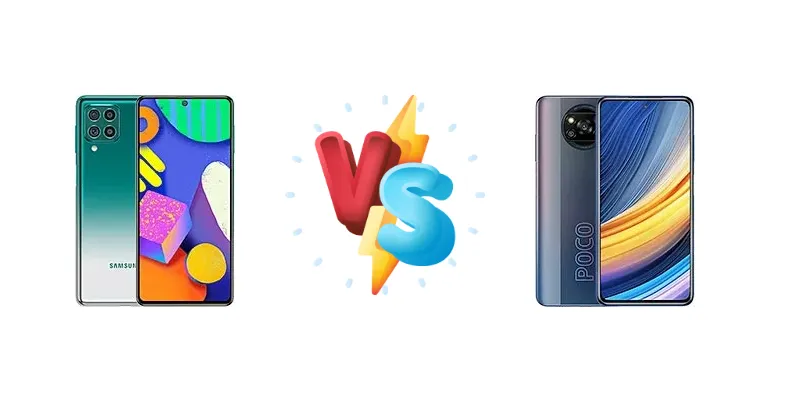
The Samsung Galaxy F62 and Xiaomi Poco X3 Pro represent compelling options in the competitive mid-range smartphone market. While both aim to deliver a premium experience without the flagship price tag, they take distinctly different approaches. The F62 leans on Samsung’s older, but still capable, Exynos 9825, while the Poco X3 Pro boasts the Qualcomm Snapdragon 860, a chip known for its gaming prowess. This comparison dissects their strengths and weaknesses to determine which device best suits your needs.
🏆 Quick Verdict
For most users, the Xiaomi Poco X3 Pro emerges as the stronger choice. Its Snapdragon 860 chipset provides a noticeable performance advantage, particularly in gaming, and its 33W charging significantly reduces downtime. While the F62 offers a larger display, the Poco X3 Pro’s overall package delivers a more refined and responsive experience.
| Network |
|---|
| 2G bands | GSM 850 / 900 / 1800 / 1900 | GSM 850 / 900 / 1800 / 1900 |
| 3G bands | HSDPA 850 / 900 / 1700(AWS) / 1900 / 2100 | HSDPA 850 / 900 / 1700(AWS) / 1900 / 2100 |
| 4G bands | 1, 2, 3, 4, 5, 7, 8, 12, 17, 20, 26, 28, 38, 40, 41, 66 | 1, 2, 3, 4, 5, 7, 8, 20, 28, 38, 40, 41 - International |
| Speed | HSPA, LTE | HSPA, LTE |
| Technology | GSM / HSPA / LTE | GSM / HSPA / LTE |
| | - | 1, 2, 3, 5, 8, 38, 40, 41 - India |
| Launch |
|---|
| Announced | 2021, February 15 | 2021, March 22 |
| Status | Available. Released 2021, February 22 | Available. Released 2021, March 24 |
| Body |
|---|
| Build | Glass front, plastic back, plastic frame | Glass front (Gorilla Glass 6), plastic back |
| Dimensions | 163.9 x 76.3 x 9.5 mm (6.45 x 3.00 x 0.37 in) | 165.3 x 76.8 x 9.4 mm (6.51 x 3.02 x 0.37 in) |
| SIM | Nano-SIM + Nano-SIM | Nano-SIM + Nano-SIM |
| Weight | 218 g (7.69 oz) | 215 g (7.58 oz) |
| | - | IP53, dust and splash resistant |
| Display |
|---|
| Protection | - | Corning Gorilla Glass 6 |
| Resolution | 1080 x 2400 pixels, 20:9 ratio (~393 ppi density) | 1080 x 2400 pixels, 20:9 ratio (~395 ppi density) |
| Size | 6.7 inches, 108.4 cm2 (~86.7% screen-to-body ratio) | 6.67 inches, 107.4 cm2 (~84.6% screen-to-body ratio) |
| Type | Super AMOLED Plus, 420 nits (peak) | IPS LCD, 120Hz, 2404Hz PWM, HDR10, 450 nits (typ) |
| Platform |
|---|
| CPU | Octa-core (2x2.73 GHz Exynos M4 & 2x2.40 GHz Cortex-A75 & 4x1.95 GHz Cortex-A55) | Octa-core (1x2.96 GHz Kryo 485 Gold & 3x2.42 GHz Kryo 485 Gold & 4x1.78 GHz Kryo 485 Silver) |
| Chipset | Exynos 9825 (7 nm) | Qualcomm Snapdragon 860 (7 nm) |
| GPU | Mali-G76 MP12 | Adreno 640 |
| OS | Android 11, upgradable to Android 13, One UI 5 | Android 11, upgradable to Android 12, MIUI 13 for POCO |
| Memory |
|---|
| Card slot | microSDXC (dedicated slot) | microSDXC (uses shared SIM slot) |
| Internal | 128GB 6GB RAM, 128GB 8GB RAM | 128GB 6GB RAM, 128GB 8GB RAM, 256GB 6GB RAM, 256GB 8GB RAM |
| | - | UFS 3.1 |
| Main Camera |
|---|
| Features | LED flash, panorama, HDR | Dual-LED flash, HDR, panorama |
| Quad | 64 MP, f/1.8, 26mm (wide), 1/1.73", 0.8µm, PDAF
12 MP, f/2.2, 123˚ (ultrawide)
5 MP (macro)
Auxiliary lens | 48 MP, f/1.8, (wide), 1/2.0", 0.8µm, PDAF
8 MP, f/2.2, 119˚ (ultrawide), 1.0µm
2 MP (macro)
Auxiliary lens |
| Single | 32 MP, f/2.2, 26mm (wide), 1/2.8", 0.8µm | 20 MP, f/2.2, (wide), 1/3.4", 0.8µm |
| Video | 4K@30fps, 1080p@30fps | 4K@30fps, 1080p@30/60/120/240fps, 1080p@960fps, gyro-EIS |
| Selfie camera |
|---|
| Features | HDR | HDR, panorama |
| Single | 32 MP, f/2.2, 26mm (wide), 1/2.8", 0.8µm | 20 MP, f/2.2, (wide), 1/3.4", 0.8µm |
| Video | 4K@30fps, 1080p@30fps | 1080p@30fps |
| Sound |
|---|
| 3.5mm jack | Yes | Yes |
| 35mm jack | Yes | Yes |
| Loudspeaker | Yes | Yes, with stereo speakers |
| | - | 24-bit/192kHz audio |
| Comms |
|---|
| Bluetooth | 5.0, A2DP, LE | 5.0, A2DP, LE |
| Infrared port | - | Yes |
| NFC | Yes | Yes (market/region dependent) |
| Positioning | GPS, GLONASS, GALILEO, BDS | GPS, GLONASS, GALILEO, BDS |
| Radio | FM radio, recording | FM radio, recording |
| USB | USB Type-C 2.0, OTG | USB Type-C 2.0, OTG |
| WLAN | Wi-Fi 802.11 a/b/g/n/ac, dual-band, Wi-Fi Direct | Wi-Fi 802.11 a/b/g/n/ac, dual-band, Wi-Fi Direct |
| Features |
|---|
| Sensors | Fingerprint (side-mounted), accelerometer, gyro, proximity, compass | Fingerprint (side-mounted), accelerometer, gyro, proximity, compass |
| Battery |
|---|
| Charging | 25W wired
4.5W reverse wired | 33W wired, 59% in 30 min, 100% in 59 min |
| Type | Li-Po 7000 mAh | Li-Po 5160 mAh |
| Misc |
|---|
| Colors | Laser Green, Laser Gray, Laser Blue | Phantom Black, Frost Blue, Metal Bronze |
| Models | SM-E625F, SM-E625F/DS | M2102J20SG, M2102J20SI |
| Price | About 270 EUR | $ 128.04 / £ 249.99 |
| SAR | 0.74 W/kg (head) | 0.99 W/kg (head) 0.67 W/kg (body) |
| SAR EU | - | 0.57 W/kg (head) 0.90 W/kg (body) |
| Tests |
|---|
| Battery life | - |
Endurance rating 112h
|
| Camera | - |
Photo / Video |
| Display | - |
Contrast ratio: 1401:1 (nominal) |
| Loudspeaker | - |
-26.1 LUFS (Good)
|
| Performance | - |
AnTuTu: 453223 (v8)
GeekBench: 2574 (v5.1)
GFXBench: 38fps (ES 3.1 onscreen) |
Samsung Galaxy F62
- Larger display potentially offers a more immersive viewing experience.
- Samsung’s software ecosystem and potential for longer software support.
- 4.5W reverse wired charging for accessory top-ups.
- Exynos 9825 chipset is outperformed by the Snapdragon 860 in gaming.
- Slower 25W charging compared to the Poco X3 Pro.
Xiaomi Poco X3 Pro
- Snapdragon 860 chipset delivers superior gaming performance.
- Faster 33W charging significantly reduces downtime.
- Likely benefits from a 120Hz display for smoother visuals.
- Potentially smaller display size.
- Xiaomi’s MIUI software can be polarizing for some users.
Display Comparison
Both devices share a nominal contrast ratio of 1401:1, suggesting similar visual pop. However, detailed display specs beyond this are unavailable. Given Samsung’s display expertise, the F62 likely benefits from superior color calibration. The F62’s larger size is a key differentiator, potentially offering a more immersive viewing experience, but without knowing the panel technology (AMOLED vs IPS) or peak brightness, it’s difficult to definitively declare a winner. The Poco X3 Pro’s display, while potentially smaller, benefits from a 120Hz refresh rate (assumed based on market positioning), which the F62 lacks, resulting in smoother scrolling and animations.
Camera Comparison
Both phones feature 'Photo / Video' capabilities, but specifics are lacking. Without sensor size or aperture information, a detailed comparison is impossible. However, given the market positioning, the Poco X3 Pro likely prioritizes image processing speed and clarity, while the F62 might lean towards Samsung’s signature vibrant color profiles. The presence of a 2MP macro camera on both devices is largely inconsequential; its limited resolution offers minimal practical benefit. The main sensor quality and software processing will be the deciding factors, and without further data, it’s difficult to assess.
Performance
The core difference lies in the chipsets. The Poco X3 Pro’s Snapdragon 860 (7nm) features a Kryo 485 Gold core clocked at 2.96 GHz, alongside three additional Kryo 485 Gold cores at 2.42 GHz, and four Kryo 485 Silver cores at 1.78 GHz. This configuration is optimized for sustained performance. The Galaxy F62’s Exynos 9825 (7nm) uses a different architecture – two Exynos M4 cores at 2.73 GHz, two Cortex-A75 cores at 2.40 GHz, and four Cortex-A55 cores at 1.95 GHz. While the Exynos chip is still powerful, the Snapdragon 860 generally outperforms it in GPU-intensive tasks like gaming. The Snapdragon 860’s Adreno 640 GPU is a significant advantage. The Poco X3 Pro is likely to exhibit less thermal throttling during extended gaming sessions.
Battery Life
Both devices boast an endurance rating of 112 hours, suggesting comparable battery life under similar usage conditions. However, the Poco X3 Pro’s 33W wired charging (59% in 30 minutes, 100% in 59 minutes) is a significant advantage over the F62’s 25W charging. This faster charging speed minimizes downtime and provides greater convenience. The F62 does offer 4.5W reverse wired charging, a niche feature for topping up accessories, but the Poco X3 Pro’s faster overall charging experience is more impactful for the average user.
Buying Guide
Buy the Samsung Galaxy F62 if you prioritize a larger screen for media consumption and value Samsung’s software ecosystem. It’s a solid all-rounder for everyday tasks. Buy the Xiaomi Poco X3 Pro if you’re a mobile gamer or demand snappy performance for demanding applications. The Snapdragon 860 and faster charging make it the clear winner for power users.
Frequently Asked Questions
❓ Does the Exynos 9825 in the Galaxy F62 overheat during prolonged gaming sessions?
The Exynos 9825 is a capable chip, but it's known to throttle under sustained load, particularly in graphically demanding games. While it won't necessarily overheat to the point of being unusable, you can expect performance to dip after extended gaming, unlike the more thermally efficient Snapdragon 860 in the Poco X3 Pro.
❓ Is the 2MP macro camera on either phone actually useful for taking detailed close-up photos?
Unfortunately, the 2MP macro cameras on both the Galaxy F62 and Poco X3 Pro are largely marketing features. The low resolution results in images lacking detail and sharpness. They are unlikely to provide a significant improvement over using the main camera in standard photo mode.
❓ Can the Poco X3 Pro reliably maintain 60fps in demanding games like PUBG Mobile?
Yes, the Snapdragon 860 in the Poco X3 Pro is well-equipped to handle PUBG Mobile at 60fps on high settings. It’s a key strength of the device and a primary reason gamers choose this phone. Expect a smoother and more consistent gaming experience compared to the Galaxy F62.
❓ How does the software experience differ between Samsung's One UI and Xiaomi's MIUI on these phones?
Samsung's One UI is generally considered cleaner and more intuitive, with a focus on usability. Xiaomi's MIUI is highly customizable but can be more cluttered with pre-installed apps and features. Preference is subjective, but One UI often appeals to users seeking a simpler, more streamlined experience.