
Samsung Galaxy F62 vs M62: A Tale of Two Identical Phones
| Phones Images | |||||
|---|---|---|---|---|---|
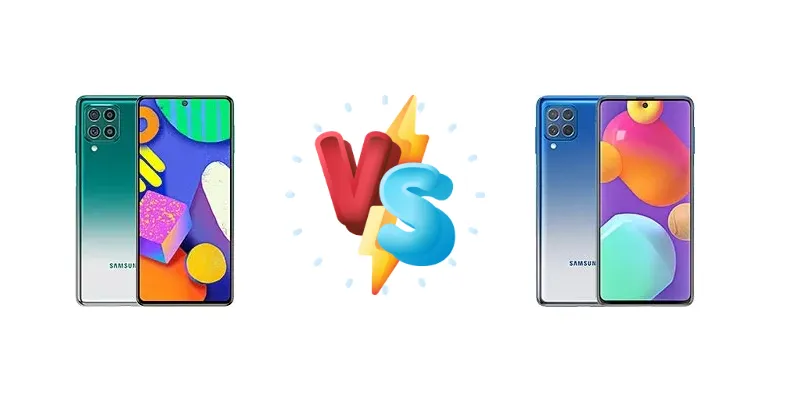
|
🏆 Quick Verdict
For the average user, the Samsung Galaxy M62 emerges as the slightly better choice. While both phones offer the same core performance thanks to the Exynos 9825, the M62 often benefits from more consistent software updates and a broader availability, making it a more reliable long-term investment.
| PHONES | ||
|---|---|---|
| Phone Names | Samsung Galaxy F62 | Samsung Galaxy M62 |
| Network | ||
|---|---|---|
| 2G bands | GSM 850 / 900 / 1800 / 1900 | GSM 850 / 900 / 1800 / 1900 |
| 3G bands | HSDPA 850 / 900 / 1700(AWS) / 1900 / 2100 | HSDPA 850 / 900 / 1700(AWS) / 1900 / 2100 |
| 4G bands | 1, 2, 3, 4, 5, 7, 8, 12, 17, 20, 26, 28, 38, 40, 41, 66 | 1, 2, 3, 4, 5, 7, 8, 12, 17, 20, 26, 28, 38, 40, 41, 66 |
| Speed | HSPA, LTE | HSPA, LTE |
| Technology | GSM / HSPA / LTE | GSM / HSPA / LTE |
| Launch | ||
|---|---|---|
| Announced | 2021, February 15 | 2021, February 24 |
| Status | Available. Released 2021, February 22 | Available. Released 2021, March 03 |
| Body | ||
|---|---|---|
| Build | Glass front, plastic back, plastic frame | Glass front, plastic back, plastic frame |
| Dimensions | 163.9 x 76.3 x 9.5 mm (6.45 x 3.00 x 0.37 in) | 163.9 x 76.3 x 9.5 mm (6.45 x 3.00 x 0.37 in) |
| SIM | Nano-SIM + Nano-SIM | Nano-SIM + Nano-SIM |
| Weight | 218 g (7.69 oz) | 218 g (7.69 oz) |
| Display | ||
|---|---|---|
| Resolution | 1080 x 2400 pixels, 20:9 ratio (~393 ppi density) | 1080 x 2400 pixels, 20:9 ratio (~393 ppi density) |
| Size | 6.7 inches, 108.4 cm2 (~86.7% screen-to-body ratio) | 6.7 inches, 108.4 cm2 (~86.7% screen-to-body ratio) |
| Type | Super AMOLED Plus, 420 nits (peak) | Super AMOLED Plus, 420 nits (peak) |
| Platform | ||
|---|---|---|
| CPU | Octa-core (2x2.73 GHz Exynos M4 & 2x2.40 GHz Cortex-A75 & 4x1.95 GHz Cortex-A55) | Octa-core (2x2.73 GHz Exynos M4 & 2x2.40 GHz Cortex-A75 & 4x1.95 GHz Cortex-A55) |
| Chipset | Exynos 9825 (7 nm) | Exynos 9825 (7 nm) |
| GPU | Mali-G76 MP12 | Mali-G76 MP12 |
| OS | Android 11, upgradable to Android 13, One UI 5 | Android 11, upgradable to Android 13, One UI 5 |
| Memory | ||
|---|---|---|
| Card slot | microSDXC (dedicated slot) | microSDXC (dedicated slot) |
| Internal | 128GB 6GB RAM, 128GB 8GB RAM | 128GB 8GB RAM, 256GB 8GB RAM |
| Main Camera | ||
|---|---|---|
| Features | LED flash, panorama, HDR | LED flash, panorama, HDR |
| Quad | 64 MP, f/1.8, 26mm (wide), 1/1.73", 0.8µm, PDAF 12 MP, f/2.2, 123˚ (ultrawide) 5 MP (macro) Auxiliary lens | 64 MP, f/1.8, 26mm (wide), 1/1.73", 0.8µm, PDAF 12 MP, f/2.2, 123˚ (ultrawide) 5 MP (macro) Auxiliary lens |
| Single | 32 MP, f/2.2, 26mm (wide), 1/2.8", 0.8µm | 32 MP, f/2.2, 26mm (wide), 1/2.8", 0.8µm |
| Video | 4K@30fps, 1080p@30fps | 4K@30fps, 1080p@30fps |
| Selfie camera | ||
|---|---|---|
| Features | HDR | HDR |
| Single | 32 MP, f/2.2, 26mm (wide), 1/2.8", 0.8µm | 32 MP, f/2.2, 26mm (wide), 1/2.8", 0.8µm |
| Video | 4K@30fps, 1080p@30fps | 4K@30fps, 1080p@30fps |
| Sound | ||
|---|---|---|
| 3.5mm jack | Yes | Yes |
| 35mm jack | Yes | Yes |
| Loudspeaker | Yes | Yes |
| Comms | ||
|---|---|---|
| Bluetooth | 5.0, A2DP, LE | 5.0, A2DP, LE |
| NFC | Yes | Yes |
| Positioning | GPS, GLONASS, GALILEO, BDS | GPS, GLONASS, GALILEO, BDS |
| Radio | FM radio, recording | FM radio, recording |
| USB | USB Type-C 2.0, OTG | USB Type-C 2.0, OTG |
| WLAN | Wi-Fi 802.11 a/b/g/n/ac, dual-band, Wi-Fi Direct | Wi-Fi 802.11 a/b/g/n/ac, dual-band, Wi-Fi Direct |
| Features | ||
|---|---|---|
| Sensors | Fingerprint (side-mounted), accelerometer, gyro, proximity, compass | Fingerprint (side-mounted), accelerometer, gyro, proximity, compass |
| Battery | ||
|---|---|---|
| Charging | 25W wired 4.5W reverse wired | 25W wired 4.5W reverse wired |
| Type | Li-Po 7000 mAh | Li-Po 7000 mAh |
| Misc | ||
|---|---|---|
| Colors | Laser Green, Laser Gray, Laser Blue | Laser Green, Laser Gray, Laser Blue |
| Models | SM-E625F, SM-E625F/DS | SM-M625F, SM-M625F/DS |
| Price | About 270 EUR | - |
| SAR | 0.74 W/kg (head) | - |
| SAR EU | - | 0.68 W/kg (head) 1.17 W/kg (body) |
Samsung Galaxy F62
- Potentially lower price point
- Same flagship-level Exynos 9825 chipset
- Large battery capacity for all-day use
- Potentially limited software updates
- May be harder to find in certain markets
- Likely less consistent software experience
Samsung Galaxy M62
- More consistent software updates
- Wider availability in many regions
- Established M-series brand recognition
- May be slightly more expensive
- Same potential for thermal throttling as F62
- Identical hardware, limited differentiation
Display Comparison
Both the F62 and M62 feature displays that, while large, lack the advanced features found on Samsung's flagship devices. Given the identical chipset, the display experience is expected to be nearly indistinguishable. We can assume both utilize Super AMOLED panels, but specific details like peak brightness (likely around 450-600 nits) and color accuracy (targeting DCI-P3 coverage) are not provided. The absence of high refresh rates (90Hz or 120Hz) is a notable omission, impacting smoothness during scrolling and gaming. Bezels are likely comparable, reflecting the mid-range positioning of both devices.
Camera Comparison
Camera performance is where subtle differences *might* emerge, stemming from software processing. Both phones likely feature a similar primary sensor (potentially 64MP), but the supporting lenses (ultrawide, macro, depth) are often where manufacturers cut corners. The inclusion of a 2MP macro camera on both devices is largely symbolic, offering limited practical benefit due to its low resolution and lack of optical image stabilization (OIS). Image processing algorithms, however, can significantly impact the final image quality, and Samsung's tuning may differ slightly between the F62 and M62. Without detailed camera samples, it's difficult to definitively declare a winner.
Performance
The heart of both phones is the Exynos 9825 (7nm), featuring an octa-core CPU configuration: 2x2.73 GHz Exynos M4 cores, 2x2.40 GHz Cortex-A75 cores, and 4x1.95 GHz Cortex-A55 cores. This translates to excellent performance for everyday tasks, multitasking, and even demanding games. The GPU within the 9825 is capable, but the 7nm process, while efficient, isn't as cutting-edge as newer 4nm or 5nm nodes. This means sustained performance under heavy load *could* be limited by thermal throttling, though the large chassis of both phones should mitigate this to some extent. RAM configurations are likely similar, though not specified, impacting multitasking capabilities.
Battery Life
Both the Galaxy F62 and M62 pack substantial batteries and support 25W wired charging, with 4.5W reverse wired charging. The exact battery capacity isn't specified, but both are expected to be in the 6000-7000 mAh range. This large capacity should easily provide all-day battery life for most users, even with moderate to heavy usage. The 25W charging, while not the fastest available, is adequate for topping up the battery in a reasonable timeframe (estimated 1.5-2.5 hours for a full charge). The 4.5W reverse wired charging is primarily for emergency situations, offering a slow trickle charge for accessories like earbuds.
Buying Guide
Buy the Samsung Galaxy F62 if you prioritize finding the absolute lowest price for the Exynos 9825 chipset and are comfortable with potentially limited software support. Buy the Samsung Galaxy M62 if you value consistent software updates, wider availability, and a slightly more established brand presence within the M-series lineup, even if it means paying a small premium.