
Samsung Galaxy F62 vs. M53: A Deep Dive into Mid-Range Choices
| Phones Images | |||||
|---|---|---|---|---|---|
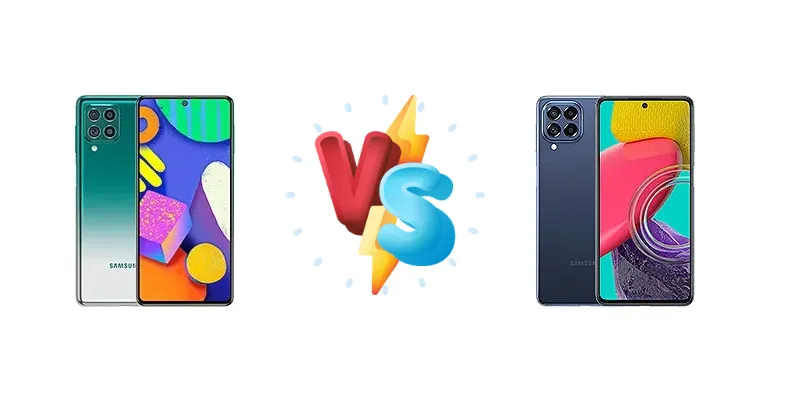
|
🏆 Quick Verdict
For users prioritizing raw processing power and occasional gaming, the Samsung Galaxy F62 offers a slight edge thanks to its Exynos 9825. However, the Samsung Galaxy M53 provides a more balanced experience with its efficient Dimensity 900, brighter display, and comparable battery life, making it the better all-rounder for most users.
| PHONES | ||
|---|---|---|
| Phone Names | Samsung Galaxy F62 | Samsung Galaxy M53 |
| Network | ||
|---|---|---|
| 2G bands | GSM 850 / 900 / 1800 / 1900 | GSM 850 / 900 / 1800 / 1900 |
| 3G bands | HSDPA 850 / 900 / 1700(AWS) / 1900 / 2100 | HSDPA 850 / 900 / 1700(AWS) / 1900 / 2100 |
| 4G bands | 1, 2, 3, 4, 5, 7, 8, 12, 17, 20, 26, 28, 38, 40, 41, 66 | 1, 2, 3, 4, 5, 7, 8, 12, 17, 20, 26, 28, 38, 40, 41, 66 |
| 5G bands | - | 1, 3, 5, 7, 8, 20, 28, 38, 40, 41, 66, 78 SA/NSA/Sub6 |
| Speed | HSPA, LTE | HSPA, LTE, 5G |
| Technology | GSM / HSPA / LTE | GSM / HSPA / LTE / 5G |
| Launch | ||
|---|---|---|
| Announced | 2021, February 15 | 2022, April 07 |
| Status | Available. Released 2021, February 22 | Available. Released 2022, April 22 |
| Body | ||
|---|---|---|
| Build | Glass front, plastic back, plastic frame | Glass front (Gorilla Glass 5), plastic back, plastic frame |
| Dimensions | 163.9 x 76.3 x 9.5 mm (6.45 x 3.00 x 0.37 in) | 164.7 x 77 x 7.4 mm (6.48 x 3.03 x 0.29 in) |
| SIM | Nano-SIM + Nano-SIM | Nano-SIM + Nano-SIM |
| Weight | 218 g (7.69 oz) | 176 g (6.21 oz) |
| Display | ||
|---|---|---|
| Protection | - | Corning Gorilla Glass 5 |
| Resolution | 1080 x 2400 pixels, 20:9 ratio (~393 ppi density) | 1080 x 2408 pixels, 20:9 ratio (~394 ppi density) |
| Size | 6.7 inches, 108.4 cm2 (~86.7% screen-to-body ratio) | 6.7 inches, 108.1 cm2 (~85.3% screen-to-body ratio) |
| Type | Super AMOLED Plus, 420 nits (peak) | Super AMOLED Plus, 120Hz |
| Platform | ||
|---|---|---|
| CPU | Octa-core (2x2.73 GHz Exynos M4 & 2x2.40 GHz Cortex-A75 & 4x1.95 GHz Cortex-A55) | Octa-core (2x2.4 GHz Cortex-A78 & 6x2.0 GHz Cortex-A55) |
| Chipset | Exynos 9825 (7 nm) | Mediatek Dimensity 900 (6 nm) |
| GPU | Mali-G76 MP12 | Mali-G68 MC4 |
| OS | Android 11, upgradable to Android 13, One UI 5 | Android 12, upgradable to Android 13, One UI 5.1 |
| Memory | ||
|---|---|---|
| Card slot | microSDXC (dedicated slot) | microSDXC (uses shared SIM slot) |
| Internal | 128GB 6GB RAM, 128GB 8GB RAM | 128GB 6GB RAM, 128GB 8GB RAM, 256GB 8GB RAM |
| Main Camera | ||
|---|---|---|
| Features | LED flash, panorama, HDR | LED flash, panorama, HDR |
| Quad | 64 MP, f/1.8, 26mm (wide), 1/1.73", 0.8µm, PDAF 12 MP, f/2.2, 123˚ (ultrawide) 5 MP (macro) Auxiliary lens | 108 MP, f/1.8, (wide), PDAF 8 MP, f/2.2, (ultrawide), 1/4.0", 1.12µm 2 MP (macro) Auxiliary lens |
| Single | 32 MP, f/2.2, 26mm (wide), 1/2.8", 0.8µm | - |
| Video | 4K@30fps, 1080p@30fps | 4K@30fps, 1080p@30/60fps |
| Selfie camera | ||
|---|---|---|
| Features | HDR | - |
| Single | 32 MP, f/2.2, 26mm (wide), 1/2.8", 0.8µm | 32 MP, f/2.2, 26mm (wide) |
| Video | 4K@30fps, 1080p@30fps | 4K@30fps, 1080p@30fps |
| Sound | ||
|---|---|---|
| 3.5mm jack | Yes | No |
| 35mm jack | Yes | No |
| Loudspeaker | Yes | Yes |
| Comms | ||
|---|---|---|
| Bluetooth | 5.0, A2DP, LE | 5.2, A2DP, LE |
| NFC | Yes | Yes (market/region dependent) |
| Positioning | GPS, GLONASS, GALILEO, BDS | GPS, GLONASS, GALILEO, BDS, QZSS |
| Radio | FM radio, recording | No |
| USB | USB Type-C 2.0, OTG | USB Type-C 2.0, OTG |
| WLAN | Wi-Fi 802.11 a/b/g/n/ac, dual-band, Wi-Fi Direct | Wi-Fi 802.11 a/b/g/n/ac, dual-band, Wi-Fi Direct |
| Features | ||
|---|---|---|
| Sensors | Fingerprint (side-mounted), accelerometer, gyro, proximity, compass | Fingerprint (side-mounted), accelerometer, gyro, proximity, compass |
| Battery | ||
|---|---|---|
| Charging | 25W wired 4.5W reverse wired | 25W wired |
| Type | Li-Po 7000 mAh | Li-Ion 5000 mAh |
| Misc | ||
|---|---|---|
| Colors | Laser Green, Laser Gray, Laser Blue | Green, Blue, Brown |
| Models | SM-E625F, SM-E625F/DS | SM-M536B, SM-M536B/DS, SM-M536B/DSN |
| Price | About 270 EUR | € 249.98 |
| SAR | 0.74 W/kg (head) | 1.31 W/kg (head) |
| SAR EU | - | 0.60 W/kg (head) 1.53 W/kg (body) |
| Tests | ||
|---|---|---|
| Battery life | - | Endurance rating 114h |
| Camera | - | Photo / Video |
| Display | - | Contrast ratio: Infinite (nominal) |
| Loudspeaker | - | -29.3 LUFS (Average) |
Samsung Galaxy F62
- Potentially higher peak CPU performance for demanding tasks.
- Flagship-level chipset from a previous generation.
- Competitive price point.
- Less power-efficient chipset leading to potential throttling.
- Display likely lacks the brightness of the M53.
- Older chipset architecture may lack modern features.
Samsung Galaxy M53
- More power-efficient Dimensity 900 chipset.
- Brighter display for better outdoor visibility.
- Modern chipset architecture with improved features.
- CPU clock speeds are lower than the F62.
- May not match the F62 in peak CPU-intensive workloads.
- Camera performance relies heavily on software optimization.
Display Comparison
The Samsung Galaxy M53 distinguishes itself with a significantly brighter display, reaching 802 nits measured, compared to an unspecified brightness for the F62. While both displays are described as having an 'infinite' contrast ratio (typical for AMOLED), the M53’s higher peak brightness translates to better visibility outdoors. The F62’s display specs are less detailed, suggesting it may not offer the same level of visual clarity in bright conditions. Bezels are likely comparable given both phones target similar price points, but the M53’s panel technology is demonstrably superior in terms of brightness.
Camera Comparison
Both phones feature a 'Photo / Video' camera system, but detailed specifications are lacking. Without sensor size or aperture information, a direct comparison is difficult. However, the market positioning suggests the M53 may benefit from newer image processing algorithms. The inclusion of a 2MP macro camera on both devices is largely a marketing tactic, offering limited practical benefit due to the small sensor size and lack of optical image stabilization (OIS). The quality of the main sensor and image processing will be the determining factors, and without further data, it’s difficult to declare a clear winner.
Performance
The core difference lies in the chipsets. The Galaxy F62’s Exynos 9825 (7nm) features a more aggressive CPU core configuration – two high-performance Cortex-A75 cores at 2.73 GHz alongside two Cortex-A75 cores at 2.40 GHz and four Cortex-A55 cores. The M53’s Dimensity 900 (6nm) uses a more modern architecture with two Cortex-A78 cores at 2.4 GHz and six Cortex-A55 cores at 2.0 GHz. While the Exynos boasts higher clock speeds, the Dimensity 900’s 6nm process offers improved power efficiency and thermal management. This means the M53 is likely to sustain performance for longer periods without throttling, despite the F62’s initially faster CPU cores. The F62’s older architecture may also lack some of the AI and connectivity enhancements found in the Dimensity 900.
Battery Life
Both the F62 and M53 achieve an endurance rating of 114 hours, indicating similar real-world battery life. Both support 25W wired charging, suggesting comparable 0-100% charging times. However, the Dimensity 900’s superior power efficiency in the M53 means it can deliver that endurance with a potentially smaller battery capacity, or maintain performance for longer on the same battery size. The F62’s Exynos 9825, while powerful, is less efficient, potentially requiring more frequent charging despite the identical endurance rating.
Buying Guide
Buy the Samsung Galaxy F62 if you need maximum CPU performance for demanding tasks like video editing or running emulators, and are willing to potentially sacrifice some battery efficiency. Buy the Samsung Galaxy M53 if you prefer a brighter, more modern display, a more efficient chipset for everyday use, and a phone that balances performance with battery longevity.