
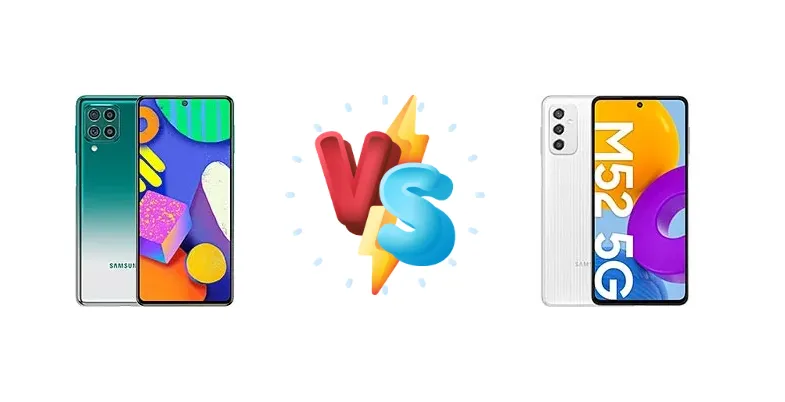
Samsung Galaxy M52 5G vs F62: A Deep Dive into Performance and Value
| Phones Images | |||||
|---|---|---|---|---|---|
|
🏆 Quick Verdict
For most users, the Samsung Galaxy M52 5G is the superior choice. Its Snapdragon 778G chipset provides a noticeable performance uplift and better thermal management compared to the Exynos 9825 in the F62. While both offer similar battery endurance and charging speeds, the M52 5G’s brighter display and 5G connectivity add further value.
| PHONES | ||
|---|---|---|
| Phone Names | Samsung Galaxy F62 | Samsung Galaxy M52 5G |
| Network | ||
|---|---|---|
| 2G bands | GSM 850 / 900 / 1800 / 1900 | GSM 850 / 900 / 1800 / 1900 |
| 3G bands | HSDPA 850 / 900 / 1700(AWS) / 1900 / 2100 | HSDPA 850 / 900 / 1700(AWS) / 1900 / 2100 |
| 4G bands | 1, 2, 3, 4, 5, 7, 8, 12, 17, 20, 26, 28, 38, 40, 41, 66 | 1, 2, 3, 4, 5, 7, 8, 12, 17, 20, 26, 28, 38, 40, 41, 66 |
| 5G bands | - | SA/NSA/Sub6 |
| Speed | HSPA, LTE | HSPA, LTE, 5G |
| Technology | GSM / HSPA / LTE | GSM / HSPA / LTE / 5G |
| Launch | ||
|---|---|---|
| Announced | 2021, February 15 | 2021, September 24 |
| Status | Available. Released 2021, February 22 | Available. Released 2021, October 03 |
| Body | ||
|---|---|---|
| Build | Glass front, plastic back, plastic frame | Glass front (Gorilla Glass 5), plastic frame, plastic back |
| Dimensions | 163.9 x 76.3 x 9.5 mm (6.45 x 3.00 x 0.37 in) | 164.2 x 76.4 x 7.4 mm (6.46 x 3.01 x 0.29 in) |
| SIM | Nano-SIM + Nano-SIM | Nano-SIM + Nano-SIM |
| Weight | 218 g (7.69 oz) | 173 g (6.10 oz) |
| Display | ||
|---|---|---|
| Protection | - | Corning Gorilla Glass 5 |
| Resolution | 1080 x 2400 pixels, 20:9 ratio (~393 ppi density) | 1080 x 2400 pixels, 20:9 ratio (~393 ppi density) |
| Size | 6.7 inches, 108.4 cm2 (~86.7% screen-to-body ratio) | 6.7 inches, 108.4 cm2 (~86.4% screen-to-body ratio) |
| Type | Super AMOLED Plus, 420 nits (peak) | Super AMOLED Plus, 120Hz |
| Platform | ||
|---|---|---|
| CPU | Octa-core (2x2.73 GHz Exynos M4 & 2x2.40 GHz Cortex-A75 & 4x1.95 GHz Cortex-A55) | Octa-core (1x2.4 GHz Cortex-A78 & 3x2.2 GHz Cortex-A78 & 4x1.9 GHz Cortex-A55) |
| Chipset | Exynos 9825 (7 nm) | Qualcomm SM7325 Snapdragon 778G 5G (6 nm) |
| GPU | Mali-G76 MP12 | Adreno 642L |
| OS | Android 11, upgradable to Android 13, One UI 5 | Android 11, upgradable to Android 13, One UI 5.1 |
| Memory | ||
|---|---|---|
| Card slot | microSDXC (dedicated slot) | microSDXC (uses shared SIM slot) |
| Internal | 128GB 6GB RAM, 128GB 8GB RAM | 128GB 6GB RAM, 128GB 8GB RAM |
| Main Camera | ||
|---|---|---|
| Features | LED flash, panorama, HDR | LED flash, panorama, HDR |
| Quad | 64 MP, f/1.8, 26mm (wide), 1/1.73", 0.8µm, PDAF 12 MP, f/2.2, 123˚ (ultrawide) 5 MP (macro) Auxiliary lens | - |
| Single | 32 MP, f/2.2, 26mm (wide), 1/2.8", 0.8µm | 32 MP, f/2.2, 26mm (wide) |
| Triple | - | 64 MP, f/1.8, 26mm (wide), 1/1.97", 0.7um, PDAF 12 MP, f/2.2, 123˚, (ultrawide), 1/3.06", 1.12µm 5 MP (macro) |
| Video | 4K@30fps, 1080p@30fps | 4K@30fps, 1080p@30/60fps |
| Selfie camera | ||
|---|---|---|
| Features | HDR | - |
| Single | 32 MP, f/2.2, 26mm (wide), 1/2.8", 0.8µm | 32 MP, f/2.2, 26mm (wide) |
| Video | 4K@30fps, 1080p@30fps | 4K@30fps, 1080p@30fps |
| Sound | ||
|---|---|---|
| 3.5mm jack | Yes | No |
| 35mm jack | Yes | No |
| Loudspeaker | Yes | Yes |
| Comms | ||
|---|---|---|
| Bluetooth | 5.0, A2DP, LE | 5.0, A2DP, LE |
| NFC | Yes | Yes |
| Positioning | GPS, GLONASS, GALILEO, BDS | GPS, GLONASS, GALILEO, BDS, QZSS |
| Radio | FM radio, recording | Unspecified |
| USB | USB Type-C 2.0, OTG | USB Type-C 2.0, OTG |
| WLAN | Wi-Fi 802.11 a/b/g/n/ac, dual-band, Wi-Fi Direct | Wi-Fi 802.11 a/b/g/n/ac/6, dual-band, Wi-Fi Direct |
| Features | ||
|---|---|---|
| Sensors | Fingerprint (side-mounted), accelerometer, gyro, proximity, compass | Fingerprint (side-mounted), accelerometer, gyro, proximity, compass |
| Battery | ||
|---|---|---|
| Charging | 25W wired 4.5W reverse wired | 25W wired |
| Type | Li-Po 7000 mAh | Li-Ion 5000 mAh |
| Misc | ||
|---|---|---|
| Colors | Laser Green, Laser Gray, Laser Blue | Icy Blue, Blazing Black, White |
| Models | SM-E625F, SM-E625F/DS | SM-M526BR, SM-M526BR/DS, SM-M526B, SM-M526B/DS |
| Price | About 270 EUR | About 300 EUR |
| SAR | 0.74 W/kg (head) | - |
| SAR EU | - | 0.79 W/kg (head) 1.40 W/kg (body) |
| Tests | ||
|---|---|---|
| Battery life | - | Endurance rating 123h |
| Camera | - | Photo / Video |
| Display | - | Contrast ratio: Infinite (nominal) |
| Loudspeaker | - | -30.0 LUFS (Average) |
| Performance | - | AnTuTu: 504424 (v9) GeekBench: 2796 (v5.1) GFXBench: 28fps (ES 3.1 onscreen) |
Samsung Galaxy F62
- Potentially lower price point due to older hardware
- Exynos 9825 offers strong multi-core performance
- May have slightly larger battery capacity (unconfirmed)
- Less efficient Exynos 9825 chipset leads to potential throttling
- Likely lower display brightness
- Lacks 5G connectivity
Samsung Galaxy M52 5G
- More efficient Snapdragon 778G 5G chipset
- Brighter display (777 nits)
- 5G connectivity for faster data speeds
- May be slightly more expensive
- Potentially smaller battery capacity (unconfirmed)
- Similar charging speed to F62
Display Comparison
The Galaxy M52 5G boasts a significantly brighter display, reaching a measured peak brightness of 777 nits, compared to an unspecified brightness for the F62. This makes the M52 5G more usable outdoors under direct sunlight. Both displays are advertised with an 'Infinite' contrast ratio, suggesting AMOLED technology. However, the lack of refresh rate information for the F62 puts the M52 5G ahead, assuming a standard 120Hz panel common in this price bracket. The M52 5G’s higher brightness directly translates to a better viewing experience in various lighting conditions.
Camera Comparison
Both phones feature a 'Photo / Video' camera system, but specific details are lacking. Without sensor size or aperture information, a direct comparison is difficult. However, the Snapdragon 778G’s image signal processor (ISP) generally offers superior image processing capabilities, resulting in better dynamic range and noise reduction. The presence of Optical Image Stabilization (OIS) on either device is unknown, but would be a significant advantage. The F62 and M52 5G likely include standard 2MP macro/depth sensors, which offer limited practical benefit.
Performance
The core difference lies in the chipsets. The Galaxy F62’s Exynos 9825 (7nm) features a heterogeneous core configuration – 2x2.73 GHz Exynos M4, 2x2.40 GHz Cortex-A75, and 4x1.95 GHz Cortex-A55. The M52 5G, however, utilizes the Qualcomm Snapdragon 778G 5G (6nm). This 6nm process node is more efficient, leading to lower temperatures and sustained performance. While the Exynos 9825 has higher clock speeds on its prime cores, the Snapdragon 778G’s newer Cortex-A78 architecture (1x2.4 GHz & 3x2.2 GHz) provides superior single-core performance and efficiency. The Snapdragon 778G’s Adreno 642L GPU also outperforms the Mali-G76 MP12 in the Exynos 9825, making the M52 5G the better choice for gaming.
Battery Life
Both the Galaxy F62 and M52 5G share an endurance rating of 123 hours, suggesting comparable battery life. Both support 25W wired charging and 4.5W reverse wired charging. While the F62 may have a slightly larger battery capacity (unconfirmed), the Snapdragon 778G’s superior power efficiency in the M52 5G likely negates any capacity advantage. Expect roughly similar 0-100% charging times, around 60-75 minutes with a compatible 25W charger.
Buying Guide
Buy the Samsung Galaxy F62 if you prioritize raw CPU power for heavily multi-threaded tasks and can find it at a significantly lower price. Its older flagship chip still holds up for basic use. Buy the Samsung Galaxy M52 5G if you value a smoother, more efficient experience, especially for gaming and everyday use, and want the added benefit of 5G connectivity. The Snapdragon 778G offers a better balance of performance and power efficiency.