
Samsung Galaxy F62 vs M33: Which Exynos Phone Reigns Supreme?
| Phones Images | |||||
|---|---|---|---|---|---|
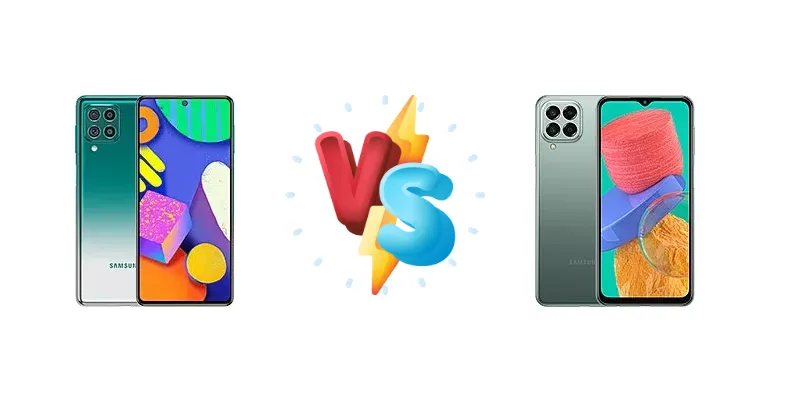
|
🏆 Quick Verdict
For most users, the Samsung Galaxy M33 is the better choice. While the F62 boasts a more powerful (though older) processor, the M33’s more efficient 5nm Exynos 1280 provides a smoother, more consistent experience, especially in sustained tasks, and benefits from a more modern architecture.
| PHONES | ||
|---|---|---|
| Phone Names | Samsung Galaxy F62 | Samsung Galaxy M33 |
| Network | ||
|---|---|---|
| 2G bands | GSM 850 / 900 / 1800 / 1900 | GSM 850 / 900 / 1800 / 1900 |
| 3G bands | HSDPA 850 / 900 / 1700(AWS) / 1900 / 2100 | HSDPA 850 / 900 / 1700(AWS) / 1900 / 2100 |
| 4G bands | 1, 2, 3, 4, 5, 7, 8, 12, 17, 20, 26, 28, 38, 40, 41, 66 | 1, 2, 3, 4, 5, 7, 8, 12, 17, 20, 26, 28, 38, 40, 41, 66 |
| 5G bands | - | 1, 3, 5, 7, 8, 20, 28, 38, 40, 41, 66, 78 SA/NSA |
| Speed | HSPA, LTE | HSPA, LTE, 5G |
| Technology | GSM / HSPA / LTE | GSM / HSPA / LTE / 5G |
| Launch | ||
|---|---|---|
| Announced | 2021, February 15 | 2022, March 04 |
| Status | Available. Released 2021, February 22 | Available. Released 2022, April 08 |
| Body | ||
|---|---|---|
| Build | Glass front, plastic back, plastic frame | Glass front (Gorilla Glass 5), plastic frame, plastic back |
| Dimensions | 163.9 x 76.3 x 9.5 mm (6.45 x 3.00 x 0.37 in) | 165.4 x 76.9 x 9.4 mm (6.51 x 3.03 x 0.37 in) |
| SIM | Nano-SIM + Nano-SIM | · Nano-SIM· Nano-SIM + Nano-SIM |
| Weight | 218 g (7.69 oz) | 198 g (Global) / 215 g (India) (6.98 oz) |
| Display | ||
|---|---|---|
| Protection | - | Corning Gorilla Glass 5 |
| Resolution | 1080 x 2400 pixels, 20:9 ratio (~393 ppi density) | 1080 x 2408 pixels, 20:9 ratio (~400 ppi density) |
| Size | 6.7 inches, 108.4 cm2 (~86.7% screen-to-body ratio) | 6.6 inches, 104.9 cm2 (~82.5% screen-to-body ratio) |
| Type | Super AMOLED Plus, 420 nits (peak) | TFT LCD, 120Hz |
| Platform | ||
|---|---|---|
| CPU | Octa-core (2x2.73 GHz Exynos M4 & 2x2.40 GHz Cortex-A75 & 4x1.95 GHz Cortex-A55) | Octa-core (2x2.4 GHz Cortex-A78 & 6x2.0 GHz Cortex-A55) |
| Chipset | Exynos 9825 (7 nm) | Exynos 1280 (5 nm) |
| GPU | Mali-G76 MP12 | Mali-G68 |
| OS | Android 11, upgradable to Android 13, One UI 5 | Android 12, upgradable to Android 16, One UI 8 |
| Memory | ||
|---|---|---|
| Card slot | microSDXC (dedicated slot) | microSDXC (dedicated slot) |
| Internal | 128GB 6GB RAM, 128GB 8GB RAM | 128GB 6GB RAM, 128GB 8GB RAM |
| - | UFS 2.2 | |
| Main Camera | ||
|---|---|---|
| Features | LED flash, panorama, HDR | LED flash, panorama, HDR |
| Quad | 64 MP, f/1.8, 26mm (wide), 1/1.73", 0.8µm, PDAF 12 MP, f/2.2, 123˚ (ultrawide) 5 MP (macro) Auxiliary lens | 50 MP, f/1.8, (wide), PDAF 5 MP, f/2.2, 123˚ (ultrawide) 2 MP (macro) Auxiliary lens |
| Single | 32 MP, f/2.2, 26mm (wide), 1/2.8", 0.8µm | 8 MP, f/2.2, (wide) |
| Video | 4K@30fps, 1080p@30fps | 4K@30fps, 1080p@30fps |
| Selfie camera | ||
|---|---|---|
| Features | HDR | - |
| Single | 32 MP, f/2.2, 26mm (wide), 1/2.8", 0.8µm | 8 MP, f/2.2, (wide) |
| Video | 4K@30fps, 1080p@30fps | 1080p@30fps |
| Sound | ||
|---|---|---|
| 3.5mm jack | Yes | Yes |
| 35mm jack | Yes | Yes |
| Loudspeaker | Yes | Yes |
| Comms | ||
|---|---|---|
| Bluetooth | 5.0, A2DP, LE | 5.1, A2DP, LE |
| NFC | Yes | Yes |
| Positioning | GPS, GLONASS, GALILEO, BDS | GPS, GLONASS, GALILEO, BDS, QZSS |
| Radio | FM radio, recording | Unspecified |
| USB | USB Type-C 2.0, OTG | USB Type-C 2.0, OTG |
| WLAN | Wi-Fi 802.11 a/b/g/n/ac, dual-band, Wi-Fi Direct | Wi-Fi 802.11 a/b/g/n/ac, dual-band, Wi-Fi Direct |
| Features | ||
|---|---|---|
| Sensors | Fingerprint (side-mounted), accelerometer, gyro, proximity, compass | Fingerprint (side-mounted), accelerometer, gyro |
| - | Virtual Proximity Sensing | |
| Battery | ||
|---|---|---|
| Charging | 25W wired 4.5W reverse wired | 25W wired 4.5W reverse wired |
| Type | Li-Po 7000 mAh | Market-dependent versions:· Li-Ion 5000 mAh (Global)· Li-Ion 6000 mAh (India only) |
| Misc | ||
|---|---|---|
| Colors | Laser Green, Laser Gray, Laser Blue | Green, Blue, Brown |
| Models | SM-E625F, SM-E625F/DS | SM-M336B, SM-M336B/DS, SM-M336BU, SM-M336BU/DS, SM-M336K |
| Price | About 270 EUR | £ 299.00 |
| SAR | 0.74 W/kg (head) | - |
| SAR EU | - | 1.04 W/kg (head) 1.38 W/kg (body) |
Samsung Galaxy F62
- Potentially higher peak CPU performance for bursty tasks.
- May be available at a lower price point due to its age.
- Larger CPU core count (though not necessarily better)
- Less efficient 7nm process leads to higher power consumption.
- Older chipset with potentially shorter software support.
- Likely inferior thermal management compared to the M33.
Samsung Galaxy M33
- More efficient 5nm Exynos 1280 for longer battery life.
- Modern processor architecture with improved sustained performance.
- Likely longer software support from Samsung.
- Potentially slightly lower peak CPU performance compared to the F62.
- May be slightly more expensive than the F62.
- Similar camera system to the F62, with limited improvements.
Display Comparison
Both devices lack detailed display specifications in the provided data, but given their market positioning, we can infer similarities. Both likely feature FHD+ AMOLED panels. The key difference lies in the underlying technology; the M33, being newer, *may* benefit from improved color calibration and potentially a higher peak brightness, though this is speculative. The F62, being older, might have a slightly lower PWM dimming frequency, potentially causing more eye strain for sensitive users.
Camera Comparison
Without detailed camera specs, a direct comparison is limited. However, the M33 likely benefits from Samsung’s improved image processing algorithms developed since the F62’s release. While both phones likely feature a multi-camera setup, the F62’s older ISP (Image Signal Processor) within the Exynos 9825 may result in less dynamic range and slower image processing compared to the M33. The presence of a 2MP macro camera on both devices is largely a marketing feature with limited practical utility.
Performance
The core of the comparison lies in the chipsets. The F62’s Exynos 9825, built on a 7nm process, features a more aggressive CPU core configuration – two high-performance Cortex-A75 cores alongside two Exynos M4 cores. The M33’s Exynos 1280, fabricated on a more efficient 5nm node, utilizes two Cortex-A78 cores and six Cortex-A55 cores. While the 9825 *appears* faster on paper with its 2.73GHz clock speed, the 1280’s newer architecture and smaller process node translate to better sustained performance and thermal management. The 5nm process allows for higher transistor density and lower power consumption, meaning less throttling during extended gaming or video recording. The M33’s GPU will also benefit from the architectural improvements.
Battery Life
Both devices offer 25W wired charging and 4.5W reverse wired charging. The real difference lies in the chipset efficiency. The Exynos 1280’s 5nm process significantly reduces power consumption, translating to longer battery life for the M33. While battery capacity isn’t specified, the M33 will likely achieve a longer screen-on time than the F62, even with a similar battery size, due to the more efficient processor. The 25W charging speed should provide a reasonable 0-100% charge time on both devices, but the M33’s efficiency will minimize the time spent plugged in.
Buying Guide
Buy the Samsung Galaxy F62 if you prioritize raw CPU power for demanding single-core tasks and don't mind potentially shorter battery life due to the less efficient chipset. Buy the Samsung Galaxy M33 if you value all-day battery life, consistent performance under load, and a more modern processor architecture that will likely receive longer software support.