
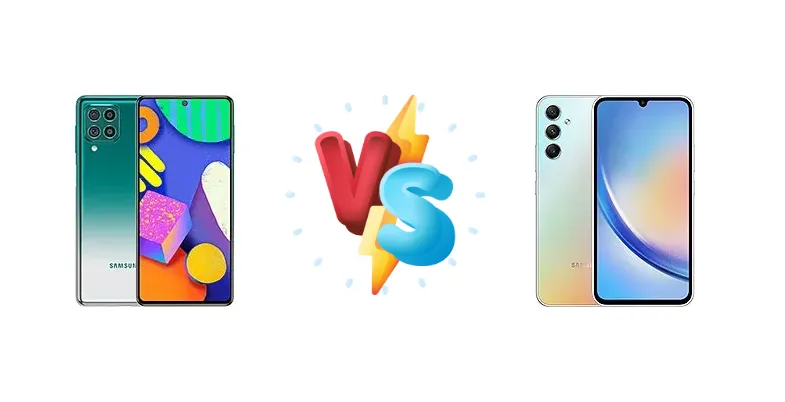
Samsung Galaxy F62 vs A34: Which Samsung Mid-Ranger Reigns Supreme?
| Phones Images | |||||
|---|---|---|---|---|---|
|
🏆 Quick Verdict
For most users, the Samsung Galaxy A34 is the better choice. While the F62 boasts a more powerful (though older) processor, the A34’s more efficient Dimensity 1080, brighter display, and modern software support provide a smoother, more enjoyable overall experience.
| PHONES | ||
|---|---|---|
| Phone Names | Samsung Galaxy F62 | Samsung Galaxy A34 |
| Network | ||
|---|---|---|
| 2G bands | GSM 850 / 900 / 1800 / 1900 | GSM 850 / 900 / 1800 / 1900 |
| 3G bands | HSDPA 850 / 900 / 1700(AWS) / 1900 / 2100 | HSDPA 850 / 900 / 1700(AWS) / 1900 / 2100 |
| 4G bands | 1, 2, 3, 4, 5, 7, 8, 12, 17, 20, 26, 28, 38, 40, 41, 66 | 1, 2, 3, 4, 5, 7, 8, 12, 17, 20, 26, 28, 32, 38, 40, 41, 66 |
| 5G bands | - | 1, 3, 7, 8, 20, 28, 38, 40, 41, 77, 78 SA/NSA/Sub6 |
| Speed | HSPA, LTE | HSPA, LTE, 5G |
| Technology | GSM / HSPA / LTE | GSM / HSPA / LTE / 5G |
| Launch | ||
|---|---|---|
| Announced | 2021, February 15 | 2023, March 14 |
| Status | Available. Released 2021, February 22 | Available. Released 2023, March 24 |
| Body | ||
|---|---|---|
| Build | Glass front, plastic back, plastic frame | Glass front (Gorilla Glass 5), plastic frame, plastic back |
| Dimensions | 163.9 x 76.3 x 9.5 mm (6.45 x 3.00 x 0.37 in) | 161.3 x 78.1 x 8.2 mm (6.35 x 3.07 x 0.32 in) |
| SIM | Nano-SIM + Nano-SIM | · Nano-SIM· Nano-SIM + Nano-SIM |
| Weight | 218 g (7.69 oz) | 199 g (7.02 oz) |
| - | IP67 dust/water resistant (up to 1m for 30 min) | |
| Display | ||
|---|---|---|
| Protection | - | Corning Gorilla Glass 5 |
| Resolution | 1080 x 2400 pixels, 20:9 ratio (~393 ppi density) | 1080 x 2340 pixels, 19.5:9 ratio (~390 ppi density) |
| Size | 6.7 inches, 108.4 cm2 (~86.7% screen-to-body ratio) | 6.6 inches, 106.9 cm2 (~84.9% screen-to-body ratio) |
| Type | Super AMOLED Plus, 420 nits (peak) | Super AMOLED, 120Hz, 1000 nits (HBM) |
| Platform | ||
|---|---|---|
| CPU | Octa-core (2x2.73 GHz Exynos M4 & 2x2.40 GHz Cortex-A75 & 4x1.95 GHz Cortex-A55) | Octa-core (2x2.6 GHz Cortex-A78 & 6x2.0 GHz Cortex-A55) |
| Chipset | Exynos 9825 (7 nm) | Mediatek Dimensity 1080 (6 nm) |
| GPU | Mali-G76 MP12 | Mali-G68 MC4 |
| OS | Android 11, upgradable to Android 13, One UI 5 | Android 13, up to 4 major Android upgrades, One UI 6.1 |
| Memory | ||
|---|---|---|
| Card slot | microSDXC (dedicated slot) | microSDXC (uses shared SIM slot) |
| Internal | 128GB 6GB RAM, 128GB 8GB RAM | 128GB 4GB RAM, 128GB 6GB RAM, 128GB 8GB RAM, 256GB 6GB RAM, 256GB 8GB RAM |
| Main Camera | ||
|---|---|---|
| Features | LED flash, panorama, HDR | LED flash, panorama, HDR |
| Quad | 64 MP, f/1.8, 26mm (wide), 1/1.73", 0.8µm, PDAF 12 MP, f/2.2, 123˚ (ultrawide) 5 MP (macro) Auxiliary lens | - |
| Single | 32 MP, f/2.2, 26mm (wide), 1/2.8", 0.8µm | - |
| Triple | - | 48 MP, f/1.8, 26mm (wide), 1/2.0", 0.8µm, PDAF, OIS 8 MP, f/2.2, 123˚, (ultrawide), 1/4.0", 1.12µm 5 MP (macro) |
| Video | 4K@30fps, 1080p@30fps | 4K@30fps, 1080p@30/60fps, 720p@480fps |
| Selfie camera | ||
|---|---|---|
| Features | HDR | - |
| Single | 32 MP, f/2.2, 26mm (wide), 1/2.8", 0.8µm | 13 MP, f/2.2, 26mm (wide), 1/3.1", 1.12µm |
| Video | 4K@30fps, 1080p@30fps | 4K@30fps, 1080p@30fps |
| Sound | ||
|---|---|---|
| 3.5mm jack | Yes | No |
| 35mm jack | Yes | No |
| Loudspeaker | Yes | Yes, with stereo speakers |
| Comms | ||
|---|---|---|
| Bluetooth | 5.0, A2DP, LE | 5.3, A2DP, LE |
| NFC | Yes | Yes (market/region dependent) |
| Positioning | GPS, GLONASS, GALILEO, BDS | GPS, GLONASS, GALILEO, BDS |
| Radio | FM radio, recording | No |
| USB | USB Type-C 2.0, OTG | USB Type-C 2.0, OTG |
| WLAN | Wi-Fi 802.11 a/b/g/n/ac, dual-band, Wi-Fi Direct | Wi-Fi 802.11 a/b/g/n/ac, dual-band, Wi-Fi Direct |
| Features | ||
|---|---|---|
| Sensors | Fingerprint (side-mounted), accelerometer, gyro, proximity, compass | Fingerprint (under display, optical), accelerometer, gyro, compass |
| - | Virtual proximity sensing | |
| Battery | ||
|---|---|---|
| Charging | 25W wired 4.5W reverse wired | 25W wired |
| Type | Li-Po 7000 mAh | Li-Ion 5000 mAh |
| Misc | ||
|---|---|---|
| Colors | Laser Green, Laser Gray, Laser Blue | Lime, Graphite, Violet, Silver |
| Models | SM-E625F, SM-E625F/DS | SM-A346E, SM-A346B, SM-A346B/DS, SM-A346B/DSN, SM-A346E/DS, SM-A346E/DSN, SM-A346M, SM-A346M/N, SM-A346M/DSN, SM-A3460 |
| Price | About 270 EUR | € 169.99 / $ 175.00 / £ 164.99 / ₹ 23,999 |
| SAR | 0.74 W/kg (head) | - |
| SAR EU | - | 0.55 W/kg (head) 1.49 W/kg (body) |
| Tests | ||
|---|---|---|
| Battery life | - | Endurance rating 133h |
| Camera | - | Photo / Video |
| Display | - | Contrast ratio: Infinite (nominal) |
| Loudspeaker | - | -26.1 LUFS (Good) |
| Performance | - | AnTuTu: 472126 (v9) GeekBench: 2316 (v5.5), 2518 (v6) GFXBench: 23fps (ES 3.1 onscreen) |
Samsung Galaxy F62
- Potentially higher peak CPU performance for demanding tasks.
- Reverse wireless charging capability.
- May be available at a lower price point due to its age.
- Older chipset with less efficient power consumption.
- Likely less frequent software updates.
- Inferior display quality compared to the A34.
Samsung Galaxy A34
- More efficient Dimensity 1080 chipset for sustained performance.
- Brighter and more modern display.
- Guaranteed software updates and security patches.
- Slightly less raw CPU power compared to the F62.
- May be slightly more expensive than the F62.
- Similar battery life despite chipset efficiency gains.
Display Comparison
The Galaxy A34 significantly outshines the F62 in display quality. The A34’s measured peak brightness of 1009 nits is substantially higher than what the F62 likely achieves (Samsung doesn't officially list this spec), making it far more usable outdoors. While both feature similar infinite contrast ratios (nominal), the A34’s newer panel technology likely offers improved color accuracy and viewing angles. The F62’s display specs are not readily available, suggesting it’s a less advanced panel.
Camera Comparison
Both devices offer photo and video capabilities, but detailed camera specs are limited. Without specific sensor size or aperture information, it’s difficult to make a definitive judgment. However, given the A34’s more recent release, it likely benefits from improved image processing algorithms and software optimizations. The F62’s camera system, while capable, is likely less refined. The presence of a 2MP macro camera on both devices suggests limited utility, as these sensors typically lack the detail and dynamic range for truly compelling macro shots.
Performance
On paper, the Galaxy F62’s Exynos 9825 appears more potent with its 2x2.73 GHz Exynos M4 cores. However, the A34’s MediaTek Dimensity 1080, built on a more efficient 6nm process versus the F62’s 7nm, offers a more consistent experience. The Dimensity 1080’s Cortex-A78 cores, while clocked slightly lower at 2.6 GHz, are architecturally more advanced than the F62’s Cortex-A75 cores. This translates to better sustained performance and thermal management, preventing the F62’s Exynos 9825 from throttling as quickly under load. The A34’s CPU configuration of 2x Cortex-A78 and 6x Cortex-A55 is also more balanced for everyday tasks.
Battery Life
Both the Galaxy F62 and A34 achieve an endurance rating of 133 hours, indicating similar real-world battery life. However, the A34’s more efficient Dimensity 1080 chipset contributes to this longevity with less power draw. Both support 25W wired charging, offering comparable charging speeds. While the F62 includes 4.5W reverse wired charging, this feature is primarily for convenience and doesn’t significantly impact the overall battery experience.
Buying Guide
Buy the Samsung Galaxy F62 if you prioritize raw processing power for demanding tasks like video editing or emulation and are comfortable with a slightly older device and potentially less frequent software updates. Buy the Samsung Galaxy A34 if you prefer a more balanced experience with a brighter, more modern display, efficient performance for everyday use, and guaranteed software support for years to come.