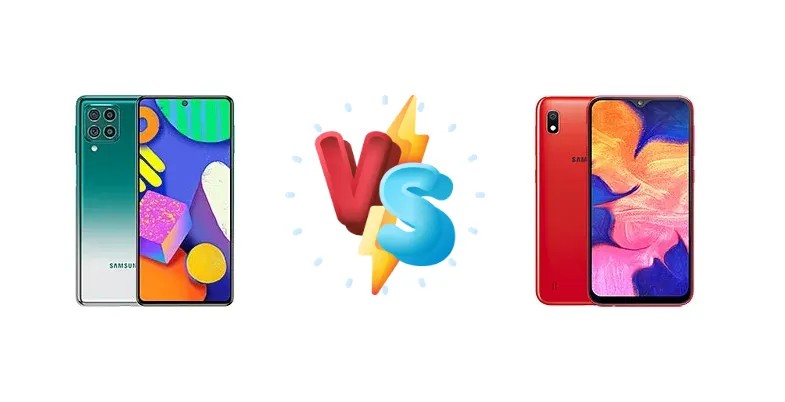
The Samsung Galaxy F62 and A10 represent vastly different points in Samsung's smartphone strategy. The A10, released in 2019, was a cornerstone of Samsung’s entry-level offerings, while the F62, arriving in 2021, aimed to deliver flagship-level processing power at a more accessible price point. This comparison dissects the core differences between these two devices, focusing on how their hardware impacts real-world usage.
🏆 Quick Verdict
For most users, the Samsung Galaxy F62 is the clear winner. Its Exynos 9825 chipset provides significantly faster performance, making it suitable for demanding tasks like gaming and multitasking. While the A10 remains a viable option for basic smartphone needs, the F62’s superior processing power and faster charging justify the price difference.
| Network |
|---|
| 2G bands | GSM 850 / 900 / 1800 / 1900 | GSM 850 / 900 / 1800 / 1900 |
| 3G bands | HSDPA 850 / 900 / 1700(AWS) / 1900 / 2100 | HSDPA 850 / 900 / 1900 / 2100 - International |
| 4G bands | 1, 2, 3, 4, 5, 7, 8, 12, 17, 20, 26, 28, 38, 40, 41, 66 | 1, 2, 3, 5, 7, 8, 20, 38, 40, 41 - International |
| Speed | HSPA, LTE | HSPA 42.2/5.76 Mbps, LTE Cat4 150/50 Mbps |
| Technology | GSM / HSPA / LTE | GSM / HSPA / LTE |
| | - | 1, 2, 3, 4, 5, 7, 8, 12, 17, 28 - LATAM |
| Launch |
|---|
| Announced | 2021, February 15 | 2019, February 28. Released 2019, March 19 |
| Status | Available. Released 2021, February 22 | Discontinued |
| Body |
|---|
| Build | Glass front, plastic back, plastic frame | Glass front, plastic back, plastic frame |
| Dimensions | 163.9 x 76.3 x 9.5 mm (6.45 x 3.00 x 0.37 in) | 155.6 x 75.6 x 7.9 mm (6.13 x 2.98 x 0.31 in) |
| SIM | Nano-SIM + Nano-SIM | · Nano-SIM· Nano-SIM + Nano-SIM |
| Weight | 218 g (7.69 oz) | 168 g (5.93 oz) |
| Display |
|---|
| Resolution | 1080 x 2400 pixels, 20:9 ratio (~393 ppi density) | 720 x 1520 pixels, 19:9 ratio (~271 ppi density) |
| Size | 6.7 inches, 108.4 cm2 (~86.7% screen-to-body ratio) | 6.2 inches, 95.9 cm2 (~81.6% screen-to-body ratio) |
| Type | Super AMOLED Plus, 420 nits (peak) | IPS LCD |
| Platform |
|---|
| CPU | Octa-core (2x2.73 GHz Exynos M4 & 2x2.40 GHz Cortex-A75 & 4x1.95 GHz Cortex-A55) | Octa-core (2x1.6 GHz Cortex-A73 & 6x1.35 GHz Cortex-A53) |
| Chipset | Exynos 9825 (7 nm) | Exynos 7884 (14 nm) |
| GPU | Mali-G76 MP12 | Mali-G71 MP2 |
| OS | Android 11, upgradable to Android 13, One UI 5 | Android 9.0 (Pie), upgradable to Android 11, One UI 3 |
| Memory |
|---|
| Card slot | microSDXC (dedicated slot) | microSDXC (dedicated slot) |
| Internal | 128GB 6GB RAM, 128GB 8GB RAM | 32GB 2GB RAM, 32GB 4GB RAM |
| | - | eMMC 5.1 |
| Main Camera |
|---|
| Features | LED flash, panorama, HDR | LED flash, panorama, HDR |
| Quad | 64 MP, f/1.8, 26mm (wide), 1/1.73", 0.8µm, PDAF
12 MP, f/2.2, 123˚ (ultrawide)
5 MP (macro)
Auxiliary lens | - |
| Single | 32 MP, f/2.2, 26mm (wide), 1/2.8", 0.8µm | 13 MP, f/1.9, 28mm (wide), AF |
| Video | 4K@30fps, 1080p@30fps | 1080p@30fps |
| Selfie camera |
|---|
| Features | HDR | - |
| Single | 32 MP, f/2.2, 26mm (wide), 1/2.8", 0.8µm | 5 MP, f/2.0 |
| Video | 4K@30fps, 1080p@30fps | - |
| Sound |
|---|
| 3.5mm jack | Yes | Yes |
| 35mm jack | Yes | Yes |
| Loudspeaker | Yes | Yes |
| Comms |
|---|
| Bluetooth | 5.0, A2DP, LE | 5.0, A2DP, LE |
| NFC | Yes | No |
| Positioning | GPS, GLONASS, GALILEO, BDS | GPS, GLONASS, GALILEO, BDS |
| Radio | FM radio, recording | FM radio |
| USB | USB Type-C 2.0, OTG | microUSB 2.0, OTG |
| WLAN | Wi-Fi 802.11 a/b/g/n/ac, dual-band, Wi-Fi Direct | Wi-Fi 802.11 b/g/n, Wi-Fi Direct |
| Features |
|---|
| Sensors | Fingerprint (side-mounted), accelerometer, gyro, proximity, compass | Accelerometer, proximity |
| Battery |
|---|
| Charging | 25W wired
4.5W reverse wired | - |
| Type | Li-Po 7000 mAh | Li-Ion 3400 mAh, non-removable |
| Misc |
|---|
| Colors | Laser Green, Laser Gray, Laser Blue | Blue, Black, Red, Gold |
| Models | SM-E625F, SM-E625F/DS | SM-A105F, SM-A105G, SM-A105M, SM-A105FN |
| Price | About 270 EUR | About 160 EUR |
| SAR | 0.74 W/kg (head) | 0.19 W/kg (head) 1.20 W/kg (body) |
| SAR EU | - | 0.32 W/kg (head) 1.09 W/kg (body) |
| Pricing |
|---|
| 32GB 2GB RAM | - | $ 122.17 |
Samsung Galaxy F62
- Significantly faster processor (Exynos 9825)
- Faster 25W wired charging
- Reverse wired charging capability
- Likely higher price point
- Potentially larger size and weight
Samsung Galaxy A10
- More affordable price ($122.17 for 32GB/2GB RAM)
- Compact and lightweight design
- Simple and easy-to-use interface
- Slow processor (Exynos 7884)
- Slow charging speeds
- Limited multitasking capabilities
Display Comparison
While display specifications aren't provided, the F62, positioned higher in the market, likely features a larger and higher-resolution display than the A10. The A10's display is expected to be a standard LCD panel. The F62’s more premium positioning suggests a potentially brighter panel, improving visibility in outdoor conditions. The A10, being an older model, likely has wider bezels, resulting in a lower screen-to-body ratio.
Camera Comparison
Camera details beyond sensor counts are unavailable. However, the F62, being a more recent and higher-tier device, likely boasts a more sophisticated camera system with a larger primary sensor and improved image processing algorithms. The A10’s camera is likely focused on basic photography needs. The F62’s chipset also provides more processing power for computational photography features like HDR and night mode. The A10’s 2MP macro camera, common in this price segment, is likely to offer limited practical benefit due to its low resolution.
Performance
The performance gap between these devices is substantial. The Galaxy F62’s Exynos 9825 (7nm) is a flagship-class chipset featuring a complex octa-core configuration (2x2.73 GHz Exynos M4, 2x2.40 GHz Cortex-A75, 4x1.95 GHz Cortex-A55). This contrasts sharply with the A10’s Exynos 7884 (14nm) which utilizes a less powerful octa-core setup (2x1.6 GHz Cortex-A73 & 6x1.35 GHz Cortex-A53). The 7nm fabrication process of the 9825 offers significantly improved power efficiency and transistor density, translating to faster processing speeds and better thermal management. The A10’s 14nm process is less efficient, leading to more heat generation and potential throttling under sustained load. The F62 will handle demanding games and applications with ease, while the A10 will struggle with more intensive tasks.
Battery Life
Battery capacity isn't specified for the A10, but the F62’s 25W wired charging is a significant advantage. The A10 likely supports slower charging speeds. The F62’s faster charging allows for quicker top-ups, minimizing downtime. While the A10 may offer comparable battery life for light usage, the F62’s more efficient chipset and faster charging make it more convenient for power users. The F62 also offers 4.5W reverse wired charging, a feature absent on the A10, allowing it to charge other devices.
Buying Guide
Buy the Samsung Galaxy F62 if you prioritize performance for gaming, streaming, or running multiple apps simultaneously, and value faster charging speeds. You'll benefit from a smoother, more responsive experience. Buy the Samsung Galaxy A10 if you need a basic, affordable smartphone for essential tasks like calls, texts, and light social media browsing, and are comfortable with slower performance and longer charging times. It's a good choice for first-time smartphone users or those on a very tight budget.
Frequently Asked Questions
❓ Does the Exynos 9825 in the F62 tend to overheat during prolonged gaming sessions?
The Exynos 9825 is a powerful chip, but Samsung implemented thermal management solutions to mitigate overheating. While some heat generation is expected during intensive gaming, the 7nm process and optimized cooling design should prevent significant throttling, providing a consistently smooth gaming experience.
❓ Is the 2GB of RAM in the A10 sufficient for modern app usage?
2GB of RAM is quite limited by today's standards. While the A10 can handle basic tasks like calls, texts, and light browsing, you may experience lag and app reloading when multitasking or running more demanding applications. It's best suited for users with minimal app usage.
❓ Can the Samsung Galaxy F62 handle graphically intensive games like PUBG Mobile at high settings?
Yes, the Exynos 9825 is capable of running PUBG Mobile at high settings with smooth frame rates. The GPU within the 9825 is significantly more powerful than the one in the A10, allowing for a more immersive and responsive gaming experience.
❓ What type of charging cable and adapter does the Samsung Galaxy A10 use?
The Samsung Galaxy A10 uses a Micro-USB port for charging and data transfer. It typically ships with a 5W charger, resulting in relatively slow charging times. Using a higher wattage charger (compatible with Micro-USB) may slightly improve charging speed, but it won't match the F62's 25W capabilities.