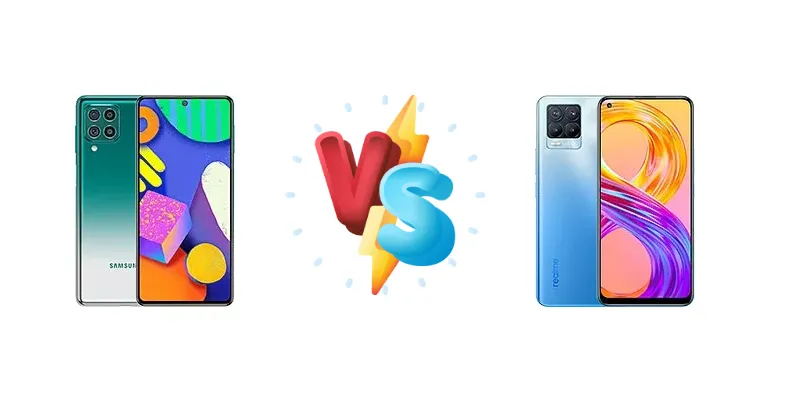
The Samsung Galaxy F62 and Realme 8 Pro represent distinct approaches to the mid-range smartphone market. The F62, leveraging a flagship-class Exynos 9825 chipset, aims for raw power, while the Realme 8 Pro prioritizes a balanced experience with the Snapdragon 720G and a focus on camera capabilities and fast charging. This comparison dissects their strengths and weaknesses to determine which device best suits your needs.
🏆 Quick Verdict
For users prioritizing sustained performance in demanding tasks like gaming and video editing, the Samsung Galaxy F62 offers a clear advantage thanks to its Exynos 9825. However, the Realme 8 Pro counters with significantly faster 50W charging and a more efficient chipset, making it the better choice for everyday users who value battery life and convenience.
| Network |
|---|
| 2G bands | GSM 850 / 900 / 1800 / 1900 | GSM 850 / 900 / 1800 / 1900 |
| 3G bands | HSDPA 850 / 900 / 1700(AWS) / 1900 / 2100 | HSDPA 850 / 900 / 2100 |
| 4G bands | 1, 2, 3, 4, 5, 7, 8, 12, 17, 20, 26, 28, 38, 40, 41, 66 | 1, 3, 5, 7, 8, 20, 28, 38, 40, 41 - International |
| Speed | HSPA, LTE | HSPA, LTE |
| Technology | GSM / HSPA / LTE | GSM / HSPA / LTE |
| | - | 1, 3, 5, 8, 38, 40, 41 - Asia |
| Launch |
|---|
| Announced | 2021, February 15 | 2021, March 24 |
| Status | Available. Released 2021, February 22 | Available. Released 2021, March 25 |
| Body |
|---|
| Build | Glass front, plastic back, plastic frame | Glass front, plastic frame, plastic back |
| Dimensions | 163.9 x 76.3 x 9.5 mm (6.45 x 3.00 x 0.37 in) | 160.6 x 73.9 x 8.1 mm (6.32 x 2.91 x 0.32 in) |
| SIM | Nano-SIM + Nano-SIM | Nano-SIM + Nano-SIM |
| Weight | 218 g (7.69 oz) | 176 g (6.21 oz) |
| Display |
|---|
| Resolution | 1080 x 2400 pixels, 20:9 ratio (~393 ppi density) | 1080 x 2400 pixels, 20:9 ratio (~411 ppi density) |
| Size | 6.7 inches, 108.4 cm2 (~86.7% screen-to-body ratio) | 6.4 inches, 98.9 cm2 (~83.3% screen-to-body ratio) |
| Type | Super AMOLED Plus, 420 nits (peak) | Super AMOLED, 430 nits (typ), 1000 nits (peak) |
| | - | Always-on display |
| Platform |
|---|
| CPU | Octa-core (2x2.73 GHz Exynos M4 & 2x2.40 GHz Cortex-A75 & 4x1.95 GHz Cortex-A55) | Octa-core (2x2.3 GHz Kryo 465 Gold & 6x1.8 GHz Kryo 465 Silver) |
| Chipset | Exynos 9825 (7 nm) | Qualcomm SM7125 Snapdragon 720G (8 nm) |
| GPU | Mali-G76 MP12 | Adreno 618 |
| OS | Android 11, upgradable to Android 13, One UI 5 | Android 11, upgradable to Android 12, Realme UI 3.0 |
| Memory |
|---|
| Card slot | microSDXC (dedicated slot) | microSDXC (dedicated slot) |
| Internal | 128GB 6GB RAM, 128GB 8GB RAM | 128GB 6GB RAM, 128GB 8GB RAM |
| | - | UFS 2.1 |
| Main Camera |
|---|
| Features | LED flash, panorama, HDR | LED flash, HDR, panorama |
| Quad | 64 MP, f/1.8, 26mm (wide), 1/1.73", 0.8µm, PDAF
12 MP, f/2.2, 123˚ (ultrawide)
5 MP (macro)
Auxiliary lens | 108 MP, f/1.9, 26mm (wide), 1/1.52", 0.7µm, PDAF
8 MP, f/2.3, 119˚, 16mm (ultrawide), 1/4.0", 1.12µm
2 MP (macro)
Auxiliary lens |
| Single | 32 MP, f/2.2, 26mm (wide), 1/2.8", 0.8µm | - |
| Video | 4K@30fps, 1080p@30fps | 4K@30fps, 1080p@30/60/120/480fps, 720p@960fps, gyro-EIS |
| Selfie camera |
|---|
| Features | HDR | HDR, panorama |
| Single | 32 MP, f/2.2, 26mm (wide), 1/2.8", 0.8µm | 16 MP, f/2.5, (wide), 1/3.0", 1.0µm |
| Video | 4K@30fps, 1080p@30fps | 1080p@30/120fps, gyro-EIS |
| Sound |
|---|
| 3.5mm jack | Yes | Yes |
| 35mm jack | Yes | Yes |
| Loudspeaker | Yes | Yes |
| | - | 24-bit/192kHz audio |
| Comms |
|---|
| Bluetooth | 5.0, A2DP, LE | 5.0, A2DP, LE |
| NFC | Yes | Yes (market/region dependent) |
| Positioning | GPS, GLONASS, GALILEO, BDS | GPS, GLONASS, BDS |
| Radio | FM radio, recording | No |
| USB | USB Type-C 2.0, OTG | USB Type-C 2.0, OTG |
| WLAN | Wi-Fi 802.11 a/b/g/n/ac, dual-band, Wi-Fi Direct | Wi-Fi 802.11 a/b/g/n/ac, dual-band, Wi-Fi Direct |
| Features |
|---|
| Sensors | Fingerprint (side-mounted), accelerometer, gyro, proximity, compass | Fingerprint (under display, optical), accelerometer, gyro, proximity, compass |
| Battery |
|---|
| Charging | 25W wired
4.5W reverse wired | 50W wired, 50% in 17 min, 100% in 47 min |
| Type | Li-Po 7000 mAh | 4500 mAh |
| Misc |
|---|
| Colors | Laser Green, Laser Gray, Laser Blue | Infinite Blue, Infinite Black, Punk Black, Illuminating Yellow |
| Models | SM-E625F, SM-E625F/DS | RMX3081 |
| Price | About 270 EUR | About 550 EUR |
| SAR | 0.74 W/kg (head) | 1.10 W/kg (head) 0.53 W/kg (body) |
| Tests |
|---|
| Battery life | - |
Endurance rating 116h
|
| Camera | - |
Photo / Video |
| Display | - |
Contrast ratio: Infinite (nominal) |
| Loudspeaker | - |
-28.2 LUFS (Average)
|
| Performance | - |
AnTuTu: 286666 (v8)
GeekBench: 1678 (v5.1)
GFXBench: 16fps (ES 3.1 onscreen) |
Samsung Galaxy F62
- More powerful processor for demanding tasks
- Reverse wireless charging capability
- Potentially better media consumption due to wider color gamut (speculation)
- Slower charging speed
- Potentially higher thermal throttling
- Likely lower battery efficiency
Realme 8 Pro
- Significantly faster charging
- More power-efficient processor
- Likely optimized camera software
- Less powerful processor for intensive tasks
- No reverse wireless charging
- Potentially less refined display
Display Comparison
Both devices share an 'Infinite' contrast ratio, a marketing term indicating a high-quality panel. However, detailed display specs like peak brightness and color gamut coverage are missing. Given the F62's positioning, it likely targets a wider color gamut for media consumption. The Realme 8 Pro's display, while likely good, doesn't have any standout features based on the provided data. The lack of refresh rate information is a significant omission for both.
Camera Comparison
The provided data only states 'Photo / Video' capabilities for both. Without sensor size, aperture, or image processing details, a direct comparison is limited. However, Realme typically focuses heavily on camera marketing, suggesting the 8 Pro may have a more refined camera experience. The absence of information regarding features like OIS or night mode performance makes it difficult to assess the real-world camera differences. The inclusion of a 2MP macro camera on the Realme 8 Pro is likely a marketing tactic with limited practical benefit.
Performance
The core difference lies in the chipsets. The Samsung Galaxy F62’s Exynos 9825 (7nm) boasts a more complex CPU configuration – 2x2.73 GHz Exynos M4 cores, 2x2.40 GHz Cortex-A75, and 4x1.95 GHz Cortex-A55 – compared to the Realme 8 Pro’s Snapdragon 720G (8nm) with 2x2.3 GHz Kryo 465 Gold and 6x1.8 GHz Kryo 465 Silver. The 8nm process of the Snapdragon 720G generally translates to better power efficiency, potentially leading to longer battery life during typical usage. While the Exynos 9825 offers higher peak performance, it may be more prone to thermal throttling under sustained load. The absence of RAM specifications prevents a full assessment, but LPDDR4X is a likely standard for both.
Battery Life
Both phones achieve an endurance rating of 116 hours, suggesting similar real-world battery life under identical usage patterns. However, the charging speeds are drastically different. The Realme 8 Pro’s 50W charging (0-50% in 17 minutes, 100% in 47 minutes) is a significant advantage over the Galaxy F62’s 25W charging. This means the Realme 8 Pro can be topped up much faster, minimizing downtime. The F62 does offer 4.5W reverse wired charging, a feature absent in the Realme 8 Pro, allowing it to charge accessories.
Buying Guide
Buy the Samsung Galaxy F62 if you need a phone capable of handling intensive applications and extended gaming sessions, and are willing to accept potentially shorter battery life. Buy the Realme 8 Pro if you prefer a phone with excellent battery management, rapid charging, and a strong emphasis on camera features for social media and casual photography.
Frequently Asked Questions
❓ Does the Exynos 9825 in the Galaxy F62 overheat during prolonged gaming sessions?
The Exynos 9825 is a powerful chip, but its 7nm process isn't as efficient as the Snapdragon 720G's 8nm process. This means it's more likely to generate heat under sustained load, potentially leading to thermal throttling and reduced performance during extended gaming. While not necessarily a deal-breaker, users should be aware of this possibility.
❓ Is the 2MP macro camera on the Realme 8 Pro actually useful for taking detailed close-up photos?
Generally, 2MP macro cameras on budget and mid-range phones offer limited image quality. The low resolution results in soft, often noisy images. While it can be fun to experiment with, don't expect professional-level macro photography. It's primarily a marketing feature.
❓ Can the Realme 8 Pro handle demanding games like PUBG Mobile at high frame rates (90fps)?
The Snapdragon 720G is capable of running PUBG Mobile, but achieving a consistent 90fps experience will likely require lower graphics settings. The chipset isn't designed for sustained high-frame-rate gaming at maximum settings. The Galaxy F62, with its more powerful processor, has a better chance of maintaining higher frame rates, but thermal throttling could still be a factor.
❓ How does the charging speed difference impact daily use between the two phones?
The Realme 8 Pro's 50W charging is a game-changer. A quick 15-20 minute charge can provide several hours of usage, making it ideal for users who frequently need to top up their battery. The Galaxy F62's 25W charging, while adequate, takes considerably longer to achieve a full charge, requiring more planning around charging times.