
Samsung Galaxy F56 vs Xiaomi Redmi Note 13 Pro 4G: Which Mid-Range Champion Reigns Supreme?
| Phones Images | |||||
|---|---|---|---|---|---|
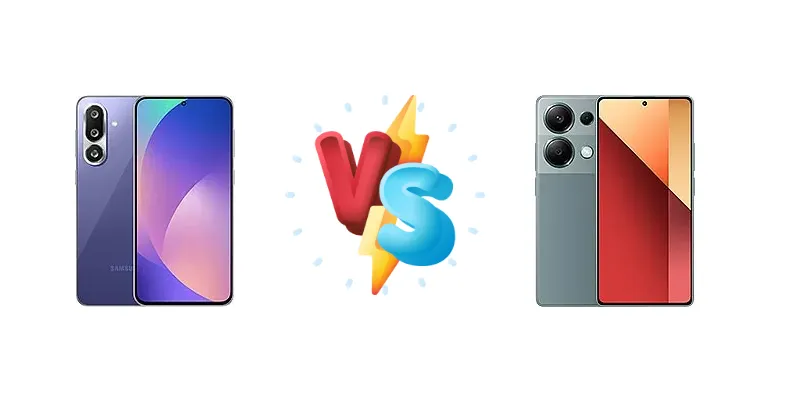
|
🏆 Quick Verdict
For the average user prioritizing sustained performance and future-proofing, the Samsung Galaxy F56 emerges as the winner. Its Exynos 1480, built on a 4nm process, offers a performance edge and potentially better thermal management compared to the Redmi Note 13 Pro 4G’s Helio G99 Ultra. However, the Redmi Note 13 Pro 4G’s significantly faster charging is a strong counterpoint.
| PHONES | ||
|---|---|---|
| Phone Names | Samsung Galaxy F56 | Xiaomi Redmi Note 13 Pro 4G |
| Network | ||
|---|---|---|
| 2G bands | GSM 850 / 900 / 1800 / 1900 | GSM 850 / 900 / 1800 / 1900 |
| 3G bands | HSDPA 850 / 900 / 1700(AWS) / 1900 / 2100 | HSDPA 850 / 900 / 1700(AWS) / 1900 / 2100 |
| 4G bands | 1, 2, 3, 4, 5, 7, 8, 12, 17, 20, 26, 28, 38, 40, 41, 66 | 1, 2, 3, 4, 5, 7, 8, 12, 13, 17, 18, 19, 20, 26, 28, 38, 40, 41, 66 |
| 5G bands | 1, 3, 5, 8, 28, 40, 41, 78 SA/NSA/Sub6 | - |
| Speed | HSPA, LTE, 5G | HSPA, LTE |
| Technology | GSM / HSPA / LTE / 5G | GSM / HSPA / LTE |
| Launch | ||
|---|---|---|
| Announced | 2025, May 07 | 2024, January 15 |
| Status | Available. Released 2025, May 14 | Available. Released 2024, January 15 |
| Body | ||
|---|---|---|
| Build | Glass front (Gorilla Glass Victus+), plastic frame, glass back (Gorilla Glass Victus+) | Glass front (Gorilla Glass 5), plastic frame, plastic back |
| Dimensions | 162 x 77.3 x 7.2 mm (6.38 x 3.04 x 0.28 in) | 161.1 x 75 x 8 mm (6.34 x 2.95 x 0.31 in) |
| SIM | Nano-SIM + Nano-SIM | Nano-SIM + Nano-SIM |
| Weight | 180 g (6.35 oz) | 188 g (6.63 oz) |
| Display | ||
|---|---|---|
| Protection | Corning Gorilla Glass Victus+ | Corning Gorilla Glass 5 |
| Resolution | 1080 x 2340 pixels, 19.5:9 ratio (~382 ppi density) | 1080 x 2400 pixels, 20:9 ratio (~395 ppi density) |
| Size | 6.74 inches, 111.5 cm2 (~89.0% screen-to-body ratio) | 6.67 inches, 107.4 cm2 (~88.9% screen-to-body ratio) |
| Type | Super AMOLED+, 120Hz | AMOLED, 1B colors, 120Hz, 500 nits (typ), 1000 nits (HBM), 1300 nits (peak) |
| Platform | ||
|---|---|---|
| CPU | Octa-core (4x2.75 GHz Cortex-A78 & 4x2.0 GHz Cortex-A55) | Octa-core (2x2.2 GHz Cortex-A76 & 6x2.0 GHz Cortex-A55) |
| Chipset | Exynos 1480 (4 nm) | Mediatek Helio G99 Ultra |
| GPU | Xclipse 530 | Mali-G57 MC2 |
| OS | Android 15, up to 6 major Android upgrades, One UI 7 | Android 13, up to 3 major Android upgrades, HyperOS |
| Memory | ||
|---|---|---|
| Card slot | No | microSDXC (uses shared SIM slot) |
| Internal | 128GB 8GB RAM, 256GB 8GB RAM | 128GB 8GB RAM, 256GB 8GB RAM, 256GB 12GB RAM, 512GB 8GB RAM, 512GB 12GB RAM |
| Main Camera | ||
|---|---|---|
| Features | LED flash, panorama, HDR | LED flash, HDR, panorama |
| Triple | 50 MP, f/1.8, (wide), PDAF, OIS 8 MP, f/2.2, (ultrawide) 2 MP (macro) | 200 MP, f/1.7, 23mm (wide), 1/1.4", 0.56µm, multi-directional PDAF, OIS 8 MP, f/2.2, 15mm, 120˚ (ultrawide), 1/4.4", 1.0µm 2 MP (macro) |
| Video | 4K@30fps, 1080p@30/60fps, gyro-EIS, OIS, 10-bit HDR | 1080p@30/60fps |
| Selfie camera | ||
|---|---|---|
| Features | HDR | - |
| Single | 12 MP, f/2.2, (wide) | 16 MP, f/2.4, (wide), 1/3.0", 1.0µm |
| Video | Yes | 1080p@30/60fps |
| Sound | ||
|---|---|---|
| 35mm jack | No | Yes |
| Loudspeaker | Yes | Yes, with dual speakers |
| Comms | ||
|---|---|---|
| Bluetooth | 5.3, A2DP, LE | 5.2, A2DP, LE |
| Infrared port | - | Yes |
| NFC | No | Yes (market/region dependent) |
| Positioning | GPS, GALILEO, GLONASS, BDS, QZSS | GPS, GLONASS, GALILEO, BDS |
| Radio | No | FM radio |
| USB | USB Type-C 2.0, OTG | USB Type-C 2.0, OTG |
| WLAN | Wi-Fi 802.11 a/b/g/n/ac/6, dual-band, Wi-Fi Direct | Wi-Fi 802.11 a/b/g/n/ac, dual-band |
| Features | ||
|---|---|---|
| Sensors | Fingerprint (under display, optical), accelerometer, gyro, proximity, compass | Fingerprint (under display, optical), accelerometer, gyro, compass |
| Battery | ||
|---|---|---|
| Charging | 45W wired | 67W wired, 50% in 16 min, 100% in 46 min |
| Type | 5000 mAh | 5000 mAh |
| Misc | ||
|---|---|---|
| Colors | Green, Violet | Midnight Black, Lavender Purple, Forest Green |
| Models | SM-E566B, SM-E566B/DS | 23117RA68G, 2312FPCA6G |
| Price | ₹ 23,250 | € 92.00 / $ 269.99 / £ 299.99 |
| SAR | 0.71 W/kg (head) | 1.09 W/kg (head) 1.09 W/kg (body) |
| SAR EU | - | 0.99 W/kg (head) 0.99 W/kg (body) |
Samsung Galaxy F56
- Potentially superior CPU performance with Exynos 1480
- More efficient 4nm manufacturing process
- Likely to offer a smoother long-term experience
- Slower 45W charging compared to the Redmi
- Camera specifications currently unknown
- Battery capacity not specified
Xiaomi Redmi Note 13 Pro 4G
- Exceptional battery life with 11:36h active use
- Ultra-fast 67W charging (50% in 16 min, 100% in 46 min)
- Bright 1047 nit display for outdoor visibility
- Helio G99 Ultra chipset may throttle under sustained load
- CPU performance lags behind the Exynos 1480
- Camera details are limited
Display Comparison
The Redmi Note 13 Pro 4G boasts a notably brighter display, reaching a measured peak of 1047 nits. This translates to superior visibility outdoors under direct sunlight. While the Galaxy F56’s display specifications are currently unknown, Samsung typically employs high-quality AMOLED panels. The Redmi’s brightness advantage is a significant benefit for users who frequently consume content outdoors. We anticipate the F56 will offer vibrant colors, but the Redmi has a clear lead in peak luminance.
Camera Comparison
Both devices feature a camera system, but detailed sensor information is limited for the Galaxy F56. The Redmi Note 13 Pro 4G’s camera capabilities are currently unknown beyond 'Photo / Video'. Without specific sensor sizes, apertures, or OIS details for either phone, a direct comparison is difficult. We can assume the Redmi Note 13 Pro 4G will likely include a high-resolution main sensor, a common trend in this segment, but image quality will depend heavily on image processing algorithms. The absence of details on the F56’s camera makes it difficult to assess its photographic capabilities.
Performance
The Samsung Galaxy F56’s Exynos 1480, fabricated on a 4nm process, represents a significant architectural advantage over the Redmi Note 13 Pro 4G’s Helio G99 Ultra. The 4nm node allows for greater transistor density and improved power efficiency, potentially leading to less thermal throttling during prolonged intensive tasks. The Exynos 1480’s CPU configuration – 4x2.75 GHz Cortex-A78 & 4x2.0 GHz Cortex-A55 – offers a higher peak clock speed on its performance cores compared to the Helio G99 Ultra’s 2x2.2 GHz Cortex-A76 & 6x2.0 GHz Cortex-A55. This suggests the F56 will excel in CPU-bound workloads and gaming. However, real-world performance will depend on software optimization and thermal design.
Battery Life
The Xiaomi Redmi Note 13 Pro 4G shines in the battery and charging department. Its active use score of 11:36h demonstrates excellent endurance. More impressively, it supports 67W wired charging, achieving 50% charge in just 16 minutes and a full charge in 46 minutes. The Samsung Galaxy F56 offers 45W wired charging, which is respectable but significantly slower. While the F56’s battery capacity is unknown, the Redmi’s faster charging mitigates any potential capacity disadvantage, making it ideal for users who need to quickly top up their device.
Buying Guide
Buy the Samsung Galaxy F56 if you need a phone capable of handling demanding applications and games with greater headroom, and value a potentially smoother long-term experience. Buy the Xiaomi Redmi Note 13 Pro 4G if you prioritize extremely fast charging and excellent battery life for everyday tasks, and are less concerned with pushing the phone to its absolute performance limits.