
Samsung Galaxy F56 vs M55s: A Deep Dive into Mid-Range Performance
| Phones Images | |||||
|---|---|---|---|---|---|
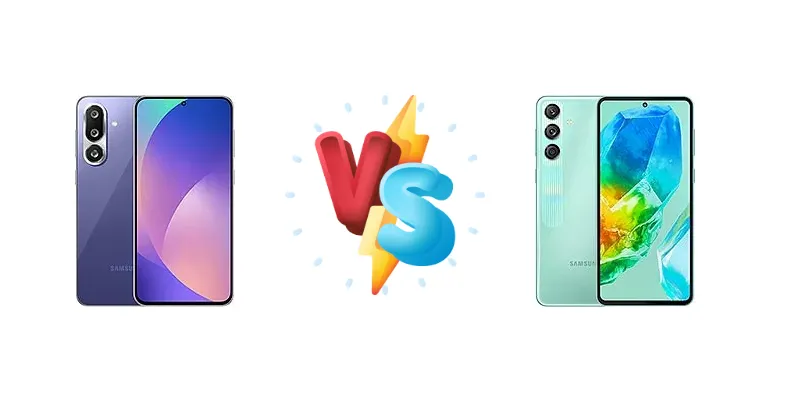
|
🏆 Quick Verdict
For most users, the Samsung Galaxy M55s emerges as the stronger choice. The Snapdragon 7 Gen 1 offers a more consistently powerful CPU performance profile and potentially better thermal management, making it ideal for sustained tasks and gaming. While both charge at 45W, the M55s’ chipset efficiency could translate to slightly better real-world battery endurance.
| PHONES | ||
|---|---|---|
| Phone Names | Samsung Galaxy F56 | Samsung Galaxy M55s |
| Network | ||
|---|---|---|
| 2G bands | GSM 850 / 900 / 1800 / 1900 | GSM 850 / 900 / 1800 / 1900 |
| 3G bands | HSDPA 850 / 900 / 1700(AWS) / 1900 / 2100 | HSDPA 850 / 900 / 1700(AWS) / 1900 / 2100 |
| 4G bands | 1, 2, 3, 4, 5, 7, 8, 12, 17, 20, 26, 28, 38, 40, 41, 66 | 1, 2, 3, 4, 5, 7, 8, 12, 17, 20, 25, 26, 28, 38, 40, 41, 66 |
| 5G bands | 1, 3, 5, 8, 28, 40, 41, 78 SA/NSA/Sub6 | 1, 3, 5, 7, 8, 20, 28, 38, 40, 41, 66, 77, 78 SA/NSA/Sub6 |
| Speed | HSPA, LTE, 5G | HSPA, LTE, 5G |
| Technology | GSM / HSPA / LTE / 5G | GSM / HSPA / LTE / 5G |
| Launch | ||
|---|---|---|
| Announced | 2025, May 07 | 2024, September 24 |
| Status | Available. Released 2025, May 14 | Available. Released 2024, September 26 |
| Body | ||
|---|---|---|
| Build | Glass front (Gorilla Glass Victus+), plastic frame, glass back (Gorilla Glass Victus+) | - |
| Dimensions | 162 x 77.3 x 7.2 mm (6.38 x 3.04 x 0.28 in) | 163.9 x 76.5 x 7.8 mm (6.45 x 3.01 x 0.31 in) |
| SIM | Nano-SIM + Nano-SIM | Nano-SIM + Nano-SIM |
| Weight | 180 g (6.35 oz) | 180 g (6.35 oz) |
| Display | ||
|---|---|---|
| Protection | Corning Gorilla Glass Victus+ | - |
| Resolution | 1080 x 2340 pixels, 19.5:9 ratio (~382 ppi density) | 1080 x 2400 pixels, 20:9 ratio (~393 ppi density) |
| Size | 6.74 inches, 111.5 cm2 (~89.0% screen-to-body ratio) | 6.7 inches, 108.4 cm2 (~86.4% screen-to-body ratio) |
| Type | Super AMOLED+, 120Hz | Super AMOLED+, 120Hz, 1000 nits (HBM) |
| Platform | ||
|---|---|---|
| CPU | Octa-core (4x2.75 GHz Cortex-A78 & 4x2.0 GHz Cortex-A55) | Octa-core (1x2.4 GHz Cortex-A710 & 3x2.36 GHz Cortex-A710 & 4x1.8 GHz Cortex-A510) |
| Chipset | Exynos 1480 (4 nm) | Qualcomm SM7450-AB Snapdragon 7 Gen 1 (4 nm) |
| GPU | Xclipse 530 | Adreno 644 |
| OS | Android 15, up to 6 major Android upgrades, One UI 7 | Android 14, up to 4 major Android upgrades, upgradable to Android 16, One UI 8 |
| Memory | ||
|---|---|---|
| Card slot | No | microSDXC (uses shared SIM slot) |
| Internal | 128GB 8GB RAM, 256GB 8GB RAM | 128GB 8GB RAM, 256GB 8GB RAM |
| Main Camera | ||
|---|---|---|
| Features | LED flash, panorama, HDR | LED flash, panorama, HDR |
| Triple | 50 MP, f/1.8, (wide), PDAF, OIS 8 MP, f/2.2, (ultrawide) 2 MP (macro) | 50 MP, f/1.8, (wide), 1/1.56", 1.0µm, PDAF, OIS 8 MP, f/2.2, 123˚ (ultrawide) 2 MP (macro) |
| Video | 4K@30fps, 1080p@30/60fps, gyro-EIS, OIS, 10-bit HDR | 4K@30fps, 1080p@30/60fps, gyro-EIS, OIS |
| Selfie camera | ||
|---|---|---|
| Features | HDR | - |
| Single | 12 MP, f/2.2, (wide) | 50 MP, f/2.4, (wide) |
| Video | Yes | 4K@30fps, 1080p@30/60fps |
| Sound | ||
|---|---|---|
| 35mm jack | No | No |
| Loudspeaker | Yes | Yes, with stereo speakers |
| Comms | ||
|---|---|---|
| Bluetooth | 5.3, A2DP, LE | 5.2, A2DP, LE |
| NFC | No | Yes |
| Positioning | GPS, GALILEO, GLONASS, BDS, QZSS | GPS, GALILEO, GLONASS, BDS, QZSS |
| Radio | No | No |
| USB | USB Type-C 2.0, OTG | USB Type-C 2.0, OTG |
| WLAN | Wi-Fi 802.11 a/b/g/n/ac/6, dual-band, Wi-Fi Direct | Wi-Fi 802.11 a/b/g/n/ac/6, dual-band, Wi-Fi Direct |
| Features | ||
|---|---|---|
| Sensors | Fingerprint (under display, optical), accelerometer, gyro, proximity, compass | Fingerprint (under display, optical), accelerometer, gyro, proximity, compass |
| Battery | ||
|---|---|---|
| Charging | 45W wired | 45W wired |
| Type | 5000 mAh | 5000 mAh |
| Misc | ||
|---|---|---|
| Colors | Green, Violet | Thunder Black, Coral Green |
| Models | SM-E566B, SM-E566B/DS | SM-M558B, SM-M558B/DS |
| Price | ₹ 23,250 | ₹ 17,799 |
| SAR | 0.71 W/kg (head) | 0.93 W/kg (head) |
Samsung Galaxy F56
- Samsung’s One UI software ecosystem
- Potentially lower price point
- Exynos 1480’s high clock speeds on A78 cores
- Exynos chipsets historically lag in GPU performance
- Potential for thermal throttling under sustained load
Samsung Galaxy M55s
- Snapdragon 7 Gen 1 offers strong CPU and GPU performance
- Qualcomm’s reputation for chipset efficiency
- Potentially better thermal management
- May be slightly more expensive than the F56
- Software updates may be less frequent than flagship models
Display Comparison
Both devices are expected to feature similar AMOLED displays, though specific details like peak brightness and color accuracy are currently unavailable. However, the display isn't a key differentiator here. The focus shifts to internal components. The absence of LTPO technology in either model suggests a standard 60Hz or 120Hz refresh rate, impacting smoothness during scrolling and animations.
Camera Comparison
Without detailed camera specifications, a direct comparison is difficult. However, the chipset’s ISP (Image Signal Processor) plays a crucial role. Qualcomm’s Snapdragon 7 Gen 1 is known for its strong image processing capabilities, potentially resulting in better dynamic range and low-light performance. The F56’s Exynos 1480 ISP is capable, but typically lags behind Qualcomm’s offerings in computational photography. The presence of OIS (Optical Image Stabilization) on the main sensor, if available on both, will be a significant factor in video stabilization and low-light image clarity.
Performance
The core difference lies in the chipsets. The Snapdragon 7 Gen 1 in the M55s utilizes a 1x Cortex-A710 prime core clocked at 2.4 GHz, alongside 3x Cortex-A710 cores at 2.36 GHz, and 4x Cortex-A510 efficiency cores at 1.8 GHz. This contrasts with the F56’s Exynos 1480, featuring 4x Cortex-A78 cores at 2.75 GHz and 4x Cortex-A55 cores at 2.0 GHz. While the Exynos boasts higher clock speeds on its A78 cores, the Snapdragon’s architecture, particularly the inclusion of more A710 cores, suggests superior multi-core performance. The 4nm fabrication process is shared, but Qualcomm’s optimizations often lead to better thermal efficiency, reducing the likelihood of throttling during extended gaming sessions.
Battery Life
Both phones support 45W wired charging, suggesting similar 0-100% charge times – likely around 60-75 minutes. The actual battery life will depend on the battery capacity (currently unknown) and the chipset’s power efficiency. The Snapdragon 7 Gen 1’s optimized architecture gives it an edge in power consumption, potentially translating to longer screen-on time, even with a similar battery capacity to the F56.
Buying Guide
Buy the Samsung Galaxy F56 if you prioritize Samsung’s One UI software experience and are heavily invested in the Samsung ecosystem, potentially benefiting from seamless integration. Buy the Samsung Galaxy M55s if you prioritize raw processing power, especially for gaming and multitasking, and value Qualcomm’s reputation for efficient chipset design and potentially longer software support.