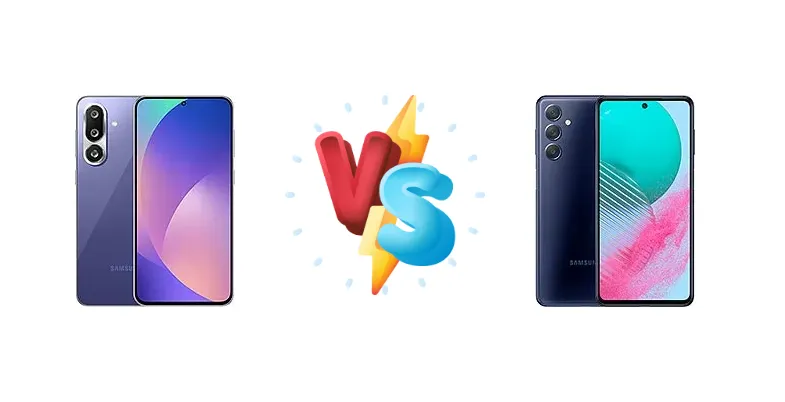
Samsung's mid-range offerings, the Galaxy F56 and Galaxy M54, present a compelling choice for budget-conscious buyers. Both leverage Samsung's Exynos silicon, but with key differences in process node and clock speeds. This comparison dives deep into the implications of the Exynos 1480 in the F56 versus the Exynos 1380 in the M54, focusing on performance, charging, and overall user experience.
🏆 Quick Verdict
For most users, the Samsung Galaxy F56 emerges as the better choice. Its newer Exynos 1480 chipset, built on a 4nm process, delivers a performance edge and potentially better thermal management, complemented by significantly faster 45W charging. While the M54 offers a larger battery, the F56's efficiency and charging speed provide a more convenient experience.
| Network |
|---|
| 2G bands | GSM 850 / 900 / 1800 / 1900 | GSM 850 / 900 / 1800 / 1900 |
| 3G bands | HSDPA 850 / 900 / 1700(AWS) / 1900 / 2100 | HSDPA 850 / 900 / 1700(AWS) / 1900 / 2100 |
| 4G bands | 1, 2, 3, 4, 5, 7, 8, 12, 17, 20, 26, 28, 38, 40, 41, 66 | 1, 2, 3, 4, 5, 7, 8, 12, 17, 20, 26, 28, 38, 40, 41, 66 |
| 5G bands | 1, 3, 5, 8, 28, 40, 41, 78 SA/NSA/Sub6 | 1, 3, 5, 7, 8, 28, 40, 41, 66, 77, 78 SA/NSA/Sub6 |
| Speed | HSPA, LTE, 5G | HSPA, LTE, 5G |
| Technology | GSM / HSPA / LTE / 5G | GSM / HSPA / LTE / 5G |
| Launch |
|---|
| Announced | 2025, May 07 | 2023, March 22 |
| Status | Available. Released 2025, May 14 | Available. Released 2023, April 11 |
| Body |
|---|
| Build | Glass front (Gorilla Glass Victus+), plastic frame, glass back (Gorilla Glass Victus+) | Glass front (Gorilla Glass 5), plastic back, plastic frame |
| Dimensions | 162 x 77.3 x 7.2 mm (6.38 x 3.04 x 0.28 in) | 164.9 x 77.3 x 8.4 mm (6.49 x 3.04 x 0.33 in) |
| SIM | Nano-SIM + Nano-SIM | Nano-SIM + Nano-SIM |
| Weight | 180 g (6.35 oz) | 199 g (7.02 oz) |
| Display |
|---|
| Protection | Corning Gorilla Glass Victus+ | Corning Gorilla Glass 5 |
| Resolution | 1080 x 2340 pixels, 19.5:9 ratio (~382 ppi density) | 1080 x 2400 pixels, 20:9 ratio (~393 ppi density) |
| Size | 6.74 inches, 111.5 cm2 (~89.0% screen-to-body ratio) | 6.7 inches, 108.4 cm2 (~85.0% screen-to-body ratio) |
| Type | Super AMOLED+, 120Hz | Super AMOLED Plus, 120Hz |
| Platform |
|---|
| CPU | Octa-core (4x2.75 GHz Cortex-A78 & 4x2.0 GHz Cortex-A55) | Octa-core (4x2.4 GHz Cortex-A78 & 4x2.0 GHz Cortex-A55) |
| Chipset | Exynos 1480 (4 nm) | Exynos 1380 (5 nm) |
| GPU | Xclipse 530 | Mali-G68 MP5 |
| OS | Android 15, up to 6 major Android upgrades, One UI 7 | Android 13, upgradable to Android 16, One UI 8 |
| Memory |
|---|
| Card slot | No | microSDXC (uses shared SIM slot) |
| Internal | 128GB 8GB RAM, 256GB 8GB RAM | 128GB 8GB RAM, 256GB 8GB RAM |
| Main Camera |
|---|
| Features | LED flash, panorama, HDR | LED flash, panorama, HDR |
| Triple | 50 MP, f/1.8, (wide), PDAF, OIS
8 MP, f/2.2, (ultrawide)
2 MP (macro) | 108 MP, f/1.8, (wide), PDAF, OIS
8 MP, f/2.2, (ultrawide), 1/4.0", 1.12µm
2 MP (macro) |
| Video | 4K@30fps, 1080p@30/60fps, gyro-EIS, OIS, 10-bit HDR | 4K@30fps, 1080p@30/60fps |
| Selfie camera |
|---|
| Features | HDR | - |
| Single | 12 MP, f/2.2, (wide) | 32 MP, f/2.2, 26mm (wide), 1/2.8", 0.8µm |
| Video | Yes | 4K@30fps, 1080p@30fps |
| Sound |
|---|
| 3.5mm jack | - | No |
| 35mm jack | No | No |
| Loudspeaker | Yes | Yes |
| Comms |
|---|
| Bluetooth | 5.3, A2DP, LE | 5.3, A2DP, LE |
| NFC | No | Yes (market/region dependent) |
| Positioning | GPS, GALILEO, GLONASS, BDS, QZSS | GPS, GLONASS, GALILEO, BDS, QZSS, NavIC |
| Radio | No | No |
| USB | USB Type-C 2.0, OTG | USB Type-C 2.0, OTG |
| WLAN | Wi-Fi 802.11 a/b/g/n/ac/6, dual-band, Wi-Fi Direct | Wi-Fi 802.11 a/b/g/n/ac/6, dual-band, Wi-Fi Direct |
| Features |
|---|
| Sensors | Fingerprint (under display, optical), accelerometer, gyro, proximity, compass | Fingerprint (side-mounted), accelerometer, gyro, proximity, compass |
| Battery |
|---|
| Charging | 45W wired | 25W wired |
| Type | 5000 mAh | Li-Po 6000 mAh |
| Misc |
|---|
| Colors | Green, Violet | Dark Blue, Silver |
| Models | SM-E566B, SM-E566B/DS | SM-M546B, SM-M546B/DS |
| Price | ₹ 23,250 | About 190 EUR |
| SAR | 0.71 W/kg (head) | - |
| SAR EU | - | 0.49 W/kg (head) 1.20 W/kg (body) |
Samsung Galaxy F56
- Faster Exynos 1480 chipset for improved performance
- More efficient 4nm process for better battery life
- Significantly faster 45W wired charging
- Potentially smaller battery capacity (unconfirmed)
- May be slightly more expensive than the M54
Samsung Galaxy M54
- Likely larger battery capacity for extended runtime
- Potentially lower price point
- Established reliability of the M-series
- Slower Exynos 1380 chipset
- Less efficient 5nm process
- Slower 25W wired charging
Display Comparison
While display specifications aren't provided, it's reasonable to assume both phones feature AMOLED panels, typical of Samsung's mid-range. However, the chipset differences don't directly impact display quality. The F56's newer processor *could* allow for more efficient display rendering, potentially contributing to slightly improved battery life during video playback. Bezels and color accuracy will likely be similar, falling within the expected range for this price segment.
Camera Comparison
Without specific camera sensor details, a direct comparison is limited. However, the chipset's image signal processor (ISP) plays a crucial role. The Exynos 1480 likely features an improved ISP compared to the 1380, potentially leading to better image processing, noise reduction, and dynamic range. The F56 may also benefit from faster image capture speeds. The presence of a 2MP macro camera on either device is largely inconsequential; focus should be on the main sensor and its capabilities, which are not specified in the provided data.
Performance
The core difference lies in the chipsets. The Galaxy F56's Exynos 1480 (4nm) boasts a slight CPU clock speed advantage (2.75 GHz vs 2.4 GHz on the M54's Exynos 1380). More importantly, the 4nm fabrication process of the 1480 is more efficient than the 5nm process of the 1380. This translates to lower power consumption at similar workloads and potentially less thermal throttling during sustained performance tasks like gaming. Both utilize the same Cortex-A78 and A55 core configuration, meaning architectural differences are minimal; the 1480 simply executes instructions more efficiently.
Battery Life
The M54 likely has a larger battery capacity, a common strategy in the M-series. However, the F56's 45W wired charging is a significant advantage over the M54's 25W. This means the F56 can replenish its battery much faster, reducing downtime. While the M54's larger battery *could* offer longer overall runtime, the F56's more efficient chipset and faster charging may provide a more practical user experience, especially for those who frequently top up their phones throughout the day.
Buying Guide
Buy the Samsung Galaxy F56 if you prioritize performance for gaming and multitasking, and value faster charging speeds to minimize downtime. This phone is ideal for users who frequently use demanding apps or enjoy mobile gaming. Buy the Samsung Galaxy M54 if you prioritize maximizing battery life above all else, and are comfortable with slower charging. This is a solid choice for users who primarily browse, stream, and communicate, and need a phone that can easily last a full day on a single charge.
Frequently Asked Questions
❓ Does the Exynos 1480 in the F56 overheat during prolonged gaming sessions?
The 4nm process of the Exynos 1480 is designed for improved thermal efficiency. While some heat generation is inevitable during gaming, it's less likely to throttle performance as aggressively as the 5nm Exynos 1380 in the M54, especially during extended gameplay. Samsung's software optimizations also play a role in thermal management.
❓ How much faster is the 45W charging on the F56 compared to the 25W charging on the M54?
The 45W charging on the F56 will significantly reduce charging times. While exact 0-100% times aren't available, expect the F56 to charge considerably faster – potentially shaving off 30-60 minutes compared to the M54. This is a major convenience factor for users who need to quickly top up their battery.
❓ Is the difference in chipset performance noticeable in everyday tasks like browsing and social media?
For basic tasks like browsing and social media, the performance difference between the two chipsets will be minimal. However, when launching apps, multitasking, or performing more demanding operations, the F56's Exynos 1480 will provide a smoother and more responsive experience.