
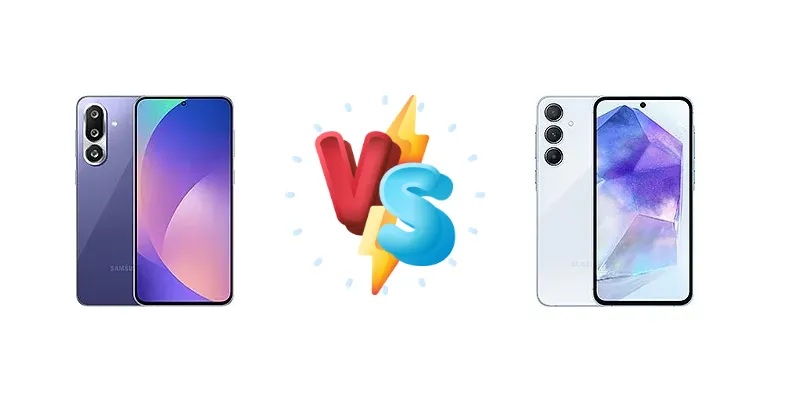
Samsung Galaxy F56 vs. A55: Which Samsung Mid-Ranger Reigns Supreme?
| Phones Images | |||||
|---|---|---|---|---|---|
|
🏆 Quick Verdict
For most users, the Samsung Galaxy A55 emerges as the better choice. While the F56 boasts faster 45W charging, the A55’s significantly longer 13:27h active use battery life and brighter 1010 nit display provide a more consistently positive user experience.
| PHONES | ||
|---|---|---|
| Phone Names | Samsung Galaxy F56 | Samsung Galaxy A55 |
| Network | ||
|---|---|---|
| 2G bands | GSM 850 / 900 / 1800 / 1900 | GSM 850 / 900 / 1800 / 1900 |
| 3G bands | HSDPA 850 / 900 / 1700(AWS) / 1900 / 2100 | HSDPA 850 / 900 / 1700(AWS) / 1900 / 2100 |
| 4G bands | 1, 2, 3, 4, 5, 7, 8, 12, 17, 20, 26, 28, 38, 40, 41, 66 | 1, 2, 3, 4, 5, 7, 8, 12, 17, 20, 25, 26, 28, 32, 38, 40, 41, 66 |
| 5G bands | 1, 3, 5, 8, 28, 40, 41, 78 SA/NSA/Sub6 | 1, 3, 5, 7, 8, 20, 28, 38, 40, 41, 66, 77, 78 SA/NSA/Sub6 |
| Speed | HSPA, LTE, 5G | HSPA, LTE, 5G |
| Technology | GSM / HSPA / LTE / 5G | GSM / HSPA / LTE / 5G |
| Launch | ||
|---|---|---|
| Announced | 2025, May 07 | 2024, March 11 |
| Status | Available. Released 2025, May 14 | Available. Released 2024, March 15 |
| Body | ||
|---|---|---|
| Build | Glass front (Gorilla Glass Victus+), plastic frame, glass back (Gorilla Glass Victus+) | Glass front (Gorilla Glass Victus+), glass back (Gorilla Glass), aluminum frame |
| Dimensions | 162 x 77.3 x 7.2 mm (6.38 x 3.04 x 0.28 in) | 161.1 x 77.4 x 8.2 mm (6.34 x 3.05 x 0.32 in) |
| SIM | Nano-SIM + Nano-SIM | · Nano-SIM· Nano-SIM + eSIM· Nano-SIM + Nano-SIM· Nano-SIM + Nano-SIM + eSIM (max 2 at a time) |
| Weight | 180 g (6.35 oz) | 213 g (7.51 oz) |
| Display | ||
|---|---|---|
| Protection | Corning Gorilla Glass Victus+ | Corning Gorilla Glass Victus+ |
| Resolution | 1080 x 2340 pixels, 19.5:9 ratio (~382 ppi density) | 1080 x 2340 pixels, 19.5:9 ratio (~390 ppi density) |
| Size | 6.74 inches, 111.5 cm2 (~89.0% screen-to-body ratio) | 6.6 inches, 106.9 cm2 (~85.8% screen-to-body ratio) |
| Type | Super AMOLED+, 120Hz | Super AMOLED, 120Hz, HDR10+, 1000 nits (HBM) |
| Platform | ||
|---|---|---|
| CPU | Octa-core (4x2.75 GHz Cortex-A78 & 4x2.0 GHz Cortex-A55) | Octa-core (4x2.75 GHz Cortex-A78 & 4x2.0 GHz Cortex-A55) |
| Chipset | Exynos 1480 (4 nm) | Exynos 1480 (4 nm) |
| GPU | Xclipse 530 | Xclipse 530 |
| OS | Android 15, up to 6 major Android upgrades, One UI 7 | Android 14, up to 4 major Android upgrades, One UI 6.1 |
| Memory | ||
|---|---|---|
| Card slot | No | microSDXC (uses shared SIM slot) |
| Internal | 128GB 8GB RAM, 256GB 8GB RAM | 128GB 6GB RAM, 128GB 8GB RAM, 256GB 6GB RAM, 256GB 8GB RAM, 256GB 12GB RAM |
| Main Camera | ||
|---|---|---|
| Features | LED flash, panorama, HDR | LED flash, panorama, HDR |
| Triple | 50 MP, f/1.8, (wide), PDAF, OIS 8 MP, f/2.2, (ultrawide) 2 MP (macro) | 50 MP, f/1.8, (wide), 1/1.56", 1.0µm, PDAF, OIS 12 MP, f/2.2, 123˚ (ultrawide), 1/3.06", 1.12µm 5 MP (macro) |
| Video | 4K@30fps, 1080p@30/60fps, gyro-EIS, OIS, 10-bit HDR | 4K@30fps, 1080p@30/60fps, gyro-EIS |
| Selfie camera | ||
|---|---|---|
| Features | HDR | - |
| Single | 12 MP, f/2.2, (wide) | 32 MP, f/2.2, 26mm (wide), 1/2.74", 0.8µm |
| Video | Yes | 4K@30fps, 1080p@30/60fps |
| Sound | ||
|---|---|---|
| 35mm jack | No | No |
| Loudspeaker | Yes | Yes, with stereo speakers |
| Comms | ||
|---|---|---|
| Bluetooth | 5.3, A2DP, LE | 5.3, A2DP, LE |
| NFC | No | Yes (market/region dependent) |
| Positioning | GPS, GALILEO, GLONASS, BDS, QZSS | GPS, GALILEO, GLONASS, BDS, QZSS |
| Radio | No | No |
| USB | USB Type-C 2.0, OTG | USB Type-C 2.0, OTG |
| WLAN | Wi-Fi 802.11 a/b/g/n/ac/6, dual-band, Wi-Fi Direct | Wi-Fi 802.11 a/b/g/n/ac/6, dual-band, Wi-Fi Direct |
| Features | ||
|---|---|---|
| Sensors | Fingerprint (under display, optical), accelerometer, gyro, proximity, compass | Fingerprint (under display, optical), accelerometer, gyro, compass |
| Battery | ||
|---|---|---|
| Charging | 45W wired | 25W wired |
| Type | 5000 mAh | Li-Ion 5000 mAh |
| Misc | ||
|---|---|---|
| Colors | Green, Violet | Iceblue, Lilac, Navy, Lemon |
| Models | SM-E566B, SM-E566B/DS | SM-A556V, SM-A556B, SM-A556B/DS, SM-A556E, SM-A556E/DS, SM-A5560 |
| Price | ₹ 23,250 | $ 324.99 / £ 251.50 / € 319.99 / ₹ 23,998 |
| SAR | 0.71 W/kg (head) | - |
| SAR EU | - | 0.68 W/kg (head) 1.04 W/kg (body) |
Samsung Galaxy F56
- Faster 45W wired charging
- Potentially more affordable price point
- Identical CPU performance to A55
- Likely shorter battery life than A55
- Display brightness likely lower than A55
Samsung Galaxy A55
- Superior 13:27h active use battery life
- Brighter 1010 nit display
- Potentially better camera image processing
- Slower 25W wired charging
- May be slightly more expensive than F56
Display Comparison
The Samsung Galaxy A55 features a display capable of reaching 1010 nits of peak brightness, a measured value that significantly enhances outdoor visibility compared to what we'd expect from the F56 (no brightness data provided). While both likely utilize Super AMOLED panels, the A55’s higher peak brightness translates to a more vibrant and readable experience in direct sunlight. The absence of LTPO technology in either model suggests a standard 60/120Hz refresh rate, impacting smoothness but conserving battery. Bezels are expected to be similar, given their shared market positioning.
Camera Comparison
Without detailed camera specifications, a direct comparison is limited. However, given Samsung’s typical approach, the A55 likely benefits from more refined image processing algorithms and potentially a slightly larger primary sensor. The inclusion of a 2MP macro camera on both devices is largely a marketing feature with limited practical utility. Optical Image Stabilization (OIS) is a key differentiator to look for, as it significantly improves low-light photography and video stability. The A55, being positioned slightly higher, is more likely to have a more capable camera system overall.
Performance
Both the Galaxy F56 and A55 are powered by the Exynos 1480 (4nm), featuring an octa-core CPU configuration with 4x2.75 GHz Cortex-A78 and 4x2.0 GHz Cortex-A55 cores. This means CPU performance will be virtually identical in day-to-day tasks and most gaming scenarios. However, the F56 and A55 may differ in RAM configurations and cooling solutions, potentially impacting sustained performance under heavy load. The 4nm process node should provide reasonable thermal efficiency, but prolonged gaming could still lead to some throttling. The GPU performance will also be identical, making graphics-intensive tasks perform similarly on both devices.
Battery Life
The Galaxy A55’s standout feature is its impressive 13:27h active use battery life. This suggests a larger battery capacity and/or more efficient power management compared to the F56. While the F56 compensates with 45W wired charging, allowing for faster top-ups, the A55’s longevity reduces the need for frequent charging. The 25W charging on the A55 is adequate, but the F56’s 45W support will likely result in significantly faster 0-100% charge times. The trade-off is convenience versus endurance.
Buying Guide
Buy the Samsung Galaxy F56 if you prioritize minimizing charging downtime and frequently need to top up your battery throughout the day. Its 45W charging is a clear advantage. Buy the Samsung Galaxy A55 if you value all-day battery life and a brighter, more visible display, especially when using your phone outdoors. The A55’s superior battery performance and screen brightness make it ideal for power users and media consumers.