
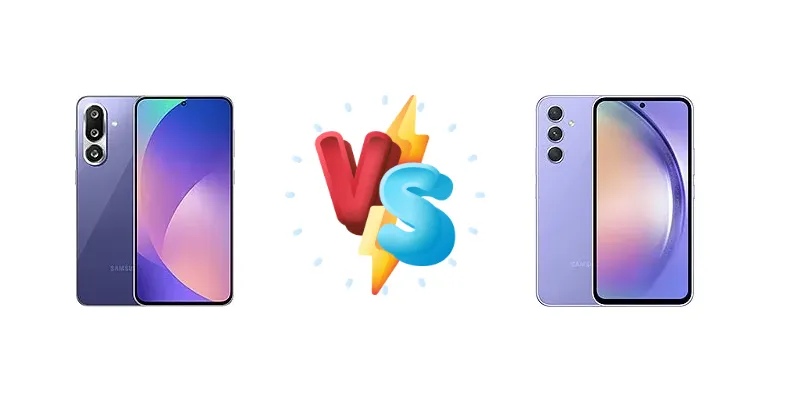
Samsung Galaxy F56 vs A54: Which Samsung Mid-Ranger Reigns Supreme?
| Phones Images | |||||
|---|---|---|---|---|---|
|
🏆 Quick Verdict
For most users, the Samsung Galaxy A54 remains the more sensible choice. Its proven 119-hour endurance rating and 980 nits of brightness offer a more consistently reliable experience. While the F56’s Exynos 1480 offers a slight CPU clock speed bump, the A54’s overall optimization and battery performance are more impactful for daily use.
| PHONES | ||
|---|---|---|
| Phone Names | Samsung Galaxy F56 | Samsung Galaxy A54 |
| Network | ||
|---|---|---|
| 2G bands | GSM 850 / 900 / 1800 / 1900 | GSM 850 / 900 / 1800 / 1900 |
| 3G bands | HSDPA 850 / 900 / 1700(AWS) / 1900 / 2100 | HSDPA 850 / 900 / 1700(AWS) / 1900 / 2100 |
| 4G bands | 1, 2, 3, 4, 5, 7, 8, 12, 17, 20, 26, 28, 38, 40, 41, 66 | 1, 2, 3, 4, 5, 7, 8, 12, 17, 20, 26, 28, 32, 38, 40, 41, 66 - International |
| 5G bands | 1, 3, 5, 8, 28, 40, 41, 78 SA/NSA/Sub6 | 1, 3, 7, 8, 20, 28, 38, 40, 41, 77, 78 SA/NSA/Sub6 - International |
| Speed | HSPA, LTE, 5G | HSPA, LTE, 5G |
| Technology | GSM / HSPA / LTE / 5G | GSM / HSPA / LTE / 5G |
| - | 25, 41, 66, 71 SA/NSA/Sub6/mmWave - USA | |
| Launch | ||
|---|---|---|
| Announced | 2025, May 07 | 2023, March 15 |
| Status | Available. Released 2025, May 14 | Available. Released 2023, March 24 |
| Body | ||
|---|---|---|
| Build | Glass front (Gorilla Glass Victus+), plastic frame, glass back (Gorilla Glass Victus+) | Glass front (Gorilla Glass 5), glass back (Gorilla Glass 5), plastic frame |
| Dimensions | 162 x 77.3 x 7.2 mm (6.38 x 3.04 x 0.28 in) | 158.2 x 76.7 x 8.2 mm (6.23 x 3.02 x 0.32 in) |
| SIM | Nano-SIM + Nano-SIM | · Nano-SIM + eSIM· Nano-SIM + Nano-SIM |
| Weight | 180 g (6.35 oz) | 202 g (7.13 oz) |
| - | IP67 dust/water resistant (up to 1m for 30 min) | |
| Display | ||
|---|---|---|
| Protection | Corning Gorilla Glass Victus+ | Corning Gorilla Glass 5 |
| Resolution | 1080 x 2340 pixels, 19.5:9 ratio (~382 ppi density) | 1080 x 2340 pixels, 19.5:9 ratio (~403 ppi density) |
| Size | 6.74 inches, 111.5 cm2 (~89.0% screen-to-body ratio) | 6.4 inches, 100.5 cm2 (~82.9% screen-to-body ratio) |
| Type | Super AMOLED+, 120Hz | Super AMOLED, 120Hz, HDR10+, 1000 nits (HBM) |
| Platform | ||
|---|---|---|
| CPU | Octa-core (4x2.75 GHz Cortex-A78 & 4x2.0 GHz Cortex-A55) | Octa-core (4x2.4 GHz Cortex-A78 & 4x2.0 GHz Cortex-A55) |
| Chipset | Exynos 1480 (4 nm) | Exynos 1380 (5 nm) |
| GPU | Xclipse 530 | Mali-G68 MP5 |
| OS | Android 15, up to 6 major Android upgrades, One UI 7 | Android 13, up to 4 major Android upgrades, One UI 7 |
| Memory | ||
|---|---|---|
| Card slot | No | microSDXC (uses shared SIM slot) |
| Internal | 128GB 8GB RAM, 256GB 8GB RAM | 128GB 4GB RAM, 128GB 6GB RAM, 128GB 8GB RAM, 256GB 6GB RAM, 256GB 8GB RAM |
| Main Camera | ||
|---|---|---|
| Features | LED flash, panorama, HDR | LED flash, panorama, HDR |
| Single | - | 32 MP, f/2.2, 26mm (wide), 1/2.8", 0.8µm |
| Triple | 50 MP, f/1.8, (wide), PDAF, OIS 8 MP, f/2.2, (ultrawide) 2 MP (macro) | 50 MP, f/1.8, 23mm (wide), 1/1.56", 1.0µm, PDAF, OIS 12 MP, f/2.2, 13mm, 123˚ (ultrawide), 1/3.X", 1.12µm 5 MP (macro) |
| Video | 4K@30fps, 1080p@30/60fps, gyro-EIS, OIS, 10-bit HDR | 4K@30fps, 1080p@30/60fps, 720p@480fps, gyro-EIS |
| Selfie camera | ||
|---|---|---|
| Features | HDR | - |
| Single | 12 MP, f/2.2, (wide) | 32 MP, f/2.2, 26mm (wide), 1/2.8", 0.8µm |
| Video | Yes | 4K@30fps, 1080p@30/60fps |
| Sound | ||
|---|---|---|
| 3.5mm jack | - | No |
| 35mm jack | No | No |
| Loudspeaker | Yes | Yes, with stereo speakers |
| Comms | ||
|---|---|---|
| Bluetooth | 5.3, A2DP, LE | 5.3, A2DP, LE |
| NFC | No | Yes (market/region dependent) |
| Positioning | GPS, GALILEO, GLONASS, BDS, QZSS | GPS, GLONASS, GALILEO, BDS |
| Radio | No | No |
| USB | USB Type-C 2.0, OTG | USB Type-C 2.0, OTG |
| WLAN | Wi-Fi 802.11 a/b/g/n/ac/6, dual-band, Wi-Fi Direct | Wi-Fi 802.11 a/b/g/n/ac/6, dual-band, Wi-Fi Direct |
| Features | ||
|---|---|---|
| Sensors | Fingerprint (under display, optical), accelerometer, gyro, proximity, compass | Fingerprint (under display, optical), accelerometer, gyro, compass, barometer (USA only) |
| - | Virtual proximity sensing | |
| Battery | ||
|---|---|---|
| Charging | 45W wired | 25W wired |
| Type | 5000 mAh | 5000 mAh |
| Misc | ||
|---|---|---|
| Colors | Green, Violet | Lime, Graphite, Violet, White |
| Models | SM-E566B, SM-E566B/DS | SM-A546V, SM-A546U, SM-A546U1, SM-A546B, SM-A546B/DS, SM-A546E, SM-A546E/DS, SM-A5460, SM-A546M, SM-A546M/DS, SM-A546W |
| Price | ₹ 23,250 | € 210.00 / $ 119.11 / £ 169.95 / ₹ 28,999 |
| SAR | 0.71 W/kg (head) | 0.81 W/kg (head) 0.67 W/kg (body) |
| SAR EU | - | 0.69 W/kg (head) 1.34 W/kg (body) |
| Tests | ||
|---|---|---|
| Battery life | - | Endurance rating 119h |
| Camera | - | Photo / Video |
| Display | - | Contrast ratio: Infinite (nominal) |
| Loudspeaker | - | -26.6 LUFS (Good) |
| Performance | - | AnTuTu: 506678 (v9) GeekBench: 2703 (v5.1), 2797 (v6) GFXBench: 25fps (ES 3.1 onscreen) |
Samsung Galaxy F56
- Faster 45W charging for quicker top-ups
- Potentially higher CPU performance with Exynos 1480
- Newer chipset may receive longer software support
- Battery life is currently unknown and could be lower than A54
- Camera specs are currently unknown
- Potential for thermal throttling due to higher clock speeds
Samsung Galaxy A54
- Excellent battery life with 119-hour endurance rating
- Bright 980 nits display for outdoor visibility
- Proven camera performance and image quality
- Slower 25W charging
- Older Exynos 1380 chipset
- May not receive as many future software updates as the F56
Display Comparison
The Samsung Galaxy A54 features a display capable of reaching 980 nits of peak brightness, ensuring excellent visibility even in direct sunlight. While the F56’s display specs are currently unavailable, the A54’s ‘Infinite’ contrast ratio (nominal) suggests a high-quality AMOLED panel. The A54’s brightness advantage is significant for outdoor use, and its established panel quality provides a more predictable viewing experience. Without knowing the F56’s panel technology, it’s difficult to assess potential differences in color accuracy or refresh rate.
Camera Comparison
Both the F56 and A54 are equipped with photo and video capabilities, but detailed sensor information is lacking for the F56. The A54’s camera system is known for its reliable performance and image processing. Without knowing the main sensor resolution or aperture of the F56, it’s difficult to make a direct comparison. It’s reasonable to assume both phones will offer similar software features and shooting modes, but the A54’s established track record provides more confidence in consistent image quality. We'll need to see sample images from the F56 to assess its capabilities.
Performance
The Galaxy F56’s Exynos 1480 (4nm) chipset boasts a slightly higher peak CPU clock speed (2.75 GHz vs 2.4 GHz) compared to the A54’s Exynos 1380 (5nm). However, the 5nm process node used in the 1380 generally translates to better power efficiency and thermal management. This means the A54 is likely to sustain peak performance for longer periods without significant throttling. Both chips utilize the same Cortex-A78 and A55 core configuration, suggesting similar architectural strengths, but the F56’s advantage is likely marginal in real-world scenarios. The F56’s 4nm node *should* improve efficiency, but the A54’s mature software optimization is a strong counterpoint.
Battery Life
The Samsung Galaxy A54 excels in battery life, achieving an impressive endurance rating of 119 hours and 11:15 hours of active use. The F56 offers 45W wired charging, significantly faster than the A54’s 25W charging. While the F56’s battery capacity is unknown, the faster charging speed allows for quicker top-ups. However, the A54’s exceptional endurance means users may not need to charge as frequently, mitigating the benefit of faster charging. The A54’s efficiency, combined with its proven endurance, makes it the clear winner in this category.
Buying Guide
Buy the Samsung Galaxy F56 if you prioritize raw processing power for demanding tasks like video editing or gaming and value the convenience of 45W fast charging. Buy the Samsung Galaxy A54 if you prioritize all-day battery life, a bright and vibrant display, and a well-rounded, consistently reliable experience. The A54 is ideal for users who value longevity and don't need the absolute latest chipset.