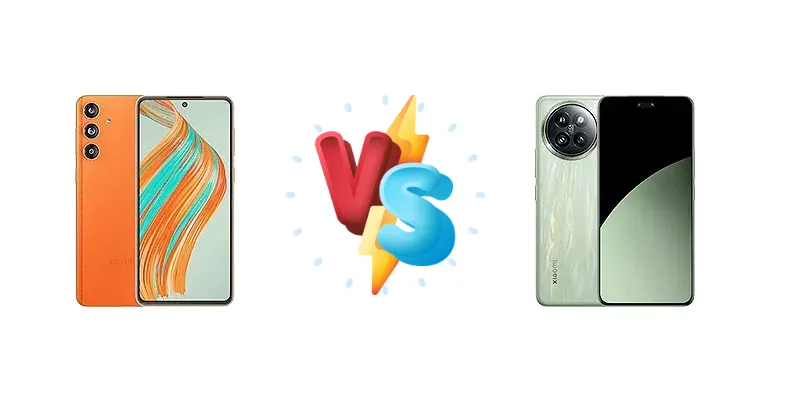
The mid-range smartphone market is fiercely competitive, and the Samsung Galaxy F55 and Xiaomi 14 Civi represent compelling options. The F55 focuses on a balanced experience with Qualcomm’s Snapdragon 7 Gen 1, while the 14 Civi aims for a more premium feel with the Snapdragon 8s Gen 3. This comparison dissects their key differences to determine which device delivers the best value.
🏆 Quick Verdict
For the average user prioritizing sustained performance and faster charging, the Xiaomi 14 Civi emerges as the winner. Its Snapdragon 8s Gen 3 offers a significant performance leap over the F55’s 7 Gen 1, and the 67W charging drastically reduces downtime. However, the F55 remains a strong contender for those seeking a more efficient chipset.
| Network |
|---|
| 2G bands | GSM 850 / 900 / 1800 / 1900 | GSM 850 / 900 / 1800 / 1900 |
| 3G bands | HSDPA 850 / 900 / 1700(AWS) / 1900 / 2100 | HSDPA 800 / 850 / 900 / 1700(AWS) / 1900 / 2100 |
| 4G bands | 1, 2, 3, 4, 5, 7, 8, 12, 17, 20, 25, 26, 28, 38, 40, 41, 66 | 1, 3, 5, 8, 28, 40, 41 |
| 5G bands | 1, 3, 5, 7, 8, 20, 28, 38, 40, 41, 66, 77, 78 SA/NSA/Sub6 | 1, 3, 5, 8, 28, 40, 41, 78 SA/NSA |
| Speed | HSPA, LTE, 5G | HSPA, LTE, 5G |
| Technology | GSM / HSPA / LTE / 5G | GSM / HSPA / LTE / 5G |
| Launch |
|---|
| Announced | 2024, May 17 | 2024, June 12 |
| Status | Available. Released 2024, May 27 | Available. Released 2024, June 20 |
| Body |
|---|
| Build | Glass front, silicone polymer (eco leather) back, plastic frame | Glass front (Gorilla Glass Victus 2), glass back or silicone polymer back (eco leather), aluminum frame |
| Dimensions | 163.9 x 76.5 x 7.8 mm (6.45 x 3.01 x 0.31 in) | 157.2 x 72.8 x 7.5 mm or 7.8 mm |
| SIM | Nano-SIM + Nano-SIM | Nano-SIM + Nano-SIM |
| Weight | 180 g (6.35 oz) | 177.6 g or 179.3 g (6.28 oz) |
| Display |
|---|
| Protection | - | Corning Gorilla Glass Victus 2 |
| Resolution | 1080 x 2400 pixels, 20:9 ratio (~393 ppi density) | 1236 x 2750 pixels, 20:9 ratio (~460 ppi density) |
| Size | 6.7 inches, 108.4 cm2 (~86.4% screen-to-body ratio) | 6.55 inches, 103.5 cm2 (~90.4% screen-to-body ratio) |
| Type | Super AMOLED+, 120Hz, 1000 nits (HBM) | AMOLED, 68B colors, 120Hz, Dolby Vision, HDR10+, 3000 nits (peak) |
| Platform |
|---|
| CPU | Octa-core (1x2.4 GHz Cortex-A710 & 3x2.36 GHz Cortex-A710 & 4x1.8 GHz Cortex-A510) | Octa-core (1x3.0 GHz Cortex-X4 & 4x2.8 GHz Cortex-A720 & 3x2.0 GHz Cortex-A520) |
| Chipset | Qualcomm SM7450-AB Snapdragon 7 Gen 1 (4 nm) | Qualcomm SM8635 Snapdragon 8s Gen 3 (4 nm) |
| GPU | Adreno 644 | Adreno 735 |
| OS | Android 14, upgradable to Android 16, One UI 8 | Android 14, HyperOS |
| Memory |
|---|
| Card slot | microSDXC (uses shared SIM slot) | No |
| Internal | 128GB 8GB RAM, 256GB 8GB RAM, 256GB 12GB RAM | 256GB 8GB RAM, 512GB 12GB RAM |
| Main Camera |
|---|
| Features | LED flash, panorama, HDR | Dual-LED flash, HDR, panorama, Leica lenses |
| Triple | 50 MP, f/1.8, (wide), 1/1.56", 1.0µm, PDAF, OIS
8 MP, f/2.2, 123˚ (ultrawide)
2 MP (macro) | 50 MP, f/1.6, 25mm (wide), 1/1.55", 1.0µm, PDAF, OIS
50 MP, f/2.0, 50mm (telephoto), 0.64µm, PDAF, 2x optical zoom
12 MP, f/2.2, 15mm, 120˚ (ultrawide), 1.12µm |
| Video | 4K@30fps, 1080p@30/60fps, gyro-EIS, OIS | 4K@24/30/60fps, 1080p@30/60/120/240/960fps, 720p@1920fps, gyro-EIS |
| Selfie camera |
|---|
| Dual | - | 32 MP, f/2.0, 26mm (wide), 1/2.8", 0.8µm, AF
32 MP, f/2.4, 100˚ (ultrawide), 1/2.8", 0.8µm |
| Features | - | HDR |
| Single | 50 MP, f/2.4, (wide) | - |
| Video | 4K@30fps, 1080p@30/60fps | 4K@30fps, 1080p@30/60fps; gyro-EIS |
| Sound |
|---|
| 35mm jack | No | No |
| Loudspeaker | Yes, with stereo speakers | Yes, with stereo speakers |
| Comms |
|---|
| Bluetooth | 5.2, A2DP, LE | 5.4, A2DP, LE |
| Infrared port | - | Yes |
| NFC | Yes | Yes |
| Positioning | GPS, GALILEO, GLONASS, BDS, QZSS | GPS, GLONASS, GALILEO, BDS, NavIC |
| Radio | No | No |
| USB | USB Type-C 2.0, OTG | USB Type-C 2.0, OTG |
| WLAN | Wi-Fi 802.11 a/b/g/n/ac/6, dual-band, Wi-Fi Direct | Wi-Fi 802.11 a/b/g/n/ac/6, dual-band, Wi-Fi Direct |
| Features |
|---|
| Sensors | Fingerprint (under display, optical), accelerometer, gyro, proximity, compass | Fingerprint (under display, optical), accelerometer, gyro, proximity, compass |
| Battery |
|---|
| Charging | 45W wired | 67W wired, PD3.0, 100% in 40 minutes |
| Type | 5000 mAh | Li-Po 4700 mAh |
| Misc |
|---|
| Colors | Black, Apricot | Cruise Blue, Matcha Green, Shadow Black |
| Models | SM-E556B/DS, SM-E556B | 24053PY09I |
| Price | ₹ 17,890 | ₹ 26,249 |
| SAR | 0.93 W/kg (head) | 0.93 W/kg (head) 0.81 W/kg (body) |
Samsung Galaxy F55
- Potentially better power efficiency with Snapdragon 7 Gen 1
- Likely more affordable price point
- Samsung's One UI software experience
- Significantly less powerful chipset compared to the 14 Civi
- Slower charging speeds (45W)
- Display likely less bright and vibrant
Xiaomi 14 Civi
- Superior performance with Snapdragon 8s Gen 3
- Faster 67W charging with PD3.0
- Brighter and more vibrant display (1441 nits)
- Potentially higher price
- Snapdragon 8s Gen 3 may run warmer under sustained load
- Xiaomi's MIUI software can be polarizing
Display Comparison
The Xiaomi 14 Civi boasts a significantly brighter display, reaching a measured 1441 nits, compared to the F55 (brightness data unavailable, but expected to be lower based on chipset tier). This brightness advantage translates to superior visibility in direct sunlight. While panel technology details for the F55 are missing, the 14 Civi’s brightness suggests a higher-quality panel. Bezels are likely comparable given the market segment, but the 14 Civi’s brightness is a clear differentiator.
Camera Comparison
Without detailed camera specs for the F55, a direct comparison is limited. However, the Xiaomi 14 Civi is expected to have a more advanced camera system leveraging the ISP capabilities of the Snapdragon 8s Gen 3. The focus should be on the main sensor resolution and aperture. Image processing will likely be more sophisticated on the 14 Civi, resulting in better dynamic range and low-light performance. The presence of OIS (Optical Image Stabilization) on the 14 Civi, if present, would further enhance image quality.
Performance
The core difference lies in the chipsets. The Xiaomi 14 Civi’s Snapdragon 8s Gen 3 (4nm) is a substantial upgrade over the Samsung Galaxy F55’s Snapdragon 7 Gen 1 (4nm). The 8s Gen 3 features a Cortex-X4 prime core clocked at 3.0 GHz, alongside Cortex-A720 performance cores, offering a noticeable boost in CPU and GPU performance. The F55’s A710 cores, while efficient, can’t match the raw power of the 8s Gen 3. This translates to smoother multitasking, faster app loading times, and a better gaming experience on the Xiaomi. The 14 Civi also benefits from potentially faster LPDDR5x RAM, further enhancing performance.
Battery Life
The Xiaomi 14 Civi’s 67W wired charging with PD3.0 support is a significant advantage, achieving a full charge in just 40 minutes. The Samsung Galaxy F55’s 45W charging is slower by comparison. While the F55’s battery capacity is unknown, the 14 Civi’s active use score of 11:36h demonstrates solid battery life. The faster charging of the 14 Civi mitigates any potential battery capacity disadvantage, offering a more convenient user experience.
Buying Guide
Buy the Samsung Galaxy F55 if you need a phone that prioritizes efficient power consumption for all-day use and are less concerned with pushing the absolute limits of gaming performance. Buy the Xiaomi 14 Civi if you prefer a device capable of handling demanding tasks, enjoy faster charging speeds, and value a brighter, more vibrant display for media consumption.
Frequently Asked Questions
❓ Will the Snapdragon 8s Gen 3 in the Xiaomi 14 Civi get noticeably hot during extended gaming sessions?
While the Snapdragon 8s Gen 3 is powerful, it can generate more heat than the Snapdragon 7 Gen 1. Xiaomi likely employs thermal management solutions, but sustained gaming at maximum settings may lead to some throttling to prevent overheating. The F55 will likely remain cooler, but at the cost of performance.
❓ Does the Xiaomi 14 Civi support features like 8K video recording or advanced stabilization modes?
The Snapdragon 8s Gen 3 supports 8K video recording, and the 14 Civi is expected to leverage this capability. Advanced stabilization modes, such as electronic image stabilization (EIS) or optical image stabilization (OIS), are also likely present, enhancing video quality and reducing shake.
❓ How does the software experience differ between Samsung's One UI on the F55 and Xiaomi's MIUI on the 14 Civi?
Samsung's One UI is known for its clean interface and feature-rich customization options. Xiaomi's MIUI, while also customizable, often includes pre-installed apps and a different aesthetic. User preference plays a significant role here; some prefer One UI's simplicity, while others enjoy MIUI's extensive features.