
Samsung Galaxy F55 vs M55s: A Deep Dive into Samsung's Mid-Range Twins
| Phones Images | |||||
|---|---|---|---|---|---|
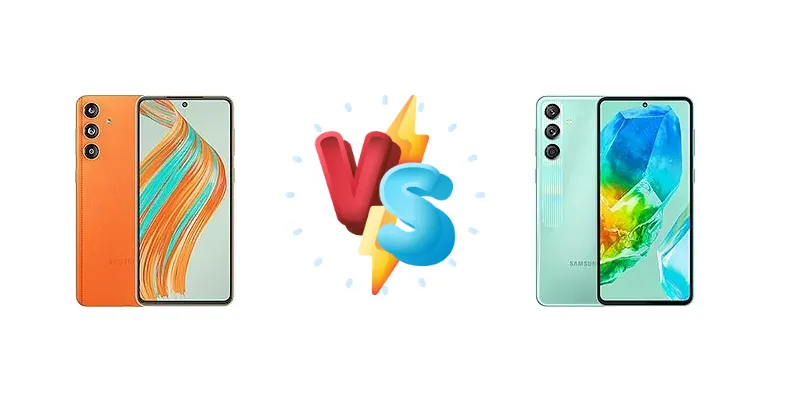
|
🏆 Quick Verdict
For the average user, the Samsung Galaxy M55s emerges as the slightly more compelling option. While both phones offer identical performance thanks to the Snapdragon 7 Gen 1, the M55s's positioning suggests a focus on value, potentially leading to a more competitive price. However, the F55 may offer unique software features or color options depending on the region.
| PHONES | ||
|---|---|---|
| Phone Names | Samsung Galaxy F55 | Samsung Galaxy M55s |
| Network | ||
|---|---|---|
| 2G bands | GSM 850 / 900 / 1800 / 1900 | GSM 850 / 900 / 1800 / 1900 |
| 3G bands | HSDPA 850 / 900 / 1700(AWS) / 1900 / 2100 | HSDPA 850 / 900 / 1700(AWS) / 1900 / 2100 |
| 4G bands | 1, 2, 3, 4, 5, 7, 8, 12, 17, 20, 25, 26, 28, 38, 40, 41, 66 | 1, 2, 3, 4, 5, 7, 8, 12, 17, 20, 25, 26, 28, 38, 40, 41, 66 |
| 5G bands | 1, 3, 5, 7, 8, 20, 28, 38, 40, 41, 66, 77, 78 SA/NSA/Sub6 | 1, 3, 5, 7, 8, 20, 28, 38, 40, 41, 66, 77, 78 SA/NSA/Sub6 |
| Speed | HSPA, LTE, 5G | HSPA, LTE, 5G |
| Technology | GSM / HSPA / LTE / 5G | GSM / HSPA / LTE / 5G |
| Launch | ||
|---|---|---|
| Announced | 2024, May 17 | 2024, September 24 |
| Status | Available. Released 2024, May 27 | Available. Released 2024, September 26 |
| Body | ||
|---|---|---|
| Build | Glass front, silicone polymer (eco leather) back, plastic frame | - |
| Dimensions | 163.9 x 76.5 x 7.8 mm (6.45 x 3.01 x 0.31 in) | 163.9 x 76.5 x 7.8 mm (6.45 x 3.01 x 0.31 in) |
| SIM | Nano-SIM + Nano-SIM | Nano-SIM + Nano-SIM |
| Weight | 180 g (6.35 oz) | 180 g (6.35 oz) |
| Display | ||
|---|---|---|
| Resolution | 1080 x 2400 pixels, 20:9 ratio (~393 ppi density) | 1080 x 2400 pixels, 20:9 ratio (~393 ppi density) |
| Size | 6.7 inches, 108.4 cm2 (~86.4% screen-to-body ratio) | 6.7 inches, 108.4 cm2 (~86.4% screen-to-body ratio) |
| Type | Super AMOLED+, 120Hz, 1000 nits (HBM) | Super AMOLED+, 120Hz, 1000 nits (HBM) |
| Platform | ||
|---|---|---|
| CPU | Octa-core (1x2.4 GHz Cortex-A710 & 3x2.36 GHz Cortex-A710 & 4x1.8 GHz Cortex-A510) | Octa-core (1x2.4 GHz Cortex-A710 & 3x2.36 GHz Cortex-A710 & 4x1.8 GHz Cortex-A510) |
| Chipset | Qualcomm SM7450-AB Snapdragon 7 Gen 1 (4 nm) | Qualcomm SM7450-AB Snapdragon 7 Gen 1 (4 nm) |
| GPU | Adreno 644 | Adreno 644 |
| OS | Android 14, upgradable to Android 16, One UI 8 | Android 14, up to 4 major Android upgrades, upgradable to Android 16, One UI 8 |
| Memory | ||
|---|---|---|
| Card slot | microSDXC (uses shared SIM slot) | microSDXC (uses shared SIM slot) |
| Internal | 128GB 8GB RAM, 256GB 8GB RAM, 256GB 12GB RAM | 128GB 8GB RAM, 256GB 8GB RAM |
| Main Camera | ||
|---|---|---|
| Features | LED flash, panorama, HDR | LED flash, panorama, HDR |
| Triple | 50 MP, f/1.8, (wide), 1/1.56", 1.0µm, PDAF, OIS 8 MP, f/2.2, 123˚ (ultrawide) 2 MP (macro) | 50 MP, f/1.8, (wide), 1/1.56", 1.0µm, PDAF, OIS 8 MP, f/2.2, 123˚ (ultrawide) 2 MP (macro) |
| Video | 4K@30fps, 1080p@30/60fps, gyro-EIS, OIS | 4K@30fps, 1080p@30/60fps, gyro-EIS, OIS |
| Selfie camera | ||
|---|---|---|
| Single | 50 MP, f/2.4, (wide) | 50 MP, f/2.4, (wide) |
| Video | 4K@30fps, 1080p@30/60fps | 4K@30fps, 1080p@30/60fps |
| Sound | ||
|---|---|---|
| 35mm jack | No | No |
| Loudspeaker | Yes, with stereo speakers | Yes, with stereo speakers |
| Comms | ||
|---|---|---|
| Bluetooth | 5.2, A2DP, LE | 5.2, A2DP, LE |
| NFC | Yes | Yes |
| Positioning | GPS, GALILEO, GLONASS, BDS, QZSS | GPS, GALILEO, GLONASS, BDS, QZSS |
| Radio | No | No |
| USB | USB Type-C 2.0, OTG | USB Type-C 2.0, OTG |
| WLAN | Wi-Fi 802.11 a/b/g/n/ac/6, dual-band, Wi-Fi Direct | Wi-Fi 802.11 a/b/g/n/ac/6, dual-band, Wi-Fi Direct |
| Features | ||
|---|---|---|
| Sensors | Fingerprint (under display, optical), accelerometer, gyro, proximity, compass | Fingerprint (under display, optical), accelerometer, gyro, proximity, compass |
| Battery | ||
|---|---|---|
| Charging | 45W wired | 45W wired |
| Type | 5000 mAh | 5000 mAh |
| Misc | ||
|---|---|---|
| Colors | Black, Apricot | Thunder Black, Coral Green |
| Models | SM-E556B/DS, SM-E556B | SM-M558B, SM-M558B/DS |
| Price | ₹ 17,890 | ₹ 17,799 |
| SAR | 0.93 W/kg (head) | 0.93 W/kg (head) |
Samsung Galaxy F55
- Potential for exclusive software features
- May offer unique color options
- Identical Snapdragon 7 Gen 1 performance
- Potentially higher price point
- No confirmed advantages over M55s
Samsung Galaxy M55s
- Likely better value for money
- Identical Snapdragon 7 Gen 1 performance
- 45W fast charging
- May lack exclusive software features
- Potentially fewer color options
Display Comparison
Both the Galaxy F55 and M55s are expected to feature Super AMOLED displays, though specific details like peak brightness (in nits) and color gamut coverage are currently unavailable. Given their mid-range positioning, we anticipate a 120Hz refresh rate on both models. The absence of LTPO technology suggests that the refresh rate will likely switch between 60Hz and 120Hz rather than dynamically scaling to conserve battery. Bezels are expected to be relatively consistent across both devices, typical for this price segment. Color accuracy will likely be tuned for vibrant, Samsung-typical visuals.
Camera Comparison
Without specific camera sensor details, it's difficult to definitively declare a winner. However, given Samsung's typical strategy, the M55s might feature a slightly more aggressive camera configuration to attract budget-conscious buyers. Both phones will likely include a primary camera, ultrawide, and macro lens. The quality of the image processing algorithms will be a key differentiator, and Samsung's software enhancements could minimize differences in image quality. We anticipate both phones will support 4K video recording at 30fps. The absence of information regarding OIS (Optical Image Stabilization) suggests it may not be present, or limited to the main sensor.
Performance
The core of both devices is the Qualcomm SM7450-AB Snapdragon 7 Gen 1 (4nm). This chipset features an octa-core CPU configuration – 1x2.4 GHz Cortex-A710, 3x2.36 GHz Cortex-A710, and 4x1.8 GHz Cortex-A510. This means CPU performance will be virtually identical between the F55 and M55s. The 4nm process node is crucial, offering a good balance between performance and thermal efficiency, minimizing throttling during sustained workloads like gaming. RAM configuration (likely 6GB or 8GB LPDDR5x) will also play a role, but is expected to be similar. The GPU performance will also be identical, capable of handling most mobile games at medium to high settings.
Battery Life
Both the Galaxy F55 and M55s support 45W wired charging. This is a significant advantage over slower charging standards, allowing for a relatively quick 0-100% charge time (estimated around 60-75 minutes). While battery capacity isn't specified, the M55s, being positioned as a value-oriented device, might have a slightly larger battery to compensate for any potential differences in display efficiency. The 45W charging speed, combined with the efficient Snapdragon 7 Gen 1, should provide all-day battery life for moderate users on both devices.
Buying Guide
Buy the Samsung Galaxy F55 if you prioritize potential exclusive software features or color options offered in your region, and are willing to potentially pay a slight premium. Buy the Samsung Galaxy M55s if you are a value-conscious buyer seeking the best possible performance-to-price ratio, and are less concerned with minor feature differences or regional exclusives.