
Samsung Galaxy F55 vs OnePlus Nord 4: A Deep Dive into Mid-Range Power
| Phones Images | |||||
|---|---|---|---|---|---|
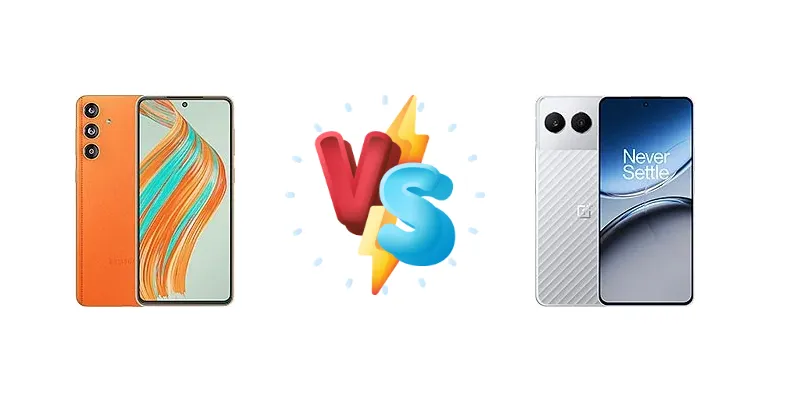
|
🏆 Quick Verdict
For most users, the OnePlus Nord 4 emerges as the stronger contender. Its Snapdragon 7+ Gen 3 chipset delivers noticeably faster performance, complemented by blazing-fast 100W charging and a brighter display. While the Galaxy F55 offers a respectable experience, the Nord 4 provides a more future-proof and responsive user experience.
| PHONES | ||
|---|---|---|
| Phone Names | Samsung Galaxy F55 | OnePlus Nord 4 |
| Network | ||
|---|---|---|
| 2G bands | GSM 850 / 900 / 1800 / 1900 | GSM 850 / 900 / 1800 / 1900 |
| 3G bands | HSDPA 850 / 900 / 1700(AWS) / 1900 / 2100 | HSDPA 800 / 850 / 900 / 1700(AWS) / 1800 / 1900 / 2100 - International |
| 4G bands | 1, 2, 3, 4, 5, 7, 8, 12, 17, 20, 25, 26, 28, 38, 40, 41, 66 | 1, 2, 3, 4, 5, 7, 8, 12, 17, 18, 19, 20, 26, 28, 38, 39, 40, 41, 66 - International |
| 5G bands | 1, 3, 5, 7, 8, 20, 28, 38, 40, 41, 66, 77, 78 SA/NSA/Sub6 | 1, 2, 3, 5, 7, 8, 12, 20, 28, 38, 40, 41, 66, 77, 78 SA/NSA - International |
| Speed | HSPA, LTE, 5G | HSPA, LTE, 5G |
| Technology | GSM / HSPA / LTE / 5G | GSM / HSPA / LTE / 5G |
| Launch | ||
|---|---|---|
| Announced | 2024, May 17 | 2024, July 16 |
| Status | Available. Released 2024, May 27 | Available. Released 2024, August 08 |
| Body | ||
|---|---|---|
| Build | Glass front, silicone polymer (eco leather) back, plastic frame | Glass front, aluminum back, aluminum frame |
| Dimensions | 163.9 x 76.5 x 7.8 mm (6.45 x 3.01 x 0.31 in) | 162.6 x 75 x 8 mm (6.40 x 2.95 x 0.31 in) |
| SIM | Nano-SIM + Nano-SIM | Nano-SIM + Nano-SIM |
| Weight | 180 g (6.35 oz) | 199.5 g (7.05 oz) |
| Display | ||
|---|---|---|
| Resolution | 1080 x 2400 pixels, 20:9 ratio (~393 ppi density) | 1240 x 2772 pixels, 20:9 ratio (~450 ppi density) |
| Size | 6.7 inches, 108.4 cm2 (~86.4% screen-to-body ratio) | 6.74 inches, 109.7 cm2 (~90.0% screen-to-body ratio) |
| Type | Super AMOLED+, 120Hz, 1000 nits (HBM) | Fluid AMOLED, 1B colors, 120Hz, HDR10+, 2150 nits (peak) |
| Platform | ||
|---|---|---|
| CPU | Octa-core (1x2.4 GHz Cortex-A710 & 3x2.36 GHz Cortex-A710 & 4x1.8 GHz Cortex-A510) | Octa-core (1x2.8 GHz Cortex-X4 & 4x2.6 GHz Cortex-A720 & 3x1.9 GHz Cortex-A520) |
| Chipset | Qualcomm SM7450-AB Snapdragon 7 Gen 1 (4 nm) | Qualcomm SM7675 Snapdragon 7+ Gen 3 (4 nm) |
| GPU | Adreno 644 | Adreno 732 |
| OS | Android 14, upgradable to Android 16, One UI 8 | Android 14, up to 4 major Android upgrades, OxygenOS 15 |
| Memory | ||
|---|---|---|
| Card slot | microSDXC (uses shared SIM slot) | No |
| Internal | 128GB 8GB RAM, 256GB 8GB RAM, 256GB 12GB RAM | 128GB 8GB RAM, 256GB 8GB RAM, 256GB 12GB RAM, 512GB 16GB RAM |
| Main Camera | ||
|---|---|---|
| Dual | - | 50 MP, f/1.8, 25mm (wide), 1/1.95", 0.8µm, PDAF, OIS 8 MP, f/2.2, 112˚ (ultrawide), 1/4.0", 1.12µm |
| Features | LED flash, panorama, HDR | Dual-LED flash, HDR, panorama |
| Triple | 50 MP, f/1.8, (wide), 1/1.56", 1.0µm, PDAF, OIS 8 MP, f/2.2, 123˚ (ultrawide) 2 MP (macro) | - |
| Video | 4K@30fps, 1080p@30/60fps, gyro-EIS, OIS | 4K@30/60fps, 1080p@30/60/120fps, gyro-EIS |
| Selfie camera | ||
|---|---|---|
| Features | - | Panorama |
| Single | 50 MP, f/2.4, (wide) | 16 MP, f/2.4, 24mm (wide), 1.0µm |
| Video | 4K@30fps, 1080p@30/60fps | 1080p@30fps |
| Sound | ||
|---|---|---|
| 35mm jack | No | No |
| Loudspeaker | Yes, with stereo speakers | Yes, with stereo speakers |
| Comms | ||
|---|---|---|
| Bluetooth | 5.2, A2DP, LE | 5.4, A2DP, LE, aptX HD, LHDC |
| Infrared port | - | Yes |
| NFC | Yes | Yes |
| Positioning | GPS, GALILEO, GLONASS, BDS, QZSS | GPS, GALILEO, GLONASS, BDS, QZSS |
| Radio | No | No |
| USB | USB Type-C 2.0, OTG | USB Type-C 2.0 |
| WLAN | Wi-Fi 802.11 a/b/g/n/ac/6, dual-band, Wi-Fi Direct | Wi-Fi 802.11 a/b/g/n/ac/6, dual-band, Wi-Fi Direct |
| Features | ||
|---|---|---|
| Sensors | Fingerprint (under display, optical), accelerometer, gyro, proximity, compass | Fingerprint (under display, optical), accelerometer, gyro, proximity, compass |
| Battery | ||
|---|---|---|
| Charging | 45W wired | 100W wired, PPS, 100% in 28 min |
| Type | 5000 mAh | 5500 mAh |
| Misc | ||
|---|---|---|
| Colors | Black, Apricot | Obsidian Midnight, Mercurial Silver, Oasis Green |
| Models | SM-E556B/DS, SM-E556B | CPH2663, CPH2661 |
| Price | ₹ 17,890 | € 410.27 / £ 423.17 |
| SAR | 0.93 W/kg (head) | 1.18 W/kg (head) 1.06 W/kg (body) |
Samsung Galaxy F55
- Potentially lower price point
- Familiar Samsung One UI experience
- Reliable brand reputation
- Less powerful Snapdragon 7 Gen 1 chipset
- Slower 45W charging
- Likely lower display brightness
OnePlus Nord 4
- Significantly faster Snapdragon 7+ Gen 3 chipset
- Blazing-fast 100W charging with PPS
- Brighter 1163 nit display
- OxygenOS may not appeal to all users
- Potentially higher price point
- OnePlus’s software update history is less consistent than Samsung’s
Display Comparison
The OnePlus Nord 4 boasts a significantly brighter display, reaching a measured peak of 1163 nits, compared to an unspecified brightness for the Galaxy F55. This higher peak brightness translates to better visibility under direct sunlight. While both likely utilize AMOLED panels, the Nord 4’s superior brightness is a clear advantage. We expect both to offer vibrant colors, but the Nord 4’s panel is likely to be more power efficient at lower brightness levels due to its higher peak output capability. Bezels are expected to be similar, given the market segment, but the Nord 4’s display is the clear winner in terms of raw performance.
Camera Comparison
Without detailed camera specs for the Galaxy F55, a direct comparison is limited. However, given the price point, both phones likely feature a primary sensor around the 50MP mark. The OnePlus Nord 4’s image processing, powered by the Snapdragon 7+ Gen 3’s ISP, is expected to deliver superior dynamic range and detail. The F55 will likely rely on Samsung’s software optimizations, but the Nord 4’s chipset provides a more powerful foundation for computational photography. We anticipate both phones will include ultra-wide and potentially macro lenses, but the quality of these secondary sensors is often limited in this price range.
Performance
The core difference lies in the chipsets: the Samsung Galaxy F55 utilizes the Qualcomm SM7450-AB Snapdragon 7 Gen 1, while the OnePlus Nord 4 features the newer SM7675 Snapdragon 7+ Gen 3. The 7+ Gen 3’s Cortex-X4 prime core (2.8 GHz) represents a substantial architectural upgrade over the F55’s Cortex-A710 (2.4 GHz). The Nord 4’s CPU also benefits from faster Cortex-A720 performance cores (2.6 GHz vs 2.36 GHz on the F55). This translates to a noticeable performance uplift in CPU-intensive tasks and gaming. The 7+ Gen 3 also features an improved GPU, further widening the performance gap. While both phones use a 4nm process, the architectural improvements in the 7+ Gen 3 provide a significant advantage.
Battery Life
The OnePlus Nord 4’s 100W wired charging is a game-changer, achieving a full charge in just 28 minutes. This is a significant advantage over the Galaxy F55’s 45W charging. While the F55’s battery capacity is unknown, the Nord 4’s active use score of 14:41h demonstrates excellent battery life. The faster charging speed of the Nord 4 mitigates any potential concerns about battery capacity, allowing for quick top-ups throughout the day. The inclusion of PPS (Power Delivery System) in the Nord 4 further optimizes charging efficiency and safety.
Buying Guide
Buy the Samsung Galaxy F55 if you prioritize a familiar Samsung One UI experience and are on a tighter budget, accepting a slight performance compromise. Buy the OnePlus Nord 4 if you value raw processing power for gaming and demanding apps, coupled with significantly faster charging speeds and a brighter, more vibrant display. The Nord 4 is the better choice for users who want a phone that will remain responsive for years to come.