
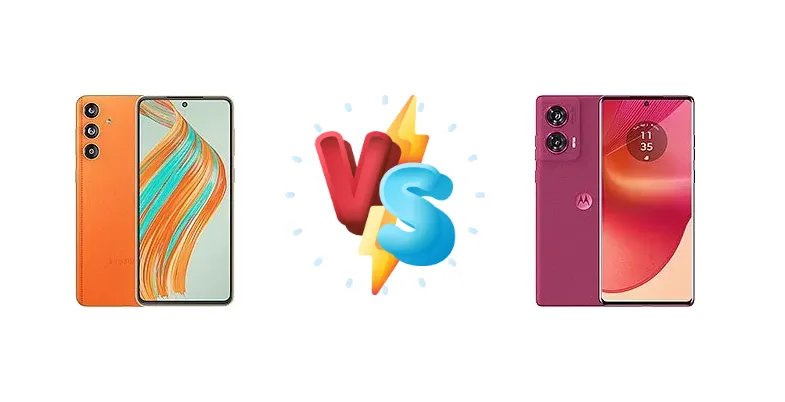
Samsung Galaxy F55 vs Motorola Edge 50 Fusion: A Deep Dive into Mid-Range Power
| Phones Images | |||||
|---|---|---|---|---|---|
|
🏆 Quick Verdict
For most users, the Motorola Edge 50 Fusion emerges as the stronger choice. Its significantly faster 68W charging, coupled with a respectable 12:40h active use battery life, provides a more convenient user experience. While the F55's Snapdragon 7 Gen 1 is capable, the Fusion's charging speed and potentially more efficient chipset (depending on region) give it an edge.
| PHONES | ||
|---|---|---|
| Phone Names | Samsung Galaxy F55 | Motorola Edge 50 Fusion |
| Network | ||
|---|---|---|
| 2G bands | GSM 850 / 900 / 1800 / 1900 | GSM 850 / 900 / 1800 / 1900 |
| 3G bands | HSDPA 850 / 900 / 1700(AWS) / 1900 / 2100 | HSDPA 850 / 900 / 1900 / 2100 |
| 4G bands | 1, 2, 3, 4, 5, 7, 8, 12, 17, 20, 25, 26, 28, 38, 40, 41, 66 | 1, 2, 3, 5, 7, 8, 18, 19, 20, 26, 28, 32, 38, 40, 41, 42, 71 - International |
| 5G bands | 1, 3, 5, 7, 8, 20, 28, 38, 40, 41, 66, 77, 78 SA/NSA/Sub6 | 1, 3, 5, 7, 8, 20, 26, 28, 38, 40, 41, 77, 78 SA/NSA |
| Speed | HSPA, LTE, 5G | HSPA, LTE, 5G |
| Technology | GSM / HSPA / LTE / 5G | GSM / HSPA / LTE / 5G |
| Launch | ||
|---|---|---|
| Announced | 2024, May 17 | 2024, April 16 |
| Status | Available. Released 2024, May 27 | Available. Released 2024, May 15 |
| Body | ||
|---|---|---|
| Build | Glass front, silicone polymer (eco leather) back, plastic frame | Glass front, silicone polymer back (eco leather), plastic frame |
| Dimensions | 163.9 x 76.5 x 7.8 mm (6.45 x 3.01 x 0.31 in) | 161.9 x 73.1 x 7.9 mm (6.37 x 2.88 x 0.31 in) |
| SIM | Nano-SIM + Nano-SIM | · Nano-SIM + eSIM· Nano-SIM + Nano-SIM |
| Weight | 180 g (6.35 oz) | 174.9 g (6.17 oz) |
| Display | ||
|---|---|---|
| Protection | - | Corning Gorilla Glass 5 |
| Resolution | 1080 x 2400 pixels, 20:9 ratio (~393 ppi density) | 1080 x 2400 pixels, 20:9 ratio (~393 ppi density) |
| Size | 6.7 inches, 108.4 cm2 (~86.4% screen-to-body ratio) | 6.7 inches, 108.4 cm2 (~91.6% screen-to-body ratio) |
| Type | Super AMOLED+, 120Hz, 1000 nits (HBM) | P-OLED, 1B colors, 120Hz (LATAM), 144Hz (INT), 1600 nits (peak) |
| Platform | ||
|---|---|---|
| CPU | Octa-core (1x2.4 GHz Cortex-A710 & 3x2.36 GHz Cortex-A710 & 4x1.8 GHz Cortex-A510) | Octa-core (4x2.40 GHz Cortex-A78 & 4x1.95 GHz Cortex-A55) - InternationalOcta-core (4x2.2 GHz Cortex-A78 & 4x1.8 GHz Cortex-A55) - LATAM |
| Chipset | Qualcomm SM7450-AB Snapdragon 7 Gen 1 (4 nm) | Qualcomm SM7435-AB Snapdragon 7s Gen 2 (4 nm) - InternationalQualcomm SM6450 Snapdragon 6 Gen 1 (4 nm) - LATAM |
| GPU | Adreno 644 | Adreno 710 |
| OS | Android 14, upgradable to Android 16, One UI 8 | Android 14, upgradable to Android 15, up to 3 major Android upgrades |
| Memory | ||
|---|---|---|
| Card slot | microSDXC (uses shared SIM slot) | No |
| Internal | 128GB 8GB RAM, 256GB 8GB RAM, 256GB 12GB RAM | 128GB 8GB RAM, 256GB 8GB RAM, 256GB 12GB RAM, 512GB 8GB RAM, 512GB 12GB RAM |
| Main Camera | ||
|---|---|---|
| Dual | - | 50 MP, f/1.9, (wide), 1/1.56", 1.0µm, multi-directional PDAF, OIS 13 MP, f/2.2, 120˚ (ultrawide), 1/3.0", 1.12µm, AF |
| Features | LED flash, panorama, HDR | LED flash, HDR, panorama |
| Triple | 50 MP, f/1.8, (wide), 1/1.56", 1.0µm, PDAF, OIS 8 MP, f/2.2, 123˚ (ultrawide) 2 MP (macro) | - |
| Video | 4K@30fps, 1080p@30/60fps, gyro-EIS, OIS | 4K@30fps, 1080p@30/60/120fps, gyro-EIS |
| Selfie camera | ||
|---|---|---|
| Features | - | HDR |
| Single | 50 MP, f/2.4, (wide) | 32 MP, f/2.5, (wide), 1/3.14", 0.7µm |
| Video | 4K@30fps, 1080p@30/60fps | 4K@30fps, 1080p@30fps |
| Sound | ||
|---|---|---|
| 35mm jack | No | No |
| Loudspeaker | Yes, with stereo speakers | Yes, with stereo speakers |
| Comms | ||
|---|---|---|
| Bluetooth | 5.2, A2DP, LE | 5.2, A2DP, LE |
| NFC | Yes | Yes |
| Positioning | GPS, GALILEO, GLONASS, BDS, QZSS | GPS, GLONASS, GALILEO |
| Radio | No | No |
| USB | USB Type-C 2.0, OTG | USB Type-C 2.0, OTG |
| WLAN | Wi-Fi 802.11 a/b/g/n/ac/6, dual-band, Wi-Fi Direct | Wi-Fi 802.11 a/b/g/n/ac, dual-band |
| Features | ||
|---|---|---|
| Sensors | Fingerprint (under display, optical), accelerometer, gyro, proximity, compass | Fingerprint (under display, optical), accelerometer, gyro, proximity, compass |
| Battery | ||
|---|---|---|
| Charging | 45W wired | 68W wired, 50% in 15 min |
| Type | 5000 mAh | 5000 mAh |
| Misc | ||
|---|---|---|
| Colors | Black, Apricot | Forest Blue, Marshmallow Blue, Hot Pink |
| Models | SM-E556B/DS, SM-E556B | XT2429-1 |
| Price | ₹ 17,890 | € 208.99 / $ 245.00 / ₹ 18,667 |
| SAR | 0.93 W/kg (head) | - |
Samsung Galaxy F55
- Proven Snapdragon 7 Gen 1 chipset architecture
- Potentially strong multitasking performance due to core count
- Samsung brand recognition and ecosystem
- Slower 45W charging
- Unknown display brightness and panel technology
- Potentially less efficient chipset compared to Snapdragon 7s Gen 2
Motorola Edge 50 Fusion
- Significantly faster 68W charging
- Brighter 1322 nits display
- More efficient Snapdragon 7s Gen 2 chipset (International version)
- LATAM version uses less powerful Snapdragon 6 Gen 1
- Motorola’s software update track record is less consistent than Samsung’s
- Potentially less brand recognition than Samsung
Display Comparison
The Motorola Edge 50 Fusion boasts a notably brighter display, reaching a measured 1322 nits, which translates to superior visibility in direct sunlight compared to the Galaxy F55 (brightness data unavailable). While both utilize 4nm chipsets, the display’s brightness impacts outdoor usability. The F55’s panel specifications are currently unknown, but the Fusion’s high peak brightness is a significant advantage for content consumption and outdoor photography. The absence of LTPO technology on either device suggests standard refresh rate management, potentially impacting battery life during dynamic content.
Camera Comparison
Detailed camera specifications are lacking for both devices, making a direct comparison challenging. However, focusing on the chipsets’ ISP capabilities, the Snapdragon 7s Gen 2 in the Fusion generally offers improved image signal processing compared to the 7 Gen 1 in the F55. This translates to potentially better dynamic range and noise reduction in photos and videos. Without knowing sensor sizes and lens apertures, it’s difficult to definitively declare a winner, but the Fusion’s chipset provides a foundation for superior image quality. We can assume both phones will feature a standard multi-camera setup, but the quality will depend heavily on the sensors used.
Performance
The core difference lies in the chipsets. The Galaxy F55’s Snapdragon 7 Gen 1 (4nm) features a 1x2.4 GHz Cortex-A710 prime core, complemented by three more Cortex-A710 cores at 2.36 GHz and four Cortex-A510 cores at 1.8 GHz. The Motorola Edge 50 Fusion, internationally, uses the Snapdragon 7s Gen 2 (4nm) with 4x2.40 GHz Cortex-A78 cores and 4x1.95 GHz Cortex-A55 cores. The A78 cores in the Fusion are architecturally more advanced than the A710, potentially offering better single-core performance. However, the LATAM version of the Fusion downgrades to the Snapdragon 6 Gen 1, which uses less powerful cores and will result in a noticeable performance decrease. The F55’s higher clock speeds on its A710 cores might partially offset the architectural advantage of the 7s Gen 2 in some tasks, but the Fusion’s more modern core design is generally more efficient.
Battery Life
The Motorola Edge 50 Fusion shines in the battery and charging department. Its 68W wired charging can deliver a 50% charge in just 15 minutes, a significant advantage over the Galaxy F55’s 45W charging. The Fusion also boasts an impressive 12:40h active use battery life, indicating excellent power efficiency. While the F55’s battery capacity is unknown, the Fusion’s combination of fast charging and long-lasting battery life makes it the more convenient option for users on the go. The Snapdragon 7s Gen 2’s efficiency contributes to the Fusion’s strong battery performance.
Buying Guide
Buy the Samsung Galaxy F55 if you prioritize a proven chipset architecture (Cortex-A710) and are comfortable with slower 45W charging. This phone is ideal for users who frequently multitask and appreciate the Samsung ecosystem. Buy the Motorola Edge 50 Fusion if you value rapid charging, a brighter display, and a more streamlined Android experience. It’s the better option for users who need to quickly top up their battery and enjoy media consumption.