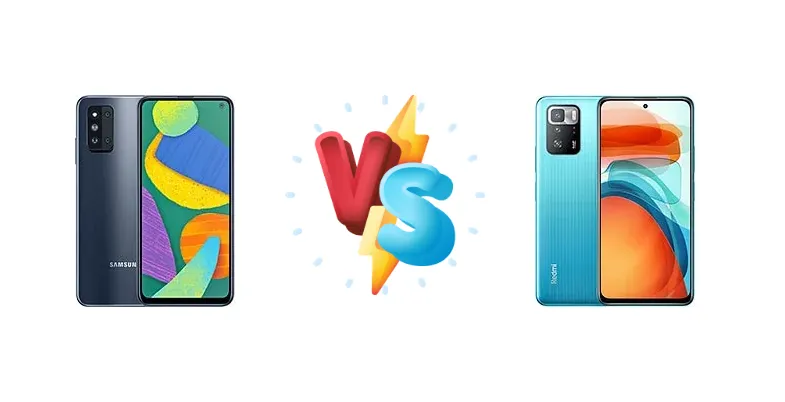
Both the Samsung Galaxy F52 5G and the Xiaomi Redmi Note 10 Pro (China) target the competitive mid-range 5G market, but they take distinctly different approaches. The F52 5G leans on Qualcomm’s Snapdragon 750G for efficiency, while the Redmi Note 10 Pro (China) packs MediaTek’s more powerful Dimensity 1100. This comparison dissects these key differences, focusing on performance, charging, and real-world usability.
🏆 Quick Verdict
For the average user prioritizing performance and convenience, the Xiaomi Redmi Note 10 Pro (China) is the stronger choice. Its Dimensity 1100 chipset offers a noticeable performance uplift, and the blazing-fast 67W charging significantly reduces downtime. While the F52 5G offers a solid experience, it can't match the Redmi Note 10 Pro's speed.
| Network |
|---|
| 2G bands | GSM 850 / 900 / 1800 / 1900 | GSM 850 / 900 / 1800 / 1900 |
| 3G bands | HSDPA 850 / 900 / 1900 / 2100 | HSDPA 850 / 900 / 1700(AWS) / 1900 / 2100 |
| 4G bands | 1, 3, 5, 7, 8, 34, 38, 39, 40, 41 | 1, 2, 3, 4, 5, 7, 8, 18, 19, 26, 34, 38, 39, 40, 41, 42 |
| 5G bands | 1, 28, 41, 78 Sub6 | 1, 3, 28, 41, 77, 78 SA/NSA/Sub6 |
| Speed | HSPA, LTE, 5G | HSPA, LTE, 5G |
| Technology | GSM / HSPA / LTE / 5G | GSM / CDMA / HSPA / EVDO / LTE / 5G |
| | - | CDMA2000 1xEV-DO |
| Launch |
|---|
| Announced | 2021, May 20 | 2021, May 26 |
| Status | Available. Released 2021, June 01 | Available. Released 2021, June 02 |
| Body |
|---|
| Build | - | Glass front (Gorilla Glass Victus), plastic frame, plastic back |
| Dimensions | 164.6 x 76.3 x 8.7 mm (6.48 x 3.00 x 0.34 in) | 163.3 x 75.9 x 8.9 mm (6.43 x 2.99 x 0.35 in) |
| SIM | Nano-SIM + Nano-SIM | Nano-SIM + Nano-SIM |
| Weight | 199 g (7.02 oz) | 193 g (6.81 oz) |
| | - | IP53, dust and splash resistant |
| Display |
|---|
| Protection | - | Corning Gorilla Glass Victus |
| Resolution | 1080 x 2408 pixels, 20:9 ratio (~400 ppi density) | 1080 x 2400 pixels, 20:9 ratio (~399 ppi density) |
| Size | 6.6 inches, 104.9 cm2 (~83.6% screen-to-body ratio) | 6.6 inches, 105.2 cm2 (~84.9% screen-to-body ratio) |
| Type | TFT LCD, 120Hz | IPS LCD, 120Hz, HDR10, 450 nits (typ) |
| Platform |
|---|
| CPU | Octa-core (2x2.2 GHz Kryo 570 & 6x1.8 GHz Kryo 570) | Octa-core (4x2.6 GHz Cortex-A78 & 4x2.0 GHz Cortex-A55) |
| Chipset | Qualcomm SM7225 Snapdragon 750G 5G (8 nm) | Mediatek Dimensity 1100 (6 nm) |
| GPU | Adreno 619 | Mali-G77 MC9 |
| OS | Android 11, One UI 3.1 | Android 11, MIUI 12.5 |
| Memory |
|---|
| Card slot | microSDXC (uses shared SIM slot) | No |
| Internal | 128GB 8GB RAM | 128GB 6GB RAM, 128GB 8GB RAM, 256GB 8GB RAM |
| | - | UFS 3.1 |
| Main Camera |
|---|
| Features | LED flash, panorama, HDR | Color spectrum sensor, LED flash, HDR, panorama |
| Quad | 64 MP, f/1.8, (wide), PDAF
8 MP, f/2.2, (ultrawide), 1.12µm
2 MP (macro)
Auxiliary lens | - |
| Single | - | 16 MP, f/2.5, (wide), 1/3.06", 1.0µm |
| Triple | - | 64 MP, f/1.8, 26mm (wide), 1/1.97", 0.7µm, PDAF
8 MP, f/2.2, 120˚ (ultrawide), 1/4.0", 1.12µm
2 MP (macro) |
| Video | 4K@30fps, 1080p@30/120fps | 4K@30fps, 1080p@30/60/120fps, 720p@960fps, HDR |
| Selfie camera |
|---|
| Features | HDR | Panorama, HDR |
| Single | 16 MP, f/2.0, (wide) | 16 MP, f/2.5, (wide), 1/3.06", 1.0µm |
| Video | 1080p@30fps | 1080p@30fps, 720p@120fps, HDR |
| Sound |
|---|
| 3.5mm jack | Yes | No |
| 35mm jack | Yes | No |
| Loudspeaker | Yes | Yes, with stereo speakers |
| | - | 24-bit/192kHz audio
Tuned by JBL |
| Comms |
|---|
| Bluetooth | 5.0, A2DP, LE | 5.2, A2DP, LE |
| Infrared port | - | Yes |
| NFC | No | Yes |
| Positioning | GPS, GLONASS, GALILEO, BDS | GPS, GLONASS, GALILEO, BDS, QZSS |
| Radio | No | No |
| USB | USB Type-C 2.0 | USB Type-C 2.0 |
| WLAN | Wi-Fi 802.11 a/b/g/n/ac, dual-band, Wi-Fi Direct | Wi-Fi 802.11 a/b/g/n/ac/6, dual-band, Wi-Fi Direct |
| Features |
|---|
| Sensors | Fingerprint (side-mounted), accelerometer, gyro, proximity, compass | Fingerprint (side-mounted), accelerometer, gyro, compass |
| | - | Virtual proximity sensing |
| Battery |
|---|
| Charging | 25W wired | 67W wired, PD3.0, 100% in 42 min |
| Type | Li-Po 4500 mAh | Li-Po 5000 mAh |
| Misc |
|---|
| Colors | White, Black | Stargaze Black, Wave Blue, Cloud White |
| Models | SM-E5260 | - |
| Price | About 260 EUR | About 200 EUR |
Samsung Galaxy F52 5G
- Potentially better power efficiency with Snapdragon 750G.
- Samsung’s One UI offers a polished software experience.
- 5G connectivity for faster data speeds.
- Slower 25W charging.
- Less powerful chipset compared to Dimensity 1100.
- Likely a less capable GPU for gaming.
Xiaomi Redmi Note 10 Pro (China)
- Significantly faster 67W charging.
- More powerful Mediatek Dimensity 1100 chipset.
- Superior GPU performance for gaming.
- Potentially better camera system.
- May experience slightly higher power consumption.
- Xiaomi’s MIUI can be more resource-intensive.
Display Comparison
Context data lacks display specifics, but given the market positioning, both likely feature LCD panels. However, the Redmi Note 10 Pro (China) often includes higher refresh rate options (120Hz) in its variants, which the F52 5G may lack. This impacts smoothness during scrolling and gaming. Color accuracy and peak brightness are unknown, but the Redmi Note 10 Pro’s higher price point suggests a potentially more vibrant display.
Camera Comparison
Without detailed camera specs, a direct comparison is limited. However, the Redmi Note 10 Pro (China) often features higher resolution main sensors (typically 108MP or higher) compared to the F52 5G. The Dimensity 1100’s image signal processor (ISP) also offers more advanced features and processing capabilities. While both phones likely include standard features like HDR and night mode, the Redmi Note 10 Pro is expected to deliver superior image quality, especially in challenging lighting conditions. The F52 5G may focus on software optimization to compensate, but hardware advantages typically prevail.
Performance
The core difference lies in the chipsets. The Mediatek Dimensity 1100 (6nm) in the Redmi Note 10 Pro (China) boasts a more advanced architecture – Cortex-A78 cores clocked at 2.6 GHz – compared to the Snapdragon 750G’s (8nm) Kryo 570 cores at 2.2 GHz. This translates to a significant CPU performance advantage for the Redmi Note 10 Pro, particularly in multi-threaded tasks. The Dimensity 1100 also features a more capable GPU, offering superior graphics performance for gaming. The 6nm process node of the Dimensity 1100 also contributes to better thermal efficiency, potentially reducing throttling under sustained load.
Battery Life
The Redmi Note 10 Pro (China)’s 67W charging is a massive advantage. A full charge in 42 minutes is significantly faster than the F52 5G’s 25W charging. While battery capacity isn’t specified, the faster charging speed effectively mitigates any potential capacity difference. The Snapdragon 750G’s efficiency may offer slightly better battery life during light usage, but the Redmi Note 10 Pro’s charging speed ensures less time tethered to a wall outlet.
Buying Guide
Buy the Samsung Galaxy F52 5G if you prioritize a potentially more refined software experience and a focus on power efficiency for extended battery life during lighter tasks. Buy the Xiaomi Redmi Note 10 Pro (China) if you demand faster performance for gaming and demanding applications, and if minimizing charging time is a top priority. The 67W charging is a game-changer for users who dislike waiting for their phone to power up.
Frequently Asked Questions
❓ Does the Dimensity 1100 in the Redmi Note 10 Pro (China) get hot during extended gaming sessions?
While the Dimensity 1100 is a powerful chip, the 6nm process node and Xiaomi’s thermal management solutions generally prevent excessive overheating. Some throttling may occur during prolonged, graphically intensive gaming, but it’s unlikely to be severe enough to significantly impact the experience. The F52 5G's Snapdragon 750G may run cooler, but at the cost of performance.
❓ Is the 67W charging on the Redmi Note 10 Pro (China) compatible with Power Delivery (PD) chargers?
Yes, the Redmi Note 10 Pro (China) supports PD3.0, meaning it can utilize compatible PD chargers for faster charging. However, to achieve the full 67W charging speed, it’s recommended to use the included charger or a charger specifically designed to support that wattage.
❓ How does the software experience differ between Samsung's One UI and Xiaomi's MIUI on these devices?
Samsung’s One UI is generally considered more polished and user-friendly, with a cleaner interface and fewer pre-installed apps. Xiaomi’s MIUI is highly customizable but can be more resource-intensive and includes more bloatware. Software preference is subjective, but One UI often appeals to users seeking a simpler, more streamlined experience.