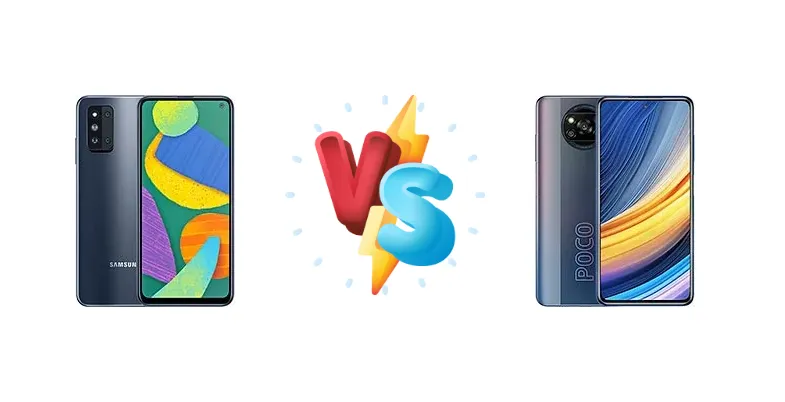
The Samsung Galaxy F52 5G and Xiaomi Poco X3 Pro represent compelling options in the competitive mid-range 5G smartphone market. While both aim to deliver a balanced experience, they take distinctly different approaches to achieving it. The F52 5G prioritizes 5G connectivity and a streamlined Samsung experience, while the Poco X3 Pro focuses on raw processing power and gaming capabilities.
🏆 Quick Verdict
For the average user prioritizing gaming and demanding tasks, the Xiaomi Poco X3 Pro is the clear winner. Its Snapdragon 860 chipset provides a significant performance advantage over the F52 5G’s Snapdragon 750G. However, the F52 5G remains a viable option for those seeking a more balanced, everyday experience with reliable 5G.
| Network |
|---|
| 2G bands | GSM 850 / 900 / 1800 / 1900 | GSM 850 / 900 / 1800 / 1900 |
| 3G bands | HSDPA 850 / 900 / 1900 / 2100 | HSDPA 850 / 900 / 1700(AWS) / 1900 / 2100 |
| 4G bands | 1, 3, 5, 7, 8, 34, 38, 39, 40, 41 | 1, 2, 3, 4, 5, 7, 8, 20, 28, 38, 40, 41 - International |
| 5G bands | 1, 28, 41, 78 Sub6 | - |
| Speed | HSPA, LTE, 5G | HSPA, LTE |
| Technology | GSM / HSPA / LTE / 5G | GSM / HSPA / LTE |
| | - | 1, 2, 3, 5, 8, 38, 40, 41 - India |
| Launch |
|---|
| Announced | 2021, May 20 | 2021, March 22 |
| Status | Available. Released 2021, June 01 | Available. Released 2021, March 24 |
| Body |
|---|
| Build | - | Glass front (Gorilla Glass 6), plastic back |
| Dimensions | 164.6 x 76.3 x 8.7 mm (6.48 x 3.00 x 0.34 in) | 165.3 x 76.8 x 9.4 mm (6.51 x 3.02 x 0.37 in) |
| SIM | Nano-SIM + Nano-SIM | Nano-SIM + Nano-SIM |
| Weight | 199 g (7.02 oz) | 215 g (7.58 oz) |
| | - | IP53, dust and splash resistant |
| Display |
|---|
| Protection | - | Corning Gorilla Glass 6 |
| Resolution | 1080 x 2408 pixels, 20:9 ratio (~400 ppi density) | 1080 x 2400 pixels, 20:9 ratio (~395 ppi density) |
| Size | 6.6 inches, 104.9 cm2 (~83.6% screen-to-body ratio) | 6.67 inches, 107.4 cm2 (~84.6% screen-to-body ratio) |
| Type | TFT LCD, 120Hz | IPS LCD, 120Hz, 2404Hz PWM, HDR10, 450 nits (typ) |
| Platform |
|---|
| CPU | Octa-core (2x2.2 GHz Kryo 570 & 6x1.8 GHz Kryo 570) | Octa-core (1x2.96 GHz Kryo 485 Gold & 3x2.42 GHz Kryo 485 Gold & 4x1.78 GHz Kryo 485 Silver) |
| Chipset | Qualcomm SM7225 Snapdragon 750G 5G (8 nm) | Qualcomm Snapdragon 860 (7 nm) |
| GPU | Adreno 619 | Adreno 640 |
| OS | Android 11, One UI 3.1 | Android 11, upgradable to Android 12, MIUI 13 for POCO |
| Memory |
|---|
| Card slot | microSDXC (uses shared SIM slot) | microSDXC (uses shared SIM slot) |
| Internal | 128GB 8GB RAM | 128GB 6GB RAM, 128GB 8GB RAM, 256GB 6GB RAM, 256GB 8GB RAM |
| | - | UFS 3.1 |
| Main Camera |
|---|
| Features | LED flash, panorama, HDR | Dual-LED flash, HDR, panorama |
| Quad | 64 MP, f/1.8, (wide), PDAF
8 MP, f/2.2, (ultrawide), 1.12µm
2 MP (macro)
Auxiliary lens | 48 MP, f/1.8, (wide), 1/2.0", 0.8µm, PDAF
8 MP, f/2.2, 119˚ (ultrawide), 1.0µm
2 MP (macro)
Auxiliary lens |
| Single | - | 20 MP, f/2.2, (wide), 1/3.4", 0.8µm |
| Video | 4K@30fps, 1080p@30/120fps | 4K@30fps, 1080p@30/60/120/240fps, 1080p@960fps, gyro-EIS |
| Selfie camera |
|---|
| Features | HDR | HDR, panorama |
| Single | 16 MP, f/2.0, (wide) | 20 MP, f/2.2, (wide), 1/3.4", 0.8µm |
| Video | 1080p@30fps | 1080p@30fps |
| Sound |
|---|
| 3.5mm jack | Yes | Yes |
| 35mm jack | Yes | Yes |
| Loudspeaker | Yes | Yes, with stereo speakers |
| | - | 24-bit/192kHz audio |
| Comms |
|---|
| Bluetooth | 5.0, A2DP, LE | 5.0, A2DP, LE |
| Infrared port | - | Yes |
| NFC | No | Yes (market/region dependent) |
| Positioning | GPS, GLONASS, GALILEO, BDS | GPS, GLONASS, GALILEO, BDS |
| Radio | No | FM radio, recording |
| USB | USB Type-C 2.0 | USB Type-C 2.0, OTG |
| WLAN | Wi-Fi 802.11 a/b/g/n/ac, dual-band, Wi-Fi Direct | Wi-Fi 802.11 a/b/g/n/ac, dual-band, Wi-Fi Direct |
| Features |
|---|
| Sensors | Fingerprint (side-mounted), accelerometer, gyro, proximity, compass | Fingerprint (side-mounted), accelerometer, gyro, proximity, compass |
| Battery |
|---|
| Charging | 25W wired | 33W wired, 59% in 30 min, 100% in 59 min |
| Type | Li-Po 4500 mAh | Li-Po 5160 mAh |
| Misc |
|---|
| Colors | White, Black | Phantom Black, Frost Blue, Metal Bronze |
| Models | SM-E5260 | M2102J20SG, M2102J20SI |
| Price | About 260 EUR | $ 128.04 / £ 249.99 |
| SAR | - | 0.99 W/kg (head) 0.67 W/kg (body) |
| SAR EU | - | 0.57 W/kg (head) 0.90 W/kg (body) |
| Tests |
|---|
| Battery life | - |
Endurance rating 112h
|
| Camera | - |
Photo / Video |
| Display | - |
Contrast ratio: 1401:1 (nominal) |
| Loudspeaker | - |
-26.1 LUFS (Good)
|
| Performance | - |
AnTuTu: 453223 (v8)
GeekBench: 2574 (v5.1)
GFXBench: 38fps (ES 3.1 onscreen) |
Samsung Galaxy F52 5G
- Reliable 5G connectivity with the Snapdragon 750G.
- Potentially superior display color accuracy (based on Samsung's reputation).
- Clean and streamlined Samsung software experience.
- Significantly weaker CPU/GPU performance compared to the Poco X3 Pro.
- Slower 25W charging.
- Limited camera details available.
Xiaomi Poco X3 Pro
- Powerful Snapdragon 860 chipset for excellent gaming and performance.
- Faster 33W wired charging.
- Competitive price-to-performance ratio.
- Software experience may be less refined than Samsung's One UI.
- Display may prioritize responsiveness over color accuracy.
- Camera details are lacking.
Display Comparison
Both devices share a nominal contrast ratio of 1401:1, suggesting similar visual pop. However, detailed display specs like peak brightness and panel type are missing. Given Samsung’s display expertise, the F52 5G likely benefits from superior color accuracy and viewing angles. The Poco X3 Pro’s display, while adequate, is likely tuned for gaming with a focus on responsiveness rather than color fidelity. Without further data, it’s difficult to definitively declare a winner, but Samsung’s brand reputation suggests a slight edge in display quality.
Camera Comparison
Both phones feature 'Photo / Video' capabilities, but lack specific details. Without sensor size, aperture, or image processing details, a direct comparison is challenging. However, given Xiaomi’s tendency to prioritize camera specs, the Poco X3 Pro likely features a more capable main sensor. The F52 5G likely leans towards Samsung’s natural image processing style, while the Poco X3 Pro may offer more vibrant, saturated images. The absence of information on OIS or advanced features makes it difficult to assess the overall camera experience.
Performance
The Poco X3 Pro’s Snapdragon 860 (7nm) is the clear performance champion. Its octa-core configuration, featuring a 2.96 GHz Kryo 485 Gold prime core, significantly outpaces the Snapdragon 750G (8nm) in the F52 5G, which tops out at 2.2 GHz. The 860’s more advanced architecture and higher clock speeds translate to faster app loading, smoother multitasking, and superior gaming performance. While the F52 5G’s 5G modem is a plus, it doesn’t compensate for the substantial CPU/GPU gap. The 7nm process node of the 860 also contributes to better thermal efficiency under sustained load.
Battery Life
Both devices boast an endurance rating of 112 hours, indicating comparable battery life under typical usage. However, the Poco X3 Pro’s 33W wired charging (59% in 30 min, 100% in 59 min) is significantly faster than the F52 5G’s 25W charging. This faster charging speed is a tangible benefit for users who frequently need to top up their battery quickly. While both offer similar longevity, the X3 Pro’s charging speed provides a more convenient user experience.
Buying Guide
Buy the Samsung Galaxy F52 5G if you need a dependable 5G connection, a clean software experience, and prioritize a balanced feature set over outright performance. Buy the Xiaomi Poco X3 Pro if you prefer a phone optimized for gaming, demanding applications, and value maximum processing power for the price, even if it means potentially sacrificing some software polish.
Frequently Asked Questions
❓ Does the Snapdragon 860 in the Poco X3 Pro get noticeably hot during extended gaming sessions?
The Snapdragon 860 is known for its efficient thermal management, but prolonged, demanding gaming will inevitably generate heat. The Poco X3 Pro incorporates heat dissipation features, but users may experience some throttling after extended play. It's generally well-managed, but not immune to heat buildup.
❓ Is the 5G connectivity on the Samsung Galaxy F52 5G significantly faster than 4G on the Poco X3 Pro?
Theoretically, 5G offers significantly faster speeds than 4G. However, real-world 5G performance depends heavily on network availability and coverage. If you live in an area with robust 5G infrastructure, the F52 5G will provide a noticeable speed advantage. Otherwise, the difference may be minimal.
❓ How does the software experience differ between Samsung's One UI and Xiaomi's MIUI on these phones?
Samsung's One UI is generally considered cleaner and more polished, with a focus on usability and features. Xiaomi's MIUI is more customizable and feature-rich, but can sometimes feel cluttered or include pre-installed bloatware. Preference is subjective, but One UI is often favored for its simplicity.
❓ Will the Poco X3 Pro receive long-term software updates and security patches?
Xiaomi's update track record is generally less consistent than Samsung's. While the Poco X3 Pro will receive updates, they may not be as frequent or for as long a period as the Galaxy F52 5G. Samsung typically provides longer software support for its devices.