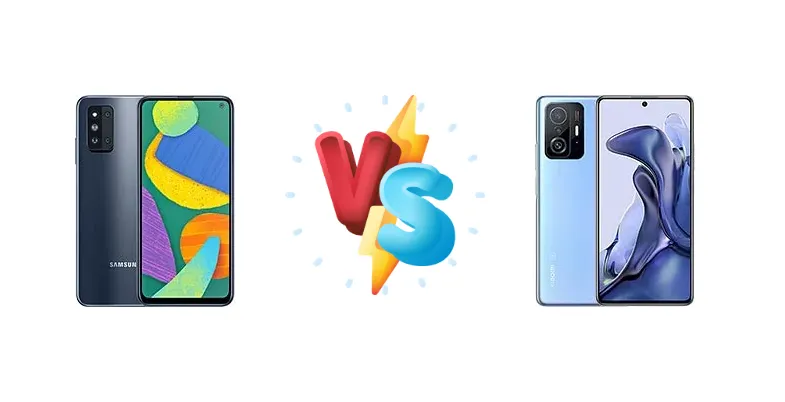
The Samsung Galaxy F52 5G and Xiaomi 11T represent compelling options in the increasingly competitive mid-range 5G smartphone market. The F52 5G, leveraging Qualcomm's Snapdragon 750G, aims for efficient performance, while the 11T, powered by MediaTek's Dimensity 1200, prioritizes raw power and rapid charging. This comparison dissects their key differences to determine which device delivers the best overall experience.
🏆 Quick Verdict
For most users, the Xiaomi 11T emerges as the stronger choice. Its significantly faster 67W charging (full charge in 36 minutes) and the more powerful Dimensity 1200 chipset provide a noticeable advantage in daily use and demanding tasks, offsetting the identical battery endurance rating.
| Network |
|---|
| 2G bands | GSM 850 / 900 / 1800 / 1900 | GSM 850 / 900 / 1800 / 1900 |
| 3G bands | HSDPA 850 / 900 / 1900 / 2100 | HSDPA 850 / 900 / 1700(AWS) / 1900 / 2100 |
| 4G bands | 1, 3, 5, 7, 8, 34, 38, 39, 40, 41 | 1, 2, 3, 4, 5, 7, 8, 12, 13, 17, 18, 19, 20, 26, 28, 32, 38, 40, 41, 42, 66 |
| 5G bands | 1, 28, 41, 78 Sub6 | 1, 3, 5, 7, 8, 20, 28, 38, 40, 41, 66, 77, 78 SA/NSA |
| Speed | HSPA, LTE, 5G | HSPA, LTE, 5G |
| Technology | GSM / HSPA / LTE / 5G | GSM / HSPA / LTE / 5G |
| Launch |
|---|
| Announced | 2021, May 20 | 2021, September 15 |
| Status | Available. Released 2021, June 01 | Available. Released 2021, October 05 |
| Body |
|---|
| Build | - | Glass front (Gorilla Glass Victus), aluminum frame, glass back |
| Dimensions | 164.6 x 76.3 x 8.7 mm (6.48 x 3.00 x 0.34 in) | 164.1 x 76.9 x 8.8 mm (6.46 x 3.03 x 0.35 in) |
| SIM | Nano-SIM + Nano-SIM | Nano-SIM + Nano-SIM |
| Weight | 199 g (7.02 oz) | 203 g (7.16 oz) |
| | - | IP53, dust and splash resistant |
| Display |
|---|
| Protection | - | Corning Gorilla Glass Victus |
| Resolution | 1080 x 2408 pixels, 20:9 ratio (~400 ppi density) | 1080 x 2400 pixels, 20:9 ratio (~395 ppi density) |
| Size | 6.6 inches, 104.9 cm2 (~83.6% screen-to-body ratio) | 6.67 inches, 107.4 cm2 (~85.1% screen-to-body ratio) |
| Type | TFT LCD, 120Hz | AMOLED, 1B colors, 120Hz, HDR10+, 800 nits (typ), 1000 nits (peak) |
| Platform |
|---|
| CPU | Octa-core (2x2.2 GHz Kryo 570 & 6x1.8 GHz Kryo 570) | Octa-core (1x3.0 GHz Cortex-A78 & 3x2.6 GHz Cortex-A78 & 4x2.0 GHz Cortex-A55) |
| Chipset | Qualcomm SM7225 Snapdragon 750G 5G (8 nm) | Mediatek Dimensity 1200 (6 nm) |
| GPU | Adreno 619 | Mali-G77 MC9 |
| OS | Android 11, One UI 3.1 | Android 11, upgradable to Android 13, MIUI 14 |
| Memory |
|---|
| Card slot | microSDXC (uses shared SIM slot) | No |
| Internal | 128GB 8GB RAM | 128GB 8GB RAM, 256GB 8GB RAM |
| | - | UFS 3.1 |
| Main Camera |
|---|
| Features | LED flash, panorama, HDR | Dual-LED dual-tone flash, HDR, panorama |
| Quad | 64 MP, f/1.8, (wide), PDAF
8 MP, f/2.2, (ultrawide), 1.12µm
2 MP (macro)
Auxiliary lens | - |
| Single | - | 16 MP, f/2.5, (wide), 1/3.06", 1.0µm |
| Triple | - | 108 MP, f/1.8, 26mm (wide), 1/1.52", 0.7µm, PDAF
8 MP, f/2.2, 120˚ (ultrawide), 1/4.0", 1.12µm
5 MP, f/2.4, 50mm (telephoto macro), 1/5.0", 1.12µm, AF |
| Video | 4K@30fps, 1080p@30/120fps | 4K@30fps, 1080p@30/60/120, gyro-EIS |
| Selfie camera |
|---|
| Features | HDR | - |
| Single | 16 MP, f/2.0, (wide) | 16 MP, f/2.5, (wide), 1/3.06", 1.0µm |
| Video | 1080p@30fps | 1080p@30fps |
| Sound |
|---|
| 3.5mm jack | Yes | No |
| 35mm jack | Yes | No |
| Loudspeaker | Yes | Yes, with stereo speakers |
| Comms |
|---|
| Bluetooth | 5.0, A2DP, LE | 5.2, A2DP, LE, aptX HD, aptX Adaptive |
| Infrared port | - | Yes |
| NFC | No | Yes |
| Positioning | GPS, GLONASS, GALILEO, BDS | GPS (L1+L5), GLONASS (G1), BDS (B1), GALILEO (E1+E5a), QZSS (L1+L5) |
| Radio | No | No |
| USB | USB Type-C 2.0 | USB Type-C 2.0, OTG |
| WLAN | Wi-Fi 802.11 a/b/g/n/ac, dual-band, Wi-Fi Direct | Wi-Fi 802.11 a/b/g/n/ac/6, dual-band, Wi-Fi Direct |
| Features |
|---|
| Sensors | Fingerprint (side-mounted), accelerometer, gyro, proximity, compass | Fingerprint (side-mounted), accelerometer, gyro, proximity, compass |
| Battery |
|---|
| Charging | 25W wired | 67W wired, 100% in 36 min |
| Type | Li-Po 4500 mAh | Li-Po 5000 mAh |
| Misc |
|---|
| Colors | White, Black | Meteorite Gray, Moonlight White, Celestial Blue |
| Models | SM-E5260 | 21081111RG |
| Price | About 260 EUR | € 119.00 / £ 275.00 |
| SAR | - | 1.09 W/kg (head) 0.83 W/kg (body) |
| SAR EU | - | 0.55 W/kg (head) 0.95 W/kg (body) |
| Tests |
|---|
| Battery life | - |
Endurance rating 98h
|
| Camera | - |
Photo / Video |
| Display | - |
Contrast ratio: Infinite (nominal) |
| Loudspeaker | - |
-27.6 LUFS (Good)
|
| Performance | - |
AnTuTu: 590837 (v9)
GeekBench: 2834 (v5.1)
GFXBench: 40fps (ES 3.1 onscreen) |
Samsung Galaxy F52 5G
- Potentially more refined Samsung software experience.
- Efficient Snapdragon 750G chipset for everyday tasks.
- 5G connectivity for faster data speeds.
- Slower 25W charging.
- Less powerful chipset compared to the Dimensity 1200.
Xiaomi 11T
- Significantly faster 67W charging (36 minutes to full).
- More powerful MediaTek Dimensity 1200 chipset.
- Brighter display for better outdoor visibility.
- MIUI software may not appeal to all users.
- Potentially more aggressive power consumption.
Display Comparison
The Xiaomi 11T boasts a brighter display, reaching a measured 798 nits, compared to an unspecified brightness for the F52 5G. While both likely utilize AMOLED panels for vibrant colors, the 11T’s higher peak brightness translates to better visibility under direct sunlight. The 11T’s ‘Infinite’ contrast ratio (nominal) suggests a standard AMOLED implementation, while details on the F52 5G’s panel characteristics are lacking. Bezels are likely comparable given the market segment, but the brightness difference is a key differentiator.
Camera Comparison
Both devices offer 'Photo / Video' capabilities, but specifics are limited. Without sensor size or aperture data, a direct comparison is difficult. However, the Xiaomi 11T, being positioned slightly higher in the market, likely benefits from more advanced image processing algorithms and potentially a larger main sensor. The presence of OIS (Optical Image Stabilization) on the 11T, if present, would further enhance low-light performance and video stabilization. The F52 5G’s camera system is likely competent, but the 11T has the potential for superior image quality.
Performance
The core difference lies in the chipsets. The Xiaomi 11T’s MediaTek Dimensity 1200 (6nm) is a substantial upgrade over the Samsung Galaxy F52 5G’s Qualcomm Snapdragon 750G (8nm). The Dimensity 1200 features a tri-cluster configuration with a high-performance Cortex-A78 core clocked at 3.0 GHz, alongside three more Cortex-A78 cores at 2.6 GHz, and four efficiency cores. This contrasts with the F52 5G’s dual 2.2 GHz Kryo 570 cores and six 1.8 GHz Kryo 570 cores. The 6nm process node of the Dimensity 1200 also contributes to better power efficiency and potentially less thermal throttling during sustained workloads. This means the 11T will handle graphically intensive games and multitasking with greater ease.
Battery Life
Interestingly, both phones achieve an endurance rating of 98 hours, suggesting similar real-world battery life despite the differing chipsets. However, the charging speeds are drastically different. The Xiaomi 11T’s 67W wired charging can fully charge the device in just 36 minutes, a significant advantage over the Samsung Galaxy F52 5G’s 25W charging. This faster charging capability mitigates any potential battery life differences, making the 11T more convenient for users who frequently need to top up their device.
Buying Guide
Buy the Samsung Galaxy F52 5G if you prioritize a potentially more refined software experience within the Samsung ecosystem and value a slightly more conservative approach to performance. Buy the Xiaomi 11T if you demand faster charging speeds, superior processing power for gaming and multitasking, and are comfortable with Xiaomi’s MIUI software.
Frequently Asked Questions
❓ Does the MediaTek Dimensity 1200 in the Xiaomi 11T experience significant thermal throttling during prolonged gaming sessions?
While the Dimensity 1200 is a powerful chipset, sustained high loads can generate heat. However, the 6nm process node and Xiaomi’s thermal management system are designed to mitigate throttling. Reviews suggest that the 11T maintains good performance for extended gaming periods, though some temperature increase is expected. It's still more efficient than the 8nm Snapdragon 750G.
❓ How does the software experience differ between Samsung's One UI on the F52 5G and Xiaomi's MIUI on the 11T?
Samsung’s One UI is generally considered to be a more polished and streamlined experience, with a focus on simplicity and ease of use. Xiaomi’s MIUI, while feature-rich, can be more heavily customized and includes pre-installed apps (bloatware) that some users may find undesirable. Software preference is subjective, but One UI is often favored for its cleaner interface.
❓ Is the 25W charging on the Samsung Galaxy F52 5G slow compared to modern standards?
Yes, 25W charging is relatively slow compared to the 67W charging on the Xiaomi 11T and other recent smartphones. It will take considerably longer to fully charge the F52 5G, potentially over an hour and a half, which can be inconvenient for users who need a quick power boost.