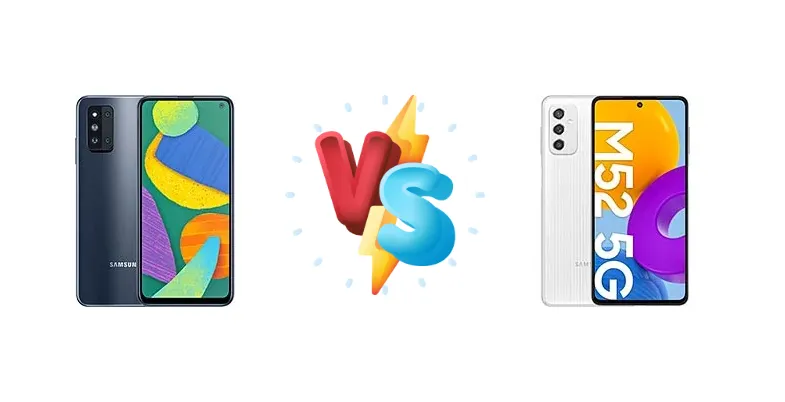
Samsung's Galaxy F and M series consistently deliver compelling value in the mid-range 5G space. The F52 5G and M52 5G, while visually similar, represent different approaches to achieving that value. The F52 5G prioritizes affordability, while the M52 5G aims for a more balanced experience with a more powerful processor and brighter display.
🏆 Quick Verdict
For most users, the Samsung Galaxy M52 5G is the superior choice. Its Snapdragon 778G chipset provides a noticeable performance boost over the F52 5G’s Snapdragon 750G, translating to smoother multitasking and gaming. While both offer similar battery endurance and charging speeds, the M52 5G’s brighter display enhances the overall user experience.
| Network |
|---|
| 2G bands | GSM 850 / 900 / 1800 / 1900 | GSM 850 / 900 / 1800 / 1900 |
| 3G bands | HSDPA 850 / 900 / 1900 / 2100 | HSDPA 850 / 900 / 1700(AWS) / 1900 / 2100 |
| 4G bands | 1, 3, 5, 7, 8, 34, 38, 39, 40, 41 | 1, 2, 3, 4, 5, 7, 8, 12, 17, 20, 26, 28, 38, 40, 41, 66 |
| 5G bands | 1, 28, 41, 78 Sub6 | SA/NSA/Sub6 |
| Speed | HSPA, LTE, 5G | HSPA, LTE, 5G |
| Technology | GSM / HSPA / LTE / 5G | GSM / HSPA / LTE / 5G |
| Launch |
|---|
| Announced | 2021, May 20 | 2021, September 24 |
| Status | Available. Released 2021, June 01 | Available. Released 2021, October 03 |
| Body |
|---|
| Build | - | Glass front (Gorilla Glass 5), plastic frame, plastic back |
| Dimensions | 164.6 x 76.3 x 8.7 mm (6.48 x 3.00 x 0.34 in) | 164.2 x 76.4 x 7.4 mm (6.46 x 3.01 x 0.29 in) |
| SIM | Nano-SIM + Nano-SIM | Nano-SIM + Nano-SIM |
| Weight | 199 g (7.02 oz) | 173 g (6.10 oz) |
| Display |
|---|
| Protection | - | Corning Gorilla Glass 5 |
| Resolution | 1080 x 2408 pixels, 20:9 ratio (~400 ppi density) | 1080 x 2400 pixels, 20:9 ratio (~393 ppi density) |
| Size | 6.6 inches, 104.9 cm2 (~83.6% screen-to-body ratio) | 6.7 inches, 108.4 cm2 (~86.4% screen-to-body ratio) |
| Type | TFT LCD, 120Hz | Super AMOLED Plus, 120Hz |
| Platform |
|---|
| CPU | Octa-core (2x2.2 GHz Kryo 570 & 6x1.8 GHz Kryo 570) | Octa-core (1x2.4 GHz Cortex-A78 & 3x2.2 GHz Cortex-A78 & 4x1.9 GHz Cortex-A55) |
| Chipset | Qualcomm SM7225 Snapdragon 750G 5G (8 nm) | Qualcomm SM7325 Snapdragon 778G 5G (6 nm) |
| GPU | Adreno 619 | Adreno 642L |
| OS | Android 11, One UI 3.1 | Android 11, upgradable to Android 13, One UI 5.1 |
| Memory |
|---|
| Card slot | microSDXC (uses shared SIM slot) | microSDXC (uses shared SIM slot) |
| Internal | 128GB 8GB RAM | 128GB 6GB RAM, 128GB 8GB RAM |
| Main Camera |
|---|
| Features | LED flash, panorama, HDR | LED flash, panorama, HDR |
| Quad | 64 MP, f/1.8, (wide), PDAF
8 MP, f/2.2, (ultrawide), 1.12µm
2 MP (macro)
Auxiliary lens | - |
| Single | - | 32 MP, f/2.2, 26mm (wide) |
| Triple | - | 64 MP, f/1.8, 26mm (wide), 1/1.97", 0.7um, PDAF
12 MP, f/2.2, 123˚, (ultrawide), 1/3.06", 1.12µm
5 MP (macro) |
| Video | 4K@30fps, 1080p@30/120fps | 4K@30fps, 1080p@30/60fps |
| Selfie camera |
|---|
| Features | HDR | - |
| Single | 16 MP, f/2.0, (wide) | 32 MP, f/2.2, 26mm (wide) |
| Video | 1080p@30fps | 4K@30fps, 1080p@30fps |
| Sound |
|---|
| 3.5mm jack | Yes | No |
| 35mm jack | Yes | No |
| Loudspeaker | Yes | Yes |
| Comms |
|---|
| Bluetooth | 5.0, A2DP, LE | 5.0, A2DP, LE |
| NFC | No | Yes |
| Positioning | GPS, GLONASS, GALILEO, BDS | GPS, GLONASS, GALILEO, BDS, QZSS |
| Radio | No | Unspecified |
| USB | USB Type-C 2.0 | USB Type-C 2.0, OTG |
| WLAN | Wi-Fi 802.11 a/b/g/n/ac, dual-band, Wi-Fi Direct | Wi-Fi 802.11 a/b/g/n/ac/6, dual-band, Wi-Fi Direct |
| Features |
|---|
| Sensors | Fingerprint (side-mounted), accelerometer, gyro, proximity, compass | Fingerprint (side-mounted), accelerometer, gyro, proximity, compass |
| Battery |
|---|
| Charging | 25W wired | 25W wired |
| Type | Li-Po 4500 mAh | Li-Ion 5000 mAh |
| Misc |
|---|
| Colors | White, Black | Icy Blue, Blazing Black, White |
| Models | SM-E5260 | SM-M526BR, SM-M526BR/DS, SM-M526B, SM-M526B/DS |
| Price | About 260 EUR | About 300 EUR |
| SAR EU | - | 0.79 W/kg (head) 1.40 W/kg (body) |
| Tests |
|---|
| Battery life | - |
Endurance rating 123h
|
| Camera | - |
Photo / Video |
| Display | - |
Contrast ratio: Infinite (nominal) |
| Loudspeaker | - |
-30.0 LUFS (Average)
|
| Performance | - |
AnTuTu: 504424 (v9)
GeekBench: 2796 (v5.1)
GFXBench: 28fps (ES 3.1 onscreen) |
Samsung Galaxy F52 5G
- More affordable price point
- Decent battery life
- Supports 5G connectivity
- Less powerful Snapdragon 750G chipset
- Likely dimmer display compared to M52 5G
- Potentially slower app loading times
Samsung Galaxy M52 5G
- Significantly faster Snapdragon 778G chipset
- Brighter 777 nit display
- Improved gaming performance
- Slightly higher price
- Similar battery life to F52 5G
- May experience more heat under heavy load (though 6nm helps)
Display Comparison
The Samsung Galaxy M52 5G boasts a significantly brighter display, reaching a measured peak brightness of 777 nits, compared to an unspecified brightness for the F52 5G. This difference is crucial for outdoor visibility. Both displays feature an 'Infinite' contrast ratio, suggesting deep blacks typical of AMOLED panels. While both likely utilize AMOLED technology, the M52 5G’s higher brightness provides a more comfortable viewing experience in various lighting conditions. The lack of refresh rate information for both devices suggests a standard 60Hz panel, which is common in this price bracket.
Camera Comparison
Both the F52 5G and M52 5G are equipped with photo and video capabilities, but detailed sensor information is limited. Without specifics on sensor size or aperture, it’s difficult to make a definitive judgment. However, the more powerful ISP (Image Signal Processor) within the Snapdragon 778G of the M52 5G likely results in better image processing, particularly in low-light conditions. The presence of OIS (Optical Image Stabilization) is unknown for both devices, but would be a significant advantage if included in either. It's safe to assume both phones include standard features like portrait mode and scene optimization.
Performance
The core difference between these two phones lies in their chipsets. The M52 5G is powered by the Qualcomm SM7325 Snapdragon 778G 5G (6 nm), a substantial upgrade over the F52 5G’s Snapdragon 750G (8 nm). The 778G features a more powerful CPU configuration – a 1x2.4 GHz Cortex-A78 prime core, 3x2.2 GHz Cortex-A78 performance cores, and 4x1.9 GHz Cortex-A55 efficiency cores – versus the F52 5G’s 2x2.2 GHz Kryo 570 and 6x1.8 GHz Kryo 570. The 6nm process node of the 778G also contributes to improved power efficiency and thermal management, potentially leading to less throttling during sustained workloads. This translates to a noticeably faster and more responsive experience on the M52 5G, particularly in gaming and demanding applications.
Battery Life
Both the Galaxy F52 5G and M52 5G share an endurance rating of 123 hours, suggesting comparable battery life despite the M52 5G’s more powerful processor. This indicates efficient power management on both devices. Both also support 25W wired charging, meaning similar 0-100% charging times. The 6nm process of the Snapdragon 778G in the M52 5G likely contributes to this similar endurance despite its higher performance.
Buying Guide
Buy the Samsung Galaxy F52 5G if you prioritize absolute affordability and your usage primarily involves basic tasks like calling, texting, and light social media. Buy the Samsung Galaxy M52 5G if you value smoother performance for gaming and demanding apps, and appreciate a brighter, more vibrant display for media consumption. The M52 5G is the better all-rounder, justifying its slightly higher price.
Frequently Asked Questions
❓ Will the Snapdragon 778G in the M52 5G handle demanding games like Genshin Impact at high settings?
Yes, the Snapdragon 778G is a capable chipset for gaming. While it won't deliver flagship-level performance, it should handle Genshin Impact at medium to high settings with playable frame rates. The 6nm process also helps mitigate thermal throttling during extended gaming sessions.
❓ Is the 25W charging speed sufficient for quick top-ups, or should I expect long charging times?
25W charging is a reasonable speed for these devices. While not the fastest available, it should fully charge the battery in approximately 1.5 to 2 hours. Both phones share this charging speed, so there's no advantage either way.
❓ Does the M52 5G's brighter display make a noticeable difference in everyday use?
Absolutely. The 777 nit peak brightness of the M52 5G’s display significantly improves visibility in direct sunlight and makes content more vibrant and enjoyable in various lighting conditions. This is a key advantage over the F52 5G.
❓ Are there any significant software differences between the F52 5G and M52 5G?
Both devices run Samsung's One UI, but the M52 5G may receive software updates slightly faster due to its newer chipset and position in Samsung's lineup. However, both phones are expected to receive a similar level of software support.