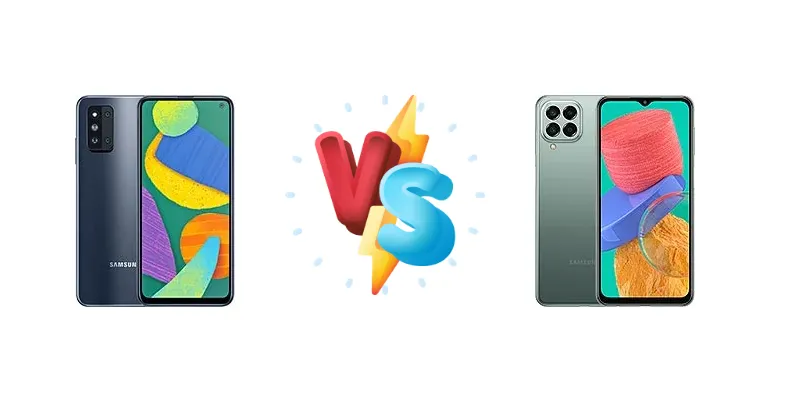
Samsung's mid-range offerings often present a difficult choice, balancing price with performance. The Galaxy F52 5G, powered by the Snapdragon 750G, and the Galaxy M33, featuring the Exynos 1280, represent distinct approaches to this challenge. This comparison dissects their key differences to determine which device delivers the best value for your needs.
🏆 Quick Verdict
For most users, the Samsung Galaxy M33 emerges as the stronger contender. The Exynos 1280’s 5nm process and Cortex-A78 cores provide a noticeable performance uplift over the Snapdragon 750G, making it better suited for demanding tasks and future-proofing. While both offer 25W charging, the M33 adds reverse wired charging for added convenience.
| Network |
|---|
| 2G bands | GSM 850 / 900 / 1800 / 1900 | GSM 850 / 900 / 1800 / 1900 |
| 3G bands | HSDPA 850 / 900 / 1900 / 2100 | HSDPA 850 / 900 / 1700(AWS) / 1900 / 2100 |
| 4G bands | 1, 3, 5, 7, 8, 34, 38, 39, 40, 41 | 1, 2, 3, 4, 5, 7, 8, 12, 17, 20, 26, 28, 38, 40, 41, 66 |
| 5G bands | 1, 28, 41, 78 Sub6 | 1, 3, 5, 7, 8, 20, 28, 38, 40, 41, 66, 78 SA/NSA |
| Speed | HSPA, LTE, 5G | HSPA, LTE, 5G |
| Technology | GSM / HSPA / LTE / 5G | GSM / HSPA / LTE / 5G |
| Launch |
|---|
| Announced | 2021, May 20 | 2022, March 04 |
| Status | Available. Released 2021, June 01 | Available. Released 2022, April 08 |
| Body |
|---|
| Build | - | Glass front (Gorilla Glass 5), plastic frame, plastic back |
| Dimensions | 164.6 x 76.3 x 8.7 mm (6.48 x 3.00 x 0.34 in) | 165.4 x 76.9 x 9.4 mm (6.51 x 3.03 x 0.37 in) |
| SIM | Nano-SIM + Nano-SIM | · Nano-SIM· Nano-SIM + Nano-SIM |
| Weight | 199 g (7.02 oz) | 198 g (Global) / 215 g (India) (6.98 oz) |
| Display |
|---|
| Protection | - | Corning Gorilla Glass 5 |
| Resolution | 1080 x 2408 pixels, 20:9 ratio (~400 ppi density) | 1080 x 2408 pixels, 20:9 ratio (~400 ppi density) |
| Size | 6.6 inches, 104.9 cm2 (~83.6% screen-to-body ratio) | 6.6 inches, 104.9 cm2 (~82.5% screen-to-body ratio) |
| Type | TFT LCD, 120Hz | TFT LCD, 120Hz |
| Platform |
|---|
| CPU | Octa-core (2x2.2 GHz Kryo 570 & 6x1.8 GHz Kryo 570) | Octa-core (2x2.4 GHz Cortex-A78 & 6x2.0 GHz Cortex-A55) |
| Chipset | Qualcomm SM7225 Snapdragon 750G 5G (8 nm) | Exynos 1280 (5 nm) |
| GPU | Adreno 619 | Mali-G68 |
| OS | Android 11, One UI 3.1 | Android 12, upgradable to Android 16, One UI 8 |
| Memory |
|---|
| Card slot | microSDXC (uses shared SIM slot) | microSDXC (dedicated slot) |
| Internal | 128GB 8GB RAM | 128GB 6GB RAM, 128GB 8GB RAM |
| | - | UFS 2.2 |
| Main Camera |
|---|
| Features | LED flash, panorama, HDR | LED flash, panorama, HDR |
| Quad | 64 MP, f/1.8, (wide), PDAF
8 MP, f/2.2, (ultrawide), 1.12µm
2 MP (macro)
Auxiliary lens | 50 MP, f/1.8, (wide), PDAF
5 MP, f/2.2, 123˚ (ultrawide)
2 MP (macro)
Auxiliary lens |
| Single | - | 8 MP, f/2.2, (wide) |
| Video | 4K@30fps, 1080p@30/120fps | 4K@30fps, 1080p@30fps |
| Selfie camera |
|---|
| Features | HDR | - |
| Single | 16 MP, f/2.0, (wide) | 8 MP, f/2.2, (wide) |
| Video | 1080p@30fps | 1080p@30fps |
| Sound |
|---|
| 3.5mm jack | Yes | Yes |
| 35mm jack | Yes | Yes |
| Loudspeaker | Yes | Yes |
| Comms |
|---|
| Bluetooth | 5.0, A2DP, LE | 5.1, A2DP, LE |
| NFC | No | Yes |
| Positioning | GPS, GLONASS, GALILEO, BDS | GPS, GLONASS, GALILEO, BDS, QZSS |
| Radio | No | Unspecified |
| USB | USB Type-C 2.0 | USB Type-C 2.0, OTG |
| WLAN | Wi-Fi 802.11 a/b/g/n/ac, dual-band, Wi-Fi Direct | Wi-Fi 802.11 a/b/g/n/ac, dual-band, Wi-Fi Direct |
| Features |
|---|
| Sensors | Fingerprint (side-mounted), accelerometer, gyro, proximity, compass | Fingerprint (side-mounted), accelerometer, gyro |
| | - | Virtual Proximity Sensing |
| Battery |
|---|
| Charging | 25W wired | 25W wired
4.5W reverse wired |
| Type | Li-Po 4500 mAh | Market-dependent versions:· Li-Ion 5000 mAh (Global)· Li-Ion 6000 mAh (India only) |
| Misc |
|---|
| Colors | White, Black | Green, Blue, Brown |
| Models | SM-E5260 | SM-M336B, SM-M336B/DS, SM-M336BU, SM-M336BU/DS, SM-M336K |
| Price | About 260 EUR | £ 299.00 |
| SAR EU | - | 1.04 W/kg (head) 1.38 W/kg (body) |
Samsung Galaxy F52 5G
- Proven Snapdragon 750G chipset offers reliable performance.
- Potentially better thermal management due to the 8nm process.
- Generally more affordable price point.
- Older chipset architecture compared to the Exynos 1280.
- Likely lacks a high refresh rate display.
- No reverse wired charging.
Samsung Galaxy M33
- More powerful Exynos 1280 chipset for improved performance.
- Likely features a 120Hz display for smoother visuals.
- Includes 4.5W reverse wired charging for added convenience.
- 5nm process may run slightly warmer under sustained load.
- Potentially higher price compared to the F52 5G.
- Exynos chipsets sometimes have a reputation for inconsistent performance.
Display Comparison
Neither Samsung provides display specs in the context data, so we must rely on market positioning. The F52 5G, being an older model, likely features a 60Hz panel. The M33, being newer, is highly likely to have a 120Hz display, offering a smoother scrolling and gaming experience. This difference in refresh rate, combined with potential variations in peak brightness and color accuracy, will be a significant factor for visually-focused users.
Camera Comparison
Without detailed camera specs, a direct comparison is limited. However, the M33’s newer chipset likely incorporates a more advanced image signal processor (ISP), potentially leading to better image processing, noise reduction, and dynamic range. The F52 5G’s ISP, while capable, is based on an older generation of technology. The presence of OIS (Optical Image Stabilization) on either device would be a significant advantage, but is not specified. The 2MP macro cameras on both devices are likely to offer limited practical benefit due to their small sensor size and low resolution.
Performance
The core difference lies in the chipsets. The Exynos 1280 (5nm) in the M33 boasts newer Cortex-A78 performance cores clocked at 2.4 GHz, compared to the Snapdragon 750G’s (8nm) Kryo 570 cores at 2.2 GHz. The 5nm fabrication process of the Exynos 1280 translates to improved power efficiency and potentially better sustained performance due to reduced thermal throttling. While both are octa-core CPUs, the architectural advantages of the Exynos 1280 will be noticeable in benchmarks and real-world applications. The M33 is expected to handle graphically intensive games and multitasking with greater ease.
Battery Life
Both devices support 25W wired charging, suggesting similar charging speeds from 0-100%. However, the M33 adds 4.5W reverse wired charging, allowing it to act as a power bank for other devices – a feature absent on the F52 5G. While battery capacity isn’t specified, the more efficient Exynos 1280 in the M33 could translate to longer real-world battery life despite potentially having a similar capacity to the F52 5G.
Buying Guide
Buy the Samsung Galaxy F52 5G if you prioritize a proven, efficient chipset and are primarily focused on everyday tasks and moderate gaming. Its Snapdragon 750G offers a solid experience without pushing the thermal limits. Buy the Samsung Galaxy M33 if you value raw processing power for gaming, multitasking, and want a device that feels more responsive and capable, even if it means potentially experiencing slightly warmer temperatures under heavy load.
Frequently Asked Questions
❓ Does the Exynos 1280 in the M33 overheat during prolonged gaming sessions?
While the Exynos 1280 is a powerful chip, the 5nm process helps mitigate thermal throttling. However, it's possible to experience some warming during extended gaming. The M33's thermal design will play a crucial role in managing heat, but it's likely to run slightly warmer than the F52 5G under similar loads.
❓ Is the 2MP macro camera on either phone worth using?
Generally, 2MP macro cameras offer limited image quality due to their small sensor size. While they can capture close-up shots, the detail and clarity are often lacking. They are best used for casual snapshots rather than serious photography.
❓ Can the Samsung Galaxy M33 charge other devices wirelessly?
No, the Samsung Galaxy M33 only supports 4.5W *wired* reverse charging. It cannot wirelessly charge other devices. This feature allows you to use the M33 as a power bank for accessories like earbuds or smartwatches via a USB-C cable.
❓ Will the Snapdragon 750G in the F52 5G still be sufficient for playing popular games like PUBG Mobile?
Yes, the Snapdragon 750G is capable of running PUBG Mobile at medium to high settings. However, you may need to lower the graphics settings for a consistently smooth experience, especially during intense firefights. The Exynos 1280 in the M33 will offer a more comfortable gaming experience with higher and more stable frame rates.