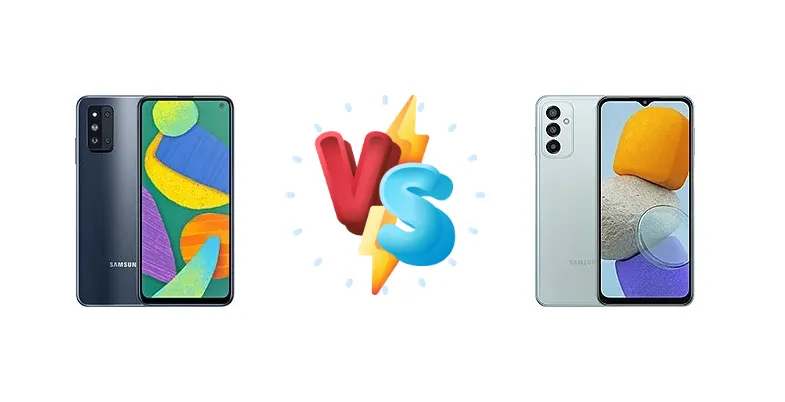
The Samsung Galaxy F52 5G and F23 present a curious case: two phones separated by a generation, yet powered by the exact same Qualcomm Snapdragon 750G 5G chipset. This comparison isn't about raw power, but about how Samsung's software optimization, potential component sourcing differences, and market positioning impact the user experience and overall value proposition of each device.
🏆 Quick Verdict
For the average user, the Samsung Galaxy F23 emerges as the slightly better buy. While performance is identical due to the shared Snapdragon 750G, the F23 likely benefits from more recent software optimizations and potentially more readily available updates, making it a more future-proof choice at a similar price point.
| Network |
|---|
| 2G bands | GSM 850 / 900 / 1800 / 1900 | GSM 850 / 900 / 1800 / 1900 |
| 3G bands | HSDPA 850 / 900 / 1900 / 2100 | HSDPA 850 / 900 / 1700(AWS) / 1900 / 2100 |
| 4G bands | 1, 3, 5, 7, 8, 34, 38, 39, 40, 41 | 1, 2, 3, 4, 5, 7, 8, 12, 17, 20, 26, 28, 38, 40, 41, 66 |
| 5G bands | 1, 28, 41, 78 Sub6 | 1, 3, 5, 7, 8, 20, 28, 38, 40, 41, 66, 78 SA/NSA/Sub6 |
| Speed | HSPA, LTE, 5G | HSPA, LTE, 5G |
| Technology | GSM / HSPA / LTE / 5G | GSM / HSPA / LTE / 5G |
| Launch |
|---|
| Announced | 2021, May 20 | 2022, March 08 |
| Status | Available. Released 2021, June 01 | Available. Released 2022, March 16 |
| Body |
|---|
| Build | - | Glass front (Gorilla Glass 5), plastic frame, plastic back |
| Dimensions | 164.6 x 76.3 x 8.7 mm (6.48 x 3.00 x 0.34 in) | 165.5 x 77 x 8.4 mm (6.52 x 3.03 x 0.33 in) |
| SIM | Nano-SIM + Nano-SIM | Nano-SIM + Nano-SIM |
| Weight | 199 g (7.02 oz) | 198 g (6.98 oz) |
| Display |
|---|
| Protection | - | Corning Gorilla Glass 5 |
| Resolution | 1080 x 2408 pixels, 20:9 ratio (~400 ppi density) | 1080 x 2408 pixels, 20:9 ratio (~400 ppi density) |
| Size | 6.6 inches, 104.9 cm2 (~83.6% screen-to-body ratio) | 6.6 inches, 104.9 cm2 (~82.3% screen-to-body ratio) |
| Type | TFT LCD, 120Hz | TFT LCD, 120Hz |
| Platform |
|---|
| CPU | Octa-core (2x2.2 GHz Kryo 570 & 6x1.8 GHz Kryo 570) | Octa-core (2x2.2 GHz Kryo 570 & 6x1.8 GHz Kryo 570) |
| Chipset | Qualcomm SM7225 Snapdragon 750G 5G (8 nm) | Qualcomm SM7225 Snapdragon 750G 5G (8 nm) |
| GPU | Adreno 619 | Adreno 619 |
| OS | Android 11, One UI 3.1 | Android 12, upgradable to Android 14, One UI 6 |
| Memory |
|---|
| Card slot | microSDXC (uses shared SIM slot) | microSDXC (dedicated slot) |
| Internal | 128GB 8GB RAM | 128GB 4GB RAM, 128GB 6GB RAM |
| Main Camera |
|---|
| Features | LED flash, panorama, HDR | LED flash, panorama, HDR |
| Quad | 64 MP, f/1.8, (wide), PDAF
8 MP, f/2.2, (ultrawide), 1.12µm
2 MP (macro)
Auxiliary lens | - |
| Single | - | 8 MP, f/2.2, (wide) |
| Triple | - | 50 MP, f/1.8, (wide), PDAF
8 MP, f/2.2, 123˚ (ultrawide), 1/4.0", 1.12µm
2 MP (macro) |
| Video | 4K@30fps, 1080p@30/120fps | 4K@30fps, 1080p@30fps, 720p@480fps |
| Selfie camera |
|---|
| Features | HDR | - |
| Single | 16 MP, f/2.0, (wide) | 8 MP, f/2.2, (wide) |
| Video | 1080p@30fps | 1080p@30fps |
| Sound |
|---|
| 3.5mm jack | Yes | Yes |
| 35mm jack | Yes | Yes |
| Loudspeaker | Yes | Yes |
| Comms |
|---|
| Bluetooth | 5.0, A2DP, LE | 5.0, A2DP, LE |
| NFC | No | Yes |
| Positioning | GPS, GLONASS, GALILEO, BDS | GPS, GLONASS, GALILEO, BDS, QZSS |
| Radio | No | FM radio, recording |
| USB | USB Type-C 2.0 | USB Type-C 2.0, OTG |
| WLAN | Wi-Fi 802.11 a/b/g/n/ac, dual-band, Wi-Fi Direct | Wi-Fi 802.11 a/b/g/n/ac, dual-band, Wi-Fi Direct |
| Features |
|---|
| Sensors | Fingerprint (side-mounted), accelerometer, gyro, proximity, compass | Fingerprint (side-mounted), accelerometer, gyro, compass |
| | - | Virtual Proximity Sensing |
| Battery |
|---|
| Charging | 25W wired | 25W wired |
| Type | Li-Po 4500 mAh | Li-Po 5000 mAh |
| Misc |
|---|
| Colors | White, Black | Aqua Blue, Forest Green |
| Models | SM-E5260 | SM-E236B, SM-E236B/DS |
| Price | About 260 EUR | About 190 EUR |
| SAR | - | 1.24 W/kg (head) |
Samsung Galaxy F52 5G
- Identical Snapdragon 750G performance
- Potentially lower price due to age
- May have a larger display (unconfirmed)
- Likely fewer software updates
- Potentially less optimized software
- Older component sourcing
Samsung Galaxy F23
- Identical Snapdragon 750G performance
- More recent software and potential updates
- Potentially improved software optimization
- May be slightly more expensive
- No inherent performance advantage
- Similar camera performance (likely)
Display Comparison
Both the F52 5G and F23 are expected to feature LCD panels, given their market segment. Without specific display specs like resolution, refresh rate, or peak brightness, it's difficult to definitively declare a winner. However, the F23, being a newer model, *may* benefit from improved color calibration or slightly better viewing angles due to advancements in panel manufacturing. The absence of LTPO technology in either device suggests standard refresh rate operation, impacting smoothness compared to flagship devices.
Camera Comparison
Without detailed camera specifications beyond the chipset, a direct comparison is limited. Both phones likely feature a multi-camera setup, but the quality will hinge on sensor size, lens aperture, and Samsung's image processing algorithms. The inclusion of a 2MP macro camera on either device is likely a marketing feature with limited practical benefit. The F23 *may* benefit from newer image processing techniques, resulting in slightly improved dynamic range or low-light performance, but this is speculative without further data.
Performance
The core of both devices is the Qualcomm SM7225 Snapdragon 750G 5G (8 nm) with an Octa-core CPU configuration (2x2.2 GHz Kryo 570 & 6x1.8 GHz Kryo 570). This means identical CPU and GPU performance. The 8nm process node offers a good balance of power efficiency and performance. However, thermal management will be key; sustained performance will depend on Samsung's cooling solution, which is not specified. The F23, benefiting from a later release, *could* have slightly optimized software to manage thermals more effectively, preventing throttling during extended gaming sessions.
Battery Life
Both devices support 25W wired charging, suggesting similar charging speeds – approximately 60-75 minutes for a full charge. The actual battery life will depend on the battery capacity (not provided) and software optimization. A larger battery capacity in the F52 5G (if it exists) would offset the identical charging speed, providing longer usage times. However, the F23's potentially more efficient software could mitigate a smaller battery capacity, resulting in comparable real-world battery performance.
Buying Guide
Buy the Samsung Galaxy F52 5G if you find a significantly discounted price and prioritize a potentially larger display (assuming display size differences exist beyond the provided specs). Buy the Samsung Galaxy F23 if you prefer a device with a higher likelihood of receiving software updates and benefit from any refinements Samsung made in component sourcing or software optimization between generations.
Frequently Asked Questions
❓ Will I notice a difference in gaming performance between the F52 5G and F23?
No, you will not notice a difference in gaming performance. Both phones utilize the same Snapdragon 750G chipset and CPU/GPU configuration. Frame rates and graphical fidelity will be identical, assuming similar RAM configurations. However, sustained performance *could* vary slightly based on thermal management, potentially favoring the F23 with newer software optimizations.
❓ How long will Samsung support the F52 5G with software updates?
The Samsung Galaxy F52 5G, being an older model, is likely nearing the end of its major software update cycle. While it may still receive security patches for a period, it's unlikely to receive updates to the latest Android versions as frequently or for as long as the newer F23.
❓ Is the 25W charging fast enough in 2024?
25W charging is considered moderate in 2024. While it won't be as rapid as the 65W or 120W charging found on flagship devices, it's still sufficient to fully charge the phone within a reasonable timeframe (approximately 60-75 minutes). It's a practical charging speed for everyday use.