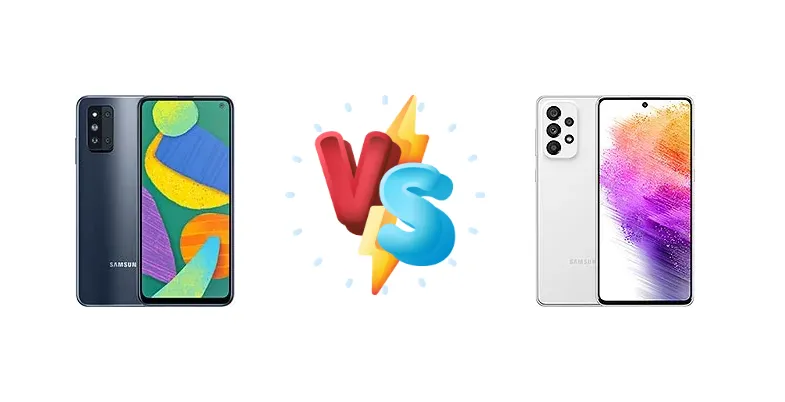
Samsung's mid-range 5G offerings, the Galaxy F52 5G and A73 5G, present a compelling choice for budget-conscious consumers. While both aim to deliver 5G connectivity and a modern smartphone experience, they differ significantly under the hood, primarily in their chipsets. This comparison dissects those differences, focusing on real-world impact for users.
🏆 Quick Verdict
For most users, the Samsung Galaxy A73 5G is the superior choice. The Snapdragon 778G's more efficient 6nm process and superior CPU architecture deliver noticeably better performance in demanding tasks and gaming, justifying the price difference. However, the F52 5G remains a viable option for those prioritizing affordability.
| Network |
|---|
| 2G bands | GSM 850 / 900 / 1800 / 1900 | GSM 850 / 900 / 1800 / 1900 |
| 3G bands | HSDPA 850 / 900 / 1900 / 2100 | HSDPA 850 / 900 / 1700(AWS) / 1900 / 2100 |
| 4G bands | 1, 3, 5, 7, 8, 34, 38, 39, 40, 41 | 1, 2, 3, 4, 5, 7, 8, 12, 13, 17, 20, 26, 28, 32, 38, 40, 41, 66 |
| 5G bands | 1, 28, 41, 78 Sub6 | 1, 3, 5, 7, 28, 40, 41, 66, 78 SA/NSA/Sub6 |
| Speed | HSPA, LTE, 5G | HSPA, LTE, 5G |
| Technology | GSM / HSPA / LTE / 5G | GSM / HSPA / LTE / 5G |
| Launch |
|---|
| Announced | 2021, May 20 | 2022, March 17 |
| Status | Available. Released 2021, June 01 | Available. Released 2022, April 22 |
| Body |
|---|
| Dimensions | 164.6 x 76.3 x 8.7 mm (6.48 x 3.00 x 0.34 in) | 163.7 x 76.1 x 7.6 mm (6.44 x 3.00 x 0.30 in) |
| SIM | Nano-SIM + Nano-SIM | · Nano-SIM· Nano-SIM + Nano-SIM |
| Weight | 199 g (7.02 oz) | 181 g (6.38 oz) |
| | - | IP67 dust/water resistant (up to 1m for 30 min) |
| Display |
|---|
| Protection | - | Corning Gorilla Glass 5 |
| Resolution | 1080 x 2408 pixels, 20:9 ratio (~400 ppi density) | 1080 x 2400 pixels, 20:9 ratio (~393 ppi density) |
| Size | 6.6 inches, 104.9 cm2 (~83.6% screen-to-body ratio) | 6.7 inches, 108.4 cm2 (~87.0% screen-to-body ratio) |
| Type | TFT LCD, 120Hz | Super AMOLED Plus, 120Hz, 800 nits (HBM) |
| Platform |
|---|
| CPU | Octa-core (2x2.2 GHz Kryo 570 & 6x1.8 GHz Kryo 570) | Octa-core (1x2.4 GHz Cortex-A78 & 3x2.2 GHz Cortex-A78 & 4x1.9 GHz Cortex-A55) |
| Chipset | Qualcomm SM7225 Snapdragon 750G 5G (8 nm) | Qualcomm SM7325 Snapdragon 778G 5G (6 nm) |
| GPU | Adreno 619 | Adreno 642L |
| OS | Android 11, One UI 3.1 | Android 12, up to 4 major Android upgrades, One UI 6.1 |
| Memory |
|---|
| Card slot | microSDXC (uses shared SIM slot) | microSDXC (uses shared SIM slot) |
| Internal | 128GB 8GB RAM | 128GB 6GB RAM, 128GB 8GB RAM, 256GB 8GB RAM |
| Main Camera |
|---|
| Features | LED flash, panorama, HDR | LED flash, panorama, HDR |
| Quad | 64 MP, f/1.8, (wide), PDAF
8 MP, f/2.2, (ultrawide), 1.12µm
2 MP (macro)
Auxiliary lens | 108 MP, f/1.8, (wide), PDAF, OIS
12 MP, f/2.2, (ultrawide)
5 MP (macro)
Auxiliary lens |
| Single | - | 32 MP, f/2.2, 26mm (wide), 1/2.8", 0.8µm |
| Video | 4K@30fps, 1080p@30/120fps | 4K@30fps, 1080p@30/60fps; gyro-EIS |
| Selfie camera |
|---|
| Features | HDR | HDR |
| Single | 16 MP, f/2.0, (wide) | 32 MP, f/2.2, 26mm (wide), 1/2.8", 0.8µm |
| Video | 1080p@30fps | 4K@30fps, 1080p@30fps |
| Sound |
|---|
| 3.5mm jack | Yes | No |
| 35mm jack | Yes | No |
| Loudspeaker | Yes | Yes, with stereo speakers |
| Comms |
|---|
| Bluetooth | 5.0, A2DP, LE | 5.0, A2DP, LE |
| NFC | No | Yes (market/region dependent) |
| Positioning | GPS, GLONASS, GALILEO, BDS | GPS, GLONASS, GALILEO, BDS, QZSS |
| Radio | No | Unspecified |
| USB | USB Type-C 2.0 | USB Type-C 2.0, OTG |
| WLAN | Wi-Fi 802.11 a/b/g/n/ac, dual-band, Wi-Fi Direct | Wi-Fi 802.11 a/b/g/n/ac/6, dual-band, Wi-Fi Direct |
| Features |
|---|
| Sensors | Fingerprint (side-mounted), accelerometer, gyro, proximity, compass | Fingerprint (under display, optical), accelerometer, gyro, proximity, compass |
| Battery |
|---|
| Charging | 25W wired | 25W wired |
| Type | Li-Po 4500 mAh | Li-Po 5000 mAh |
| Misc |
|---|
| Colors | White, Black | Gray, Mint, White |
| Models | SM-E5260 | SM-A736B, SM-A736B/DS |
| Price | About 260 EUR | About 600 EUR |
| SAR | - | 1.14 W/kg (head) |
| SAR EU | - | 1.28 W/kg (head) 1.42 W/kg (body) |
Samsung Galaxy F52 5G
- More affordable price point
- Supports 5G connectivity
- Decent performance for everyday tasks
- Less powerful chipset compared to the A73 5G
- Potentially lower battery life due to less efficient processor
Samsung Galaxy A73 5G
- Significantly faster and more efficient Snapdragon 778G
- Improved gaming performance
- Better camera image processing capabilities
- Higher price tag
- May not offer a substantial visual upgrade in basic tasks
Display Comparison
While both devices likely feature similar LCD panels (data unavailable), the core difference lies in the processing power driving them. The impact of the chipset on display responsiveness and smoothness will be more noticeable during gaming and scrolling. We anticipate similar color accuracy and brightness levels given Samsung's display expertise, but the A73 5G's more powerful GPU will contribute to a better overall visual experience.
Camera Comparison
Without detailed camera specs, it's difficult to make a definitive judgment. However, the A73 5G’s more powerful ISP (Image Signal Processor) within the Snapdragon 778G will likely result in better image processing, particularly in low-light conditions. The 778G’s superior processing capabilities allow for more complex algorithms for noise reduction and dynamic range optimization. While both phones likely feature similar primary sensors, the A73 5G will extract more detail and clarity from them. We expect the F52 5G to offer acceptable image quality for casual users, but the A73 5G will appeal to those who prioritize camera performance.
Performance
The Snapdragon 778G in the A73 5G represents a significant upgrade over the 750G in the F52 5G. Built on a 6nm process versus the 750G’s 8nm, the 778G offers improved power efficiency and thermal performance. The A73 5G’s CPU configuration – a 1x2.4 GHz Cortex-A78 prime core, 3x2.2 GHz Cortex-A78 performance cores, and 4x1.9 GHz Cortex-A55 efficiency cores – is a substantial leap over the F52 5G’s 2x2.2 GHz Kryo 570 and 6x1.8 GHz Kryo 570 setup. This translates to faster app loading times, smoother multitasking, and a more responsive user interface. Gamers will particularly benefit from the Adreno 642L GPU in the A73 5G, offering a significant performance advantage over the Adreno 619 in the F52 5G.
Battery Life
Both devices feature 25W wired charging, suggesting similar charging speeds from 0-100%. However, the Snapdragon 778G’s 6nm process is more power-efficient than the 750G’s 8nm process. This means the A73 5G will likely deliver longer battery life under similar usage conditions, despite potentially having a similar battery capacity (data unavailable). The improved efficiency of the A73 5G allows it to maintain performance for longer periods without significant throttling, further extending usable battery life.
Buying Guide
Buy the Samsung Galaxy F52 5G if you need a highly affordable 5G phone for basic tasks like browsing, social media, and light media consumption, and aren't concerned with demanding gaming or heavy multitasking. Buy the Samsung Galaxy A73 5G if you prioritize smoother performance, better gaming capabilities, and a more future-proof experience, even if it means spending a bit more.
Frequently Asked Questions
❓ Will the Snapdragon 778G in the A73 5G handle demanding games like Genshin Impact at high settings?
Yes, the Snapdragon 778G is capable of running Genshin Impact at medium to high settings with playable frame rates. While it won't match the performance of flagship chipsets, it provides a significantly smoother gaming experience compared to the Snapdragon 750G in the F52 5G.
❓ Does the A73 5G's improved processor translate to faster software updates?
Not necessarily. Software update speed is primarily determined by Samsung's software support policies, not the chipset. However, the more powerful processor in the A73 5G may handle larger updates slightly faster during the installation process.
❓ Is the 25W charging on both phones considered fast charging in 2024?
25W charging is considered moderate in 2024. While it's not the fastest available, it's still reasonably quick and should fully charge both devices in around 1.5 to 2 hours. The efficiency of the Snapdragon 778G might allow the A73 5G to reach full charge slightly faster.