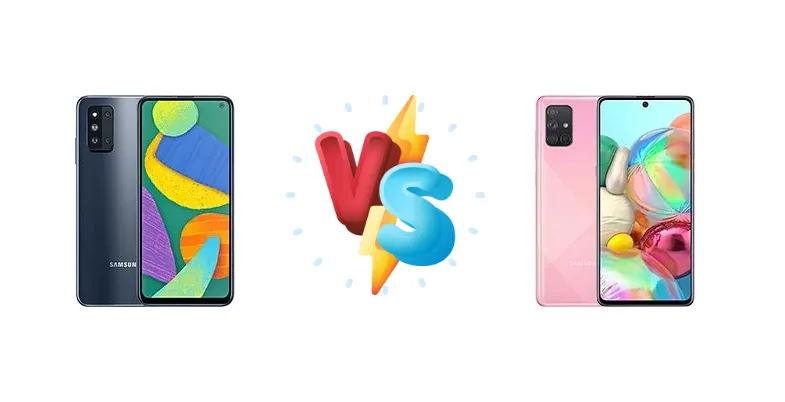
The Samsung Galaxy A71 was a mainstay in the mid-range market, lauded for its solid battery life and dependable performance. The Galaxy F52 5G, arriving later, introduces 5G connectivity and a newer chipset. This comparison dissects whether the F52 5G’s advancements justify an upgrade or if the A71 remains a compelling option, particularly given potential price drops.
🏆 Quick Verdict
For most users, the Samsung Galaxy F52 5G is the better choice. Its Snapdragon 750G chipset offers a noticeable performance uplift over the A71’s Snapdragon 730, enabling smoother multitasking and gaming. While both phones share a 25W charging rate and similar battery endurance ratings, the F52 5G’s 5G capabilities provide future-proofing.
| Network |
|---|
| 2G bands | GSM 850 / 900 / 1800 / 1900 | GSM 850 / 900 / 1800 / 1900 |
| 3G bands | HSDPA 850 / 900 / 1900 / 2100 | HSDPA 850 / 900 / 1900 / 2100 |
| 4G bands | 1, 3, 5, 7, 8, 34, 38, 39, 40, 41 | 1, 2, 3, 4, 5, 7, 8, 12, 13, 17, 20, 28, 38, 40, 41, 66 |
| 5G bands | 1, 28, 41, 78 Sub6 | - |
| Speed | HSPA, LTE, 5G | HSPA, LTE |
| Technology | GSM / HSPA / LTE / 5G | GSM / HSPA / LTE |
| | - | HSDPA 850 / 900 / 1700(AWS) / 1900 / 2100 |
| Launch |
|---|
| Announced | 2021, May 20 | 2019, December 12. Released 2020, January 17 |
| Status | Available. Released 2021, June 01 | Discontinued |
| Body |
|---|
| Build | - | Glass front (Gorilla Glass 3), plastic back, plastic frame |
| Dimensions | 164.6 x 76.3 x 8.7 mm (6.48 x 3.00 x 0.34 in) | 163.6 x 76 x 7.7 mm (6.44 x 2.99 x 0.30 in) |
| SIM | Nano-SIM + Nano-SIM | · Nano-SIM· Nano-SIM + Nano-SIM |
| Weight | 199 g (7.02 oz) | 179 g (6.31 oz) |
| Display |
|---|
| Protection | - | Corning Gorilla Glass 3 |
| Resolution | 1080 x 2408 pixels, 20:9 ratio (~400 ppi density) | 1080 x 2400 pixels, 20:9 ratio (~393 ppi density) |
| Size | 6.6 inches, 104.9 cm2 (~83.6% screen-to-body ratio) | 6.7 inches, 108.4 cm2 (~87.2% screen-to-body ratio) |
| Type | TFT LCD, 120Hz | Super AMOLED Plus |
| Platform |
|---|
| CPU | Octa-core (2x2.2 GHz Kryo 570 & 6x1.8 GHz Kryo 570) | Octa-core (2x2.2 GHz Kryo 470 Gold & 6x1.8 GHz Kryo 470 Silver) |
| Chipset | Qualcomm SM7225 Snapdragon 750G 5G (8 nm) | Qualcomm SDM730 Snapdragon 730 (8 nm) - GlobalQualcomm SDM730 Snapdragon 730G (8 nm) - Philippines |
| GPU | Adreno 619 | Adreno 618 |
| OS | Android 11, One UI 3.1 | Android 10, upgradable to Android 13, One UI 5 |
| Memory |
|---|
| Card slot | microSDXC (uses shared SIM slot) | microSDXC (dedicated slot) |
| Internal | 128GB 8GB RAM | 128GB 6GB RAM, 128GB 8GB RAM |
| | - | UFS 2.1 |
| Main Camera |
|---|
| Features | LED flash, panorama, HDR | LED flash, panorama, HDR |
| Quad | 64 MP, f/1.8, (wide), PDAF
8 MP, f/2.2, (ultrawide), 1.12µm
2 MP (macro)
Auxiliary lens | 64 MP, f/1.8, 26mm (wide), 1/1.72", 0.8µm, PDAF
12 MP, f/2.2, 123˚ (ultrawide)
5 MP (macro)
Auxiliary lens |
| Video | 4K@30fps, 1080p@30/120fps | 4K@30fps, 1080p@30/240fps, 1080p@960fps; gyro-EIS |
| Selfie camera |
|---|
| Features | HDR | HDR |
| Single | 16 MP, f/2.0, (wide) | 32 MP, f/2.2, 26mm (wide), 1/2.8", 0.8µm |
| Video | 1080p@30fps | 4K@30fps, 1080p@30fps |
| Sound |
|---|
| 3.5mm jack | Yes | Yes |
| 35mm jack | Yes | Yes |
| Loudspeaker | Yes | Yes |
| Comms |
|---|
| Bluetooth | 5.0, A2DP, LE | 5.0, A2DP, LE |
| NFC | No | Yes (market dependent) |
| Positioning | GPS, GLONASS, GALILEO, BDS | GPS, GLONASS, GALILEO, BDS |
| Radio | No | FM radio |
| USB | USB Type-C 2.0 | USB Type-C 2.0, OTG |
| WLAN | Wi-Fi 802.11 a/b/g/n/ac, dual-band, Wi-Fi Direct | Wi-Fi 802.11 a/b/g/n/ac, dual-band, Wi-Fi Direct |
| Features |
|---|
| Sensors | Fingerprint (side-mounted), accelerometer, gyro, proximity, compass | Fingerprint (under display, optical), accelerometer, gyro, proximity, compass |
| | - | ANT+ |
| Battery |
|---|
| Charging | 25W wired | 25W wired |
| Type | Li-Po 4500 mAh | Li-Ion 4500 mAh, non-removable |
| Misc |
|---|
| Colors | White, Black | Prism Crush Black, Prism Crush Silver, Prism Crush Blue, Prism Crush Pink |
| Models | SM-E5260 | SM-A715F, SM-A715F/DS, SM-A715F/DSN, SM-A715F/DSM, SM-A715W, SM-A715X |
| Price | About 260 EUR | About 120 EUR |
| SAR | - | 0.98 W/kg (head) 0.90 W/kg (body) |
| SAR EU | - | 0.51 W/kg (head) 1.56 W/kg (body) |
| Tests |
|---|
| Audio quality | - |
Noise -93.5dB / Crosstalk -92.6dB |
| Battery life | - | Endurance rating 102h |
| Camera | - |
Photo / Video |
| Display | - |
Contrast ratio: Infinite (nominal) |
| Loudspeaker | - |
-29.0 LUFS (Average) |
| Performance | - |
AnTuTu: 192 458(v7), 263396 (v8)
GeekBench: 7039 (v4.4), 1733 (v5.1)
GFXBench: 15fps (ES 3.1 onscreen) |
Samsung Galaxy F52 5G
- Faster processor with Snapdragon 750G
- 5G connectivity for future-proofing
- Potentially better thermal management
- Camera specifications are unknown
- Display details are limited
Samsung Galaxy A71
- Proven reliability and established user base
- Good battery life (102h endurance)
- Potentially more refined camera software
- Older Snapdragon 730 chipset
- Lacks 5G connectivity
Display Comparison
Both the Galaxy F52 5G and A71 lack detailed display specifications in the provided data, but the A71 is confirmed to reach 515 nits of peak brightness. This suggests a reasonably viewable experience outdoors, though not exceptional. Given the A71’s ‘Infinite’ contrast ratio (nominal), it likely employs a Super AMOLED panel, known for vibrant colors. The F52 5G’s display characteristics are unknown, but its positioning suggests a similar AMOLED technology. Without refresh rate data, it’s safe to assume both operate at a standard 60Hz.
Camera Comparison
Both phones are listed as having ‘Photo / Video’ capabilities, offering little differentiation. Without sensor size or aperture details, a direct comparison is difficult. However, the A71’s market positioning suggests a more refined camera experience, potentially with better image processing algorithms. The inclusion of a 2MP macro camera on either device is largely a marketing tactic, offering limited practical benefit due to the small sensor size and lack of optical image stabilization (OIS).
Performance
The core difference lies in the chipsets. The Galaxy F52 5G’s Qualcomm SM7225 Snapdragon 750G 5G (8nm) represents a generational leap over the A71’s Snapdragon 730 (8nm) or 730G. The 750G’s Kryo 570 cores, while maintaining the same core count (Octa-core: 2x2.2 GHz & 6x1.8 GHz) as the A71’s Kryo 470, benefit from architectural improvements and a more efficient 8nm process. This translates to better sustained performance and potentially improved thermal management. The 5G modem integrated into the 750G is a key advantage, offering faster data speeds where available. The A71’s Snapdragon 730 is still capable, but will show its age in demanding tasks.
Battery Life
Both the Galaxy F52 5G and A71 achieve an endurance rating of 102 hours, indicating comparable battery life under similar usage conditions. Both support 25W wired charging, suggesting similar 0-100% charging times. The F52 5G’s more efficient chipset *could* translate to slightly better real-world battery performance, but the difference is likely marginal given the identical endurance rating.
Buying Guide
Buy the Samsung Galaxy F52 5G if you prioritize 5G connectivity, smoother performance for demanding apps and games, and want a phone that feels more modern. Buy the Samsung Galaxy A71 if you value a proven track record of reliability, are less concerned with 5G, and find a significantly lower price point. The A71 remains a viable option for users on a tight budget who don't need the latest features.
Frequently Asked Questions
❓ Will the Snapdragon 750G in the F52 5G handle demanding games like PUBG or Call of Duty Mobile at high settings?
Yes, the Snapdragon 750G is a capable chipset for mobile gaming. It offers a noticeable performance improvement over the Snapdragon 730 in the A71, allowing for smoother gameplay at higher settings in titles like PUBG and Call of Duty Mobile. However, sustained performance will depend on thermal management.
❓ Does the Galaxy F52 5G’s 5G connectivity actually make a difference in real-world usage?
The benefit of 5G depends heavily on your location and carrier coverage. If you live in an area with robust 5G infrastructure, you’ll experience significantly faster download and upload speeds compared to 4G LTE. However, if 5G coverage is limited, the advantage will be minimal.
❓ Is the battery life of the F52 5G significantly impacted by using 5G?
Using 5G does consume more battery power than 4G LTE. However, the Snapdragon 750G’s improved efficiency and the F52 5G’s overall endurance rating of 102 hours suggest that the battery impact of 5G will be manageable for most users. You can always switch back to 4G to conserve battery life when 5G isn’t necessary.