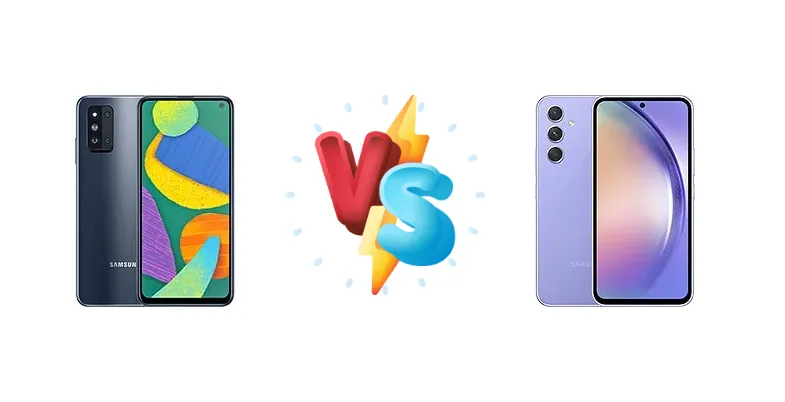
The Samsung Galaxy A54 represents a newer generation of Samsung's popular A-series, while the Galaxy F52 5G, though older, offered compelling value with 5G connectivity. This comparison dissects the key differences between these two devices, focusing on performance, display quality, camera capabilities, and battery life to determine which offers the best experience in today's market.
🏆 Quick Verdict
For most users, the Samsung Galaxy A54 is the superior choice. Its more efficient Exynos 1380 chipset, brighter display reaching 980 nits, and comparable battery endurance rating of 119 hours provide a smoother and more enjoyable user experience, justifying its typically higher price point.
| Network |
|---|
| 2G bands | GSM 850 / 900 / 1800 / 1900 | GSM 850 / 900 / 1800 / 1900 |
| 3G bands | HSDPA 850 / 900 / 1900 / 2100 | HSDPA 850 / 900 / 1700(AWS) / 1900 / 2100 |
| 4G bands | 1, 3, 5, 7, 8, 34, 38, 39, 40, 41 | 1, 2, 3, 4, 5, 7, 8, 12, 17, 20, 26, 28, 32, 38, 40, 41, 66 - International |
| 5G bands | 1, 28, 41, 78 Sub6 | 1, 3, 7, 8, 20, 28, 38, 40, 41, 77, 78 SA/NSA/Sub6 - International |
| Speed | HSPA, LTE, 5G | HSPA, LTE, 5G |
| Technology | GSM / HSPA / LTE / 5G | GSM / HSPA / LTE / 5G |
| | - | 25, 41, 66, 71 SA/NSA/Sub6/mmWave - USA |
| Launch |
|---|
| Announced | 2021, May 20 | 2023, March 15 |
| Status | Available. Released 2021, June 01 | Available. Released 2023, March 24 |
| Body |
|---|
| Build | - | Glass front (Gorilla Glass 5), glass back (Gorilla Glass 5), plastic frame |
| Dimensions | 164.6 x 76.3 x 8.7 mm (6.48 x 3.00 x 0.34 in) | 158.2 x 76.7 x 8.2 mm (6.23 x 3.02 x 0.32 in) |
| SIM | Nano-SIM + Nano-SIM | · Nano-SIM + eSIM· Nano-SIM + Nano-SIM |
| Weight | 199 g (7.02 oz) | 202 g (7.13 oz) |
| | - | IP67 dust/water resistant (up to 1m for 30 min) |
| Display |
|---|
| Protection | - | Corning Gorilla Glass 5 |
| Resolution | 1080 x 2408 pixels, 20:9 ratio (~400 ppi density) | 1080 x 2340 pixels, 19.5:9 ratio (~403 ppi density) |
| Size | 6.6 inches, 104.9 cm2 (~83.6% screen-to-body ratio) | 6.4 inches, 100.5 cm2 (~82.9% screen-to-body ratio) |
| Type | TFT LCD, 120Hz | Super AMOLED, 120Hz, HDR10+, 1000 nits (HBM) |
| Platform |
|---|
| CPU | Octa-core (2x2.2 GHz Kryo 570 & 6x1.8 GHz Kryo 570) | Octa-core (4x2.4 GHz Cortex-A78 & 4x2.0 GHz Cortex-A55) |
| Chipset | Qualcomm SM7225 Snapdragon 750G 5G (8 nm) | Exynos 1380 (5 nm) |
| GPU | Adreno 619 | Mali-G68 MP5 |
| OS | Android 11, One UI 3.1 | Android 13, up to 4 major Android upgrades, One UI 7 |
| Memory |
|---|
| Card slot | microSDXC (uses shared SIM slot) | microSDXC (uses shared SIM slot) |
| Internal | 128GB 8GB RAM | 128GB 4GB RAM, 128GB 6GB RAM, 128GB 8GB RAM, 256GB 6GB RAM, 256GB 8GB RAM |
| Main Camera |
|---|
| Features | LED flash, panorama, HDR | LED flash, panorama, HDR |
| Quad | 64 MP, f/1.8, (wide), PDAF
8 MP, f/2.2, (ultrawide), 1.12µm
2 MP (macro)
Auxiliary lens | - |
| Single | - | 32 MP, f/2.2, 26mm (wide), 1/2.8", 0.8µm |
| Triple | - | 50 MP, f/1.8, 23mm (wide), 1/1.56", 1.0µm, PDAF, OIS
12 MP, f/2.2, 13mm, 123˚ (ultrawide), 1/3.X", 1.12µm
5 MP (macro) |
| Video | 4K@30fps, 1080p@30/120fps | 4K@30fps, 1080p@30/60fps, 720p@480fps, gyro-EIS |
| Selfie camera |
|---|
| Features | HDR | - |
| Single | 16 MP, f/2.0, (wide) | 32 MP, f/2.2, 26mm (wide), 1/2.8", 0.8µm |
| Video | 1080p@30fps | 4K@30fps, 1080p@30/60fps |
| Sound |
|---|
| 3.5mm jack | Yes | No |
| 35mm jack | Yes | No |
| Loudspeaker | Yes | Yes, with stereo speakers |
| Comms |
|---|
| Bluetooth | 5.0, A2DP, LE | 5.3, A2DP, LE |
| NFC | No | Yes (market/region dependent) |
| Positioning | GPS, GLONASS, GALILEO, BDS | GPS, GLONASS, GALILEO, BDS |
| Radio | No | No |
| USB | USB Type-C 2.0 | USB Type-C 2.0, OTG |
| WLAN | Wi-Fi 802.11 a/b/g/n/ac, dual-band, Wi-Fi Direct | Wi-Fi 802.11 a/b/g/n/ac/6, dual-band, Wi-Fi Direct |
| Features |
|---|
| Sensors | Fingerprint (side-mounted), accelerometer, gyro, proximity, compass | Fingerprint (under display, optical), accelerometer, gyro, compass, barometer (USA only) |
| | - | Virtual proximity sensing |
| Battery |
|---|
| Charging | 25W wired | 25W wired |
| Type | Li-Po 4500 mAh | 5000 mAh |
| Misc |
|---|
| Colors | White, Black | Lime, Graphite, Violet, White |
| Models | SM-E5260 | SM-A546V, SM-A546U, SM-A546U1, SM-A546B, SM-A546B/DS, SM-A546E, SM-A546E/DS, SM-A5460, SM-A546M, SM-A546M/DS, SM-A546W |
| Price | About 260 EUR | € 210.00 / $ 119.11 / £ 169.95 / ₹ 28,999 |
| SAR | - | 0.81 W/kg (head) 0.67 W/kg (body) |
| SAR EU | - | 0.69 W/kg (head) 1.34 W/kg (body) |
| Tests |
|---|
| Battery life | - |
Endurance rating 119h
|
| Camera | - |
Photo / Video |
| Display | - |
Contrast ratio: Infinite (nominal) |
| Loudspeaker | - |
-26.6 LUFS (Good)
|
| Performance | - |
AnTuTu: 506678 (v9)
GeekBench: 2703 (v5.1), 2797 (v6)
GFXBench: 25fps (ES 3.1 onscreen) |
Samsung Galaxy F52 5G
- Brighter and more vibrant display (980 nits)
- More powerful and efficient Exynos 1380 chipset
- Likely superior camera performance due to newer technology
- Generally higher price point
- May not offer a significantly longer battery life in real-world use despite efficiency gains
Samsung Galaxy A54
- Lower upfront cost
- Acceptable performance for basic tasks
- Comparable battery endurance rating
- Less powerful Snapdragon 750G chipset
- Dimmer display, potentially impacting outdoor visibility
- Likely inferior camera performance
Display Comparison
The Galaxy A54 boasts a significantly brighter display, peaking at 980 nits, compared to an unlisted value for the F52 5G, suggesting a noticeable advantage in outdoor visibility. While both likely utilize AMOLED panels, the A54’s higher peak brightness translates to more vivid colors and better contrast in bright sunlight. The A54’s 'Infinite' contrast ratio (nominal) further enhances image quality. The F52 5G’s display specs are less defined, making it difficult to assess its color accuracy or viewing angles relative to the A54.
Camera Comparison
Both phones are listed as having Photo/Video capabilities, but detailed sensor information is missing for both. However, given the A54’s position as a newer model, it likely benefits from improved image processing algorithms and potentially larger sensor sizes. The F52 5G’s camera system is likely more basic, potentially lacking features like advanced night mode or 4K video recording capabilities found on the A54. Without specific sensor details, it’s difficult to make a definitive judgment, but the A54’s newer generation hardware suggests a superior camera experience.
Performance
The core difference lies in the chipsets: the A54 features the Exynos 1380 (5nm) while the F52 5G uses the Snapdragon 750G (8nm). The 5nm fabrication process of the Exynos 1380 offers superior power efficiency and transistor density, resulting in better performance and thermal management. The A54’s CPU configuration – Octa-core (4x2.4 GHz Cortex-A78 & 4x2.0 GHz Cortex-A55) – provides a performance edge over the F52 5G’s Octa-core (2x2.2 GHz Kryo 570 & 6x1.8 GHz Kryo 570), particularly in multi-threaded tasks. While both are 5G capable, the A54’s more modern chipset likely offers improved 5G modem performance.
Battery Life
Both the Galaxy A54 and F52 5G share an endurance rating of 119 hours, indicating similar overall battery life. However, the A54 achieves this with an active use score of 11:15h, while the F52 5G’s active use score is not provided. Both support 25W wired charging, suggesting comparable charging speeds. The Exynos 1380’s superior power efficiency in the A54 may contribute to more consistent battery performance throughout the day, despite the similar endurance rating.
Buying Guide
Buy the Samsung Galaxy F52 5G if you prioritize a lower upfront cost and are primarily focused on basic smartphone tasks like calling, texting, and light social media use. The Snapdragon 750G is sufficient for these needs. Buy the Samsung Galaxy A54 if you value a brighter, more vibrant display, smoother performance for demanding apps and games, and a more modern feature set, even if it means spending a bit more.
Frequently Asked Questions
❓ Does the Exynos 1380 in the Galaxy A54 tend to overheat during prolonged gaming sessions?
The Exynos 1380, built on a 5nm process, is generally efficient and well-managed in the Galaxy A54. While it can get warm during extended gaming, it's unlikely to experience significant throttling, providing a consistently smooth gaming experience. The 5nm process contributes to better thermal efficiency compared to the 8nm Snapdragon 750G in the F52 5G.
❓ Is the 25W charging speed on both phones sufficient for quick top-ups throughout the day?
25W charging is a standard speed for mid-range phones. While not the fastest available, it's sufficient to provide a noticeable charge boost in a short amount of time. Expect approximately 30-60 minutes to charge from 0-50%, depending on usage. Both phones offer similar charging capabilities in this regard.
❓ How does the Snapdragon 750G in the F52 5G handle multitasking compared to the Exynos 1380 in the A54?
The Exynos 1380’s CPU architecture, with its Cortex-A78 performance cores, provides a significant advantage in multitasking. It can handle more apps running in the background and switch between them more seamlessly than the Snapdragon 750G. Users who frequently multitask will notice a smoother experience on the A54.