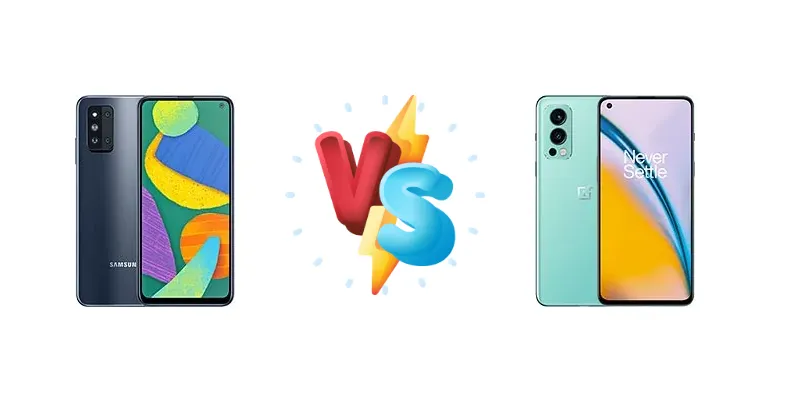
The Samsung Galaxy F52 5G and OnePlus Nord 2 5G represent compelling options in the increasingly competitive mid-range 5G smartphone market. The F52 5G, leveraging Qualcomm's Snapdragon 750G, aims for efficient performance, while the Nord 2 5G, powered by MediaTek's Dimensity 1200, prioritizes raw power and rapid charging. This comparison dissects their key differences to help you determine which device best suits your needs.
🏆 Quick Verdict
For the average user prioritizing speed and convenience, the OnePlus Nord 2 5G emerges as the winner. Its Dimensity 1200 chipset delivers significantly higher performance, and the 65W charging is a game-changer, fully replenishing the battery in just 30 minutes. However, the F52 5G remains a viable option for those on a tighter budget.
| Network |
|---|
| 2G bands | GSM 850 / 900 / 1800 / 1900 | GSM 850 / 900 / 1800 / 1900 |
| 3G bands | HSDPA 850 / 900 / 1900 / 2100 | HSDPA 800 / 850 / 900 / 1700(AWS) / 1800 / 1900 / 2100 |
| 4G bands | 1, 3, 5, 7, 8, 34, 38, 39, 40, 41 | 1, 2, 3, 4, 5, 7, 8, 12, 17, 18, 19, 20, 26, 28, 32, 34, 38, 39, 40, 41, 66 - EU |
| 5G bands | 1, 28, 41, 78 Sub6 | 1, 3, 7, 8, 20, 28, 38, 41, 66, 78 SA/NSA - EU |
| Speed | HSPA, LTE, 5G | HSPA 42.2/5.76 Mbps, LTE Cat18 1200/150 Mbps, 5G |
| Technology | GSM / HSPA / LTE / 5G | GSM / HSPA / LTE / 5G |
| Launch |
|---|
| Announced | 2021, May 20 | 2021, July 22 |
| Status | Available. Released 2021, June 01 | Available. Released 2021, July 28 |
| Body |
|---|
| Build | - | Glass front (Gorilla Glass 5), glass back (Gorilla Glass 5), plastic frame |
| Dimensions | 164.6 x 76.3 x 8.7 mm (6.48 x 3.00 x 0.34 in) | 159.1 x 73.3 x 8.3 mm (6.26 x 2.89 x 0.33 in) |
| SIM | Nano-SIM + Nano-SIM | Nano-SIM + Nano-SIM |
| Weight | 199 g (7.02 oz) | 189 g (6.67 oz) |
| Display |
|---|
| Protection | - | Corning Gorilla Glass 5 |
| Resolution | 1080 x 2408 pixels, 20:9 ratio (~400 ppi density) | 1080 x 2400 pixels, 20:9 ratio (~409 ppi density) |
| Size | 6.6 inches, 104.9 cm2 (~83.6% screen-to-body ratio) | 6.43 inches, 99.8 cm2 (~85.6% screen-to-body ratio) |
| Type | TFT LCD, 120Hz | Fluid AMOLED, 90Hz, HDR10+ |
| Platform |
|---|
| CPU | Octa-core (2x2.2 GHz Kryo 570 & 6x1.8 GHz Kryo 570) | Octa-core (1x3.0 GHz Cortex-A78 & 3x2.6 GHz Cortex-A78 & 4x2.0 GHz Cortex-A55) |
| Chipset | Qualcomm SM7225 Snapdragon 750G 5G (8 nm) | Mediatek Dimensity 1200 (6 nm) |
| GPU | Adreno 619 | Mali-G77 MC9 |
| OS | Android 11, One UI 3.1 | Android 11, upgradable to Android 13, OxygenOS 13 |
| Memory |
|---|
| Card slot | microSDXC (uses shared SIM slot) | No |
| Internal | 128GB 8GB RAM | 128GB 6GB RAM, 128GB 8GB RAM, 256GB 8GB RAM, 256GB 12GB RAM |
| Main Camera |
|---|
| Features | LED flash, panorama, HDR | Dual-LED flash, HDR, panorama |
| Quad | 64 MP, f/1.8, (wide), PDAF
8 MP, f/2.2, (ultrawide), 1.12µm
2 MP (macro)
Auxiliary lens | - |
| Triple | - | 50 MP, f/1.9, 24mm (wide), 1/1.56", 1.0µm, PDAF, OIS
8 MP, f/2.3, 120˚ (ultrawide)
Auxiliary lens |
| Video | 4K@30fps, 1080p@30/120fps | 4K@30fps, 1080p@30/60/120fps, gyro-EIS |
| Selfie camera |
|---|
| Features | HDR | Auto HDR |
| Single | 16 MP, f/2.0, (wide) | 32 MP, f/2.5, (wide), 1/2.8", 0.8µm |
| Video | 1080p@30fps | 1080p@30fps, gyro-EIS |
| Sound |
|---|
| 3.5mm jack | Yes | No |
| 35mm jack | Yes | No |
| Loudspeaker | Yes | Yes, with stereo speakers |
| Comms |
|---|
| Bluetooth | 5.0, A2DP, LE | 5.2, A2DP, LE, aptX HD |
| NFC | No | Yes |
| Positioning | GPS, GLONASS, GALILEO, BDS | GPS, GLONASS, GALILEO, BDS, SBAS, NavIC |
| Radio | No | No |
| USB | USB Type-C 2.0 | USB Type-C 2.0, OTG |
| WLAN | Wi-Fi 802.11 a/b/g/n/ac, dual-band, Wi-Fi Direct | Wi-Fi 802.11 a/b/g/n/ac/6, dual-band, Wi-Fi Direct |
| Features |
|---|
| Sensors | Fingerprint (side-mounted), accelerometer, gyro, proximity, compass | Fingerprint (under display, optical), accelerometer, gyro, proximity, compass |
| Battery |
|---|
| Charging | 25W wired | 65W wired, PD, 100% in 30 min |
| Type | Li-Po 4500 mAh | Li-Po 4500 mAh |
| Misc |
|---|
| Colors | White, Black | Gray Sierra, Blue Haze, Green Wood, Pac-Man Edition |
| Models | SM-E5260 | DN2101, DN2103 |
| Price | About 260 EUR | € 189.00 / $ 219.99 / £ 148.00 |
| Tests |
|---|
| Battery life | - |
Endurance rating 102h
|
| Camera | - |
Photo / Video |
| Display | - |
Contrast ratio: Infinite (nominal) |
| Loudspeaker | - |
-24.3 LUFS (Very good)
|
| Performance | - |
AnTuTu: 512164 (v8) | 598022 (v9)
GeekBench: 2792 (v5.1)
GFXBench: 38fps (ES 3.1 onscreen) |
Samsung Galaxy F52 5G
- Potentially lower price point
- Decent 5G connectivity with Snapdragon 750G
- Solid battery endurance (102h)
- Slower charging speed (25W)
- Less powerful chipset compared to Dimensity 1200
- Limited display details
OnePlus Nord 2 5G
- Significantly faster performance with Dimensity 1200
- Ultra-fast 65W charging (0-100% in 30 minutes)
- Brighter display (633 nits)
- Higher price compared to the F52 5G
- Battery life is comparable, not superior, despite faster charging
- Camera details are limited
Display Comparison
The OnePlus Nord 2 5G boasts a brighter display, reaching a measured 633 nits, compared to an unspecified brightness for the F52 5G. While both offer a 'nominal' infinite contrast ratio, the higher peak brightness of the Nord 2 5G translates to better visibility in direct sunlight. The F52 5G's display specifications are less detailed, suggesting a potentially less vibrant or color-accurate panel. The lack of information on the F52 5G's panel type (e.g., AMOLED, IPS) makes a direct comparison difficult, but OnePlus's focus on display quality typically results in a superior viewing experience.
Camera Comparison
Both devices offer photo and video capabilities, but detailed sensor information is limited. The absence of specific sensor details for both phones makes a precise comparison challenging. However, the market positioning of the Nord 2 5G suggests a more sophisticated camera system, potentially with a larger main sensor and improved image processing algorithms. The F52 5G likely relies on software optimization to compensate for potentially less advanced hardware. Without knowing the aperture and sensor size, it's difficult to assess low-light performance or dynamic range.
Performance
The core difference lies in the chipsets: the Samsung Galaxy F52 5G utilizes the Qualcomm Snapdragon 750G (8nm), while the OnePlus Nord 2 5G features the MediaTek Dimensity 1200 (6nm). The Dimensity 1200, with its Cortex-A78 prime core clocked at 3.0 GHz, significantly outperforms the Snapdragon 750G's Kryo 570 cores (2.2 GHz). The 6nm process node of the Dimensity 1200 also contributes to better power efficiency. This translates to faster app loading times, smoother multitasking, and a more responsive gaming experience on the Nord 2 5G. While the Snapdragon 750G is capable, it's geared towards efficiency rather than outright performance.
Battery Life
Both phones achieve an endurance rating of 102 hours, indicating similar overall battery life. However, the charging speeds are drastically different. The Samsung Galaxy F52 5G supports 25W wired charging, while the OnePlus Nord 2 5G boasts a blazing-fast 65W wired charging with PD support, achieving a full charge in just 30 minutes. This difference is substantial; the Nord 2 5G's charging speed minimizes downtime and offers a significantly more convenient user experience. While the battery capacity isn't specified for either device, the faster charging of the Nord 2 5G effectively mitigates any potential capacity disadvantage.
Buying Guide
Buy the Samsung Galaxy F52 5G if you need a reliable 5G phone with decent performance for everyday tasks and prioritize a lower price point. Buy the OnePlus Nord 2 5G if you prefer a faster, more responsive experience, demand incredibly quick charging, and are willing to spend a bit more for premium features and performance.
Frequently Asked Questions
❓ Is the MediaTek Dimensity 1200 in the OnePlus Nord 2 5G prone to overheating during extended gaming sessions?
While the Dimensity 1200 is a powerful chipset, MediaTek has made significant strides in thermal management. The 6nm process node contributes to improved efficiency, and OnePlus typically implements effective cooling solutions. Reports suggest that the Nord 2 5G handles demanding games well, with minimal throttling, though sustained high performance will inevitably generate some heat.
❓ Does the Samsung Galaxy F52 5G support carrier aggregation for improved 5G speeds?
The Snapdragon 750G does support carrier aggregation, which allows the phone to combine multiple 5G channels for faster data speeds. However, the specific carrier aggregation bands supported will vary depending on the region and carrier. Check with your mobile provider to confirm compatibility.
❓ How does the image processing differ between the Samsung Galaxy F52 5G and the OnePlus Nord 2 5G?
Samsung typically employs a more saturated and vibrant image processing style, while OnePlus aims for a more natural and realistic look. This is a subjective preference, but generally, Samsung photos tend to 'pop' more, while OnePlus photos retain more detail and accuracy. Without sample images, it's difficult to provide a definitive comparison.