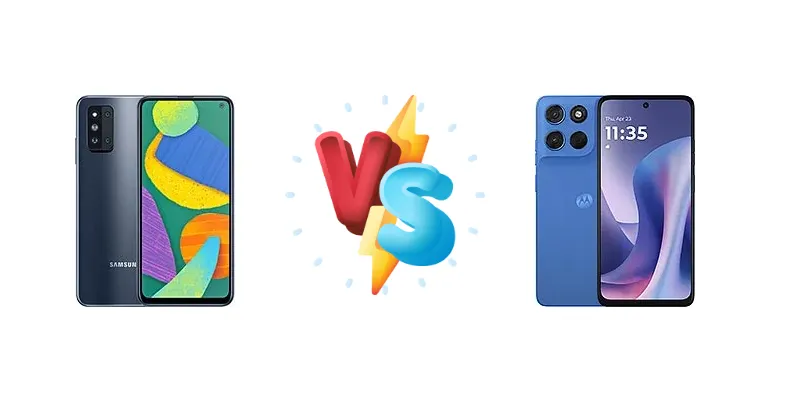
The Samsung Galaxy F52 5G and Motorola Moto G100S represent compelling options in the increasingly competitive mid-range 5G smartphone market. While both aim to deliver 5G connectivity at accessible price points, they diverge significantly in their core hardware, particularly in their chipset choices. This comparison dissects those differences to determine which device offers the best overall experience.
🏆 Quick Verdict
For the average user prioritizing efficiency and sustained performance, the Motorola Moto G100S is the stronger choice. Its Snapdragon 6s Gen 4, built on a 4nm process, offers superior thermal management and potentially longer battery life compared to the Samsung Galaxy F52 5G’s Snapdragon 750G.
| Network |
|---|
| 2G bands | GSM 850 / 900 / 1800 / 1900 | GSM 850 / 900 / 1800 / 1900 |
| 3G bands | HSDPA 850 / 900 / 1900 / 2100 | HSDPA 850 / 900 / 1900 / 2100 |
| 4G bands | 1, 3, 5, 7, 8, 34, 38, 39, 40, 41 | LTE |
| 5G bands | 1, 28, 41, 78 Sub6 | SA/NSA |
| Speed | HSPA, LTE, 5G | HSPA, LTE, 5G |
| Technology | GSM / HSPA / LTE / 5G | GSM / HSPA / LTE / 5G |
| Launch |
|---|
| Announced | 2021, May 20 | 2025, November 03 |
| Status | Available. Released 2021, June 01 | Available. Released 2025, November 03 |
| Body |
|---|
| Build | - | Glass front, plastic frame, silicone polymer (eco leather) back |
| Dimensions | 164.6 x 76.3 x 8.7 mm (6.48 x 3.00 x 0.34 in) | 166.2 x 76.5 x 8.6 mm (6.54 x 3.01 x 0.34 in) |
| SIM | Nano-SIM + Nano-SIM | Nano-SIM + Nano-SIM |
| Weight | 199 g (7.02 oz) | 210 g (7.41 oz) |
| Display |
|---|
| Resolution | 1080 x 2408 pixels, 20:9 ratio (~400 ppi density) | 1080 x 2400 pixels, 20:9 ratio (~392 ppi density) |
| Size | 6.6 inches, 104.9 cm2 (~83.6% screen-to-body ratio) | 6.72 inches, 109.0 cm2 (~85.8% screen-to-body ratio) |
| Type | TFT LCD, 120Hz | IPS LCD, 120Hz, 1050 nits (peak) |
| Platform |
|---|
| CPU | Octa-core (2x2.2 GHz Kryo 570 & 6x1.8 GHz Kryo 570) | Octa-core (4x2.4 GHz Cortex-A78 & 4x1.8 GHz Cortex-A55) |
| Chipset | Qualcomm SM7225 Snapdragon 750G 5G (8 nm) | Qualcomm SM6435-AA Snapdragon 6s Gen 4 (4 nm) |
| GPU | Adreno 619 | Adreno |
| OS | Android 11, One UI 3.1 | Android 15 |
| Memory |
|---|
| Card slot | microSDXC (uses shared SIM slot) | No |
| Internal | 128GB 8GB RAM | 128GB 8GB RAM, 256GB 8GB RAM |
| Main Camera |
|---|
| Dual | - | 50 MP, f/1.9 (wide), 1/1.95", 0.8µm, PDAF
8 MP, f/2.2, 118˚ (ultrawide), 1/4.0", 1.12µm |
| Features | LED flash, panorama, HDR | LED flash, HDR, panorama |
| Quad | 64 MP, f/1.8, (wide), PDAF
8 MP, f/2.2, (ultrawide), 1.12µm
2 MP (macro)
Auxiliary lens | - |
| Video | 4K@30fps, 1080p@30/120fps | 1440p@30fps, 1080p@30fps |
| Selfie camera |
|---|
| Features | HDR | HDR |
| Single | 16 MP, f/2.0, (wide) | 8 MP, f/2.2, (wide), 1/4.0", 1.12µm |
| Video | 1080p@30fps | 1440p@30fps, 1080p@30fps |
| Sound |
|---|
| 3.5mm jack | Yes | - |
| 35mm jack | Yes | Yes |
| Loudspeaker | Yes | Yes, with stereo speakers |
| Comms |
|---|
| Bluetooth | 5.0, A2DP, LE | 5.1, A2DP, LE |
| NFC | No | Yes |
| Positioning | GPS, GLONASS, GALILEO, BDS | GPS, GALILEO, GLONASS, BDS, QZSS |
| Radio | No | No |
| USB | USB Type-C 2.0 | USB Type-C 2.0, OTG |
| WLAN | Wi-Fi 802.11 a/b/g/n/ac, dual-band, Wi-Fi Direct | Wi-Fi 802.11 a/b/g/n/ac, dual-band |
| Features |
|---|
| Sensors | Fingerprint (side-mounted), accelerometer, gyro, proximity, compass | Fingerprint (side-mounted), accelerometer, gyro, proximity, compass |
| Battery |
|---|
| Charging | 25W wired | 30W wired |
| Type | Li-Po 4500 mAh | Si/C Li-Ion 7000 mAh |
| Misc |
|---|
| Colors | White, Black | Black, Blue |
| Models | SM-E5260 | - |
| Price | About 260 EUR | About 120 EUR |
Samsung Galaxy F52 5G
- Established Samsung brand reputation
- Potentially vibrant display colors
- Wider availability in some regions
- Less efficient Snapdragon 750G chipset
- Slower 25W charging
- Potential for thermal throttling
Motorola Moto G100S
- More efficient Snapdragon 6s Gen 4 (4nm)
- Faster 30W wired charging
- Balanced CPU core configuration
- Less brand recognition
- Potentially less saturated display colors
- Software update support may be shorter
Display Comparison
Detailed display specifications are absent, but given the market positioning, both likely feature LCD panels. The key differentiator will be color accuracy and peak brightness. However, without specific nit ratings, it's difficult to declare a clear winner. Motorola often prioritizes color calibration, while Samsung tends towards vibrant, saturated colors. Bezels are likely comparable, reflecting the mid-range segment.
Camera Comparison
Without detailed sensor information, a direct camera comparison is challenging. However, the chipset plays a role in image signal processing (ISP) capabilities. The newer Snapdragon 6s Gen 4 likely benefits from improved ISP algorithms, potentially leading to better dynamic range and noise reduction. The absence of OIS information suggests neither phone prioritizes optical image stabilization. The usefulness of any 2MP macro lens on either device is questionable; image quality will likely be subpar. The larger the primary sensor (which is unknown for both), the better the low-light performance.
Performance
The core battleground is the chipset. The Motorola Moto G100S’s Snapdragon 6s Gen 4 (4nm) represents a significant architectural leap over the Samsung Galaxy F52 5G’s Snapdragon 750G (8nm). The 4nm process inherently provides better power efficiency, translating to less heat generation under load. While the F52 5G’s Kryo 570 cores offer a 2.2GHz peak clock speed, the G100S counters with Cortex-A78 cores clocked at 2.4GHz, offering superior single-core performance. The G100S’s CPU configuration (4x A78 + 4x A55) is also more balanced than the F52 5G’s (2x Kryo 570 + 6x Kryo 570). This suggests the G100S will handle multitasking and demanding applications more smoothly.
Battery Life
Battery capacity is not specified, but the Motorola Moto G100S’s 30W wired charging is a clear advantage over the Samsung Galaxy F52 5G’s 25W charging. The 4nm process of the Snapdragon 6s Gen 4 also contributes to better power efficiency, potentially offsetting any capacity differences. Expect the G100S to achieve a 0-100% charge faster and potentially offer longer screen-on time.
Buying Guide
Buy the Samsung Galaxy F52 5G if you prioritize a well-established brand ecosystem and are comfortable with potentially warmer temperatures during extended use. Buy the Motorola Moto G100S if you value efficient performance, faster charging, and a more modern chipset architecture, even if it means sacrificing brand recognition.
Frequently Asked Questions
❓ Will the Motorola Moto G100S get noticeably warmer than the Samsung Galaxy F52 5G during extended gaming sessions?
Yes, the Samsung Galaxy F52 5G, with its 8nm Snapdragon 750G, is more likely to experience thermal throttling and become warmer during prolonged gaming. The Motorola Moto G100S’s 4nm Snapdragon 6s Gen 4 is significantly more power-efficient, resulting in lower heat output and sustained performance.
❓ How much faster is the 30W charging on the Moto G100S compared to the 25W charging on the F52 5G?
While the difference isn't exponential, the 30W charging on the Moto G100S will likely shave off approximately 15-20 minutes from a full 0-100% charge compared to the F52 5G. The efficiency gains from the 4nm chipset also contribute to faster overall charging times.
❓ Does the Snapdragon 6s Gen 4 in the Moto G100S offer a significant performance boost for everyday tasks like browsing and social media?
While both phones will handle everyday tasks smoothly, the Snapdragon 6s Gen 4 provides a more responsive experience due to its Cortex-A78 performance cores and optimized architecture. App launch times and multitasking will feel snappier on the Moto G100S.