
Samsung Galaxy F52 5G vs Google Pixel 5a 5G: A Deep Dive into Mid-Range 5G Contenders
| Phones Images | |||||
|---|---|---|---|---|---|
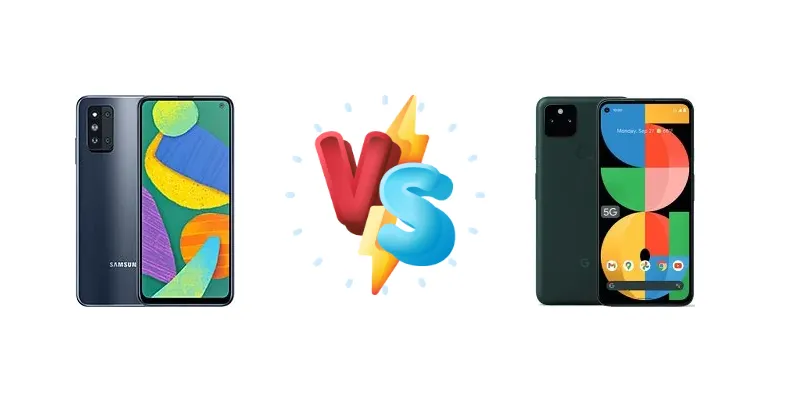
|
🏆 Quick Verdict
For the average user prioritizing display quality and software experience, the Google Pixel 5a 5G is the stronger choice. However, the Samsung Galaxy F52 5G offers faster 25W charging and a potentially more robust gaming experience due to its newer Snapdragon 750G, making it ideal for power users.
| PHONES | ||
|---|---|---|
| Phone Names | Samsung Galaxy F52 5G | Google Pixel 5a 5G |
| Network | ||
|---|---|---|
| 2G bands | GSM 850 / 900 / 1800 / 1900 | GSM 850 / 900 / 1800 / 1900 |
| 3G bands | HSDPA 850 / 900 / 1900 / 2100 | HSDPA 850 / 900 / 1700(AWS) / 1900 / 2100 |
| 4G bands | 1, 3, 5, 7, 8, 34, 38, 39, 40, 41 | 1, 2, 3, 4, 5, 7, 8, 12, 13, 14, 17, 18, 19, 20, 25, 26, 28, 29, 30, 32, 38, 39, 40, 41, 42, 46, 48, 66, 71 |
| 5G bands | 1, 28, 41, 78 Sub6 | 1, 2, 5, 12, 25, 28, 41, 66, 71, 77, 78 SA/NSA/Sub6 |
| Speed | HSPA, LTE, 5G | HSPA, LTE, 5G |
| Technology | GSM / HSPA / LTE / 5G | GSM / HSPA / EVDO / LTE / 5G |
| - | CDMA2000 1xEV-DO | |
| Launch | ||
|---|---|---|
| Announced | 2021, May 20 | 2021, August 17 |
| Status | Available. Released 2021, June 01 | Available. Released 2021, August 26 |
| Body | ||
|---|---|---|
| Build | - | Glass front (Gorilla Glass 3), aluminum frame, aluminum back |
| Dimensions | 164.6 x 76.3 x 8.7 mm (6.48 x 3.00 x 0.34 in) | 156.2 x 73.2 x 8.8 mm (6.15 x 2.88 x 0.35 in) |
| SIM | Nano-SIM + Nano-SIM | Nano-SIM + eSIM |
| Weight | 199 g (7.02 oz) | 183 g (6.46 oz) |
| - | IP67 dust/water resistant (up to 1m for 30 min) | |
| Display | ||
|---|---|---|
| Protection | - | Corning Gorilla Glass 3 |
| Resolution | 1080 x 2408 pixels, 20:9 ratio (~400 ppi density) | 1080 x 2400 pixels, 20:9 ratio (~415 ppi density) |
| Size | 6.6 inches, 104.9 cm2 (~83.6% screen-to-body ratio) | 6.34 inches, 97.0 cm2 (~84.9% screen-to-body ratio) |
| Type | TFT LCD, 120Hz | OLED, HDR |
| - | Always-on display | |
| Platform | ||
|---|---|---|
| CPU | Octa-core (2x2.2 GHz Kryo 570 & 6x1.8 GHz Kryo 570) | Octa-core (1x2.4 GHz Kryo 475 Prime & 1x2.2 GHz Kryo 475 Gold & 6x1.8 GHz Kryo 475 Silver) |
| Chipset | Qualcomm SM7225 Snapdragon 750G 5G (8 nm) | Qualcomm SM7250 Snapdragon 765G 5G (7 nm) |
| GPU | Adreno 619 | Adreno 620 |
| OS | Android 11, One UI 3.1 | Android 11, upgradable to Android 14 |
| Memory | ||
|---|---|---|
| Card slot | microSDXC (uses shared SIM slot) | No |
| Internal | 128GB 8GB RAM | 128GB 6GB RAM |
| Main Camera | ||
|---|---|---|
| Dual | - | 12.2 MP, f/1.7, 27mm, (wide), 1/2.55", 1.4µm, dual pixel PDAF, OIS 16 MP, f/2.2, 119˚ (ultrawide), 1.0µm |
| Features | LED flash, panorama, HDR | LED flash, Pixel Shift, Auto-HDR, panorama |
| Quad | 64 MP, f/1.8, (wide), PDAF 8 MP, f/2.2, (ultrawide), 1.12µm 2 MP (macro) Auxiliary lens | - |
| Single | - | 8 MP, f/2.0, 24mm (wide), 1.12µm |
| Video | 4K@30fps, 1080p@30/120fps | 4K@30/60fps, 1080p@30/60/120/240fps; gyro-EIS |
| Selfie camera | ||
|---|---|---|
| Features | HDR | HDR |
| Single | 16 MP, f/2.0, (wide) | 8 MP, f/2.0, 24mm (wide), 1.12µm |
| Video | 1080p@30fps | 1080p@30fps |
| Sound | ||
|---|---|---|
| 3.5mm jack | Yes | Yes |
| 35mm jack | Yes | Yes |
| Loudspeaker | Yes | Yes, with stereo speakers |
| Comms | ||
|---|---|---|
| Bluetooth | 5.0, A2DP, LE | 5.0, A2DP, LE, aptX HD |
| NFC | No | Yes |
| Positioning | GPS, GLONASS, GALILEO, BDS | GPS, GLONASS, GALILEO, QZSS, BDS |
| Radio | No | No |
| USB | USB Type-C 2.0 | USB Type-C 3.1 |
| WLAN | Wi-Fi 802.11 a/b/g/n/ac, dual-band, Wi-Fi Direct | Wi-Fi 802.11 a/b/g/n/ac, dual-band, Wi-Fi Direct |
| Features | ||
|---|---|---|
| Sensors | Fingerprint (side-mounted), accelerometer, gyro, proximity, compass | Fingerprint (rear-mounted), accelerometer, gyro, proximity, compass, barometer |
| Battery | ||
|---|---|---|
| Charging | 25W wired | 18W wired, PD2.0 |
| Type | Li-Po 4500 mAh | Li-Po 4680 mAh |
| Misc | ||
|---|---|---|
| Colors | White, Black | Mostly Black |
| Models | SM-E5260 | G1F8F, G4S1M |
| Price | About 260 EUR | $ 189.00 / C$ 249.99 |
| Tests | ||
|---|---|---|
| Battery life | - | Endurance rating 122h |
| Display | - | Contrast ratio: Infinite (nominal) |
| Performance | - | AnTuTu: 291303 (v8) GeekBench: 1337 (v5.1) GFXBench: 19fps (ES 3.1 onscreen) |
Samsung Galaxy F52 5G
- Faster 25W charging for quicker top-ups
- Newer Snapdragon 750G chipset for potentially better sustained gaming
- More customizable Android experience (One UI)
- Display likely inferior to Pixel 5a 5G in brightness and color accuracy
- Camera performance likely relies more on hardware than software
Google Pixel 5a 5G
- Brighter display (861 nits) for excellent outdoor visibility
- Superior camera performance thanks to Google’s computational photography
- Guaranteed software updates and a clean Android experience
- Slower 18W charging
- Older Snapdragon 765G chipset
Display Comparison
The Google Pixel 5a 5G boasts a significantly brighter display, reaching a measured 861 nits, compared to an unspecified brightness for the F52 5G. This higher peak brightness translates to better outdoor visibility. While both displays have an 'infinite' (nominal) contrast ratio, the Pixel 5a’s superior brightness is a clear advantage. The F52 5G’s display specs are less detailed, suggesting a potentially lower-quality panel, though refresh rate information is missing for both devices. The Pixel 5a’s display is likely to offer a more vibrant and enjoyable viewing experience.
Camera Comparison
The Pixel 5a 5G leverages Google’s computational photography prowess, even without detailed sensor specifications. While sensor sizes aren't provided, Google’s image processing algorithms are known to extract exceptional detail and dynamic range. The F52 5G’s camera specs are similarly sparse. Without knowing sensor sizes or apertures, it’s difficult to make a direct comparison. However, the Pixel 5a’s reputation for consistently excellent image quality, particularly in challenging lighting conditions, gives it a significant edge. The absence of detailed camera information for the F52 5G suggests it may rely more on hardware than software for image quality.
Performance
Both phones utilize Qualcomm Snapdragon 7-series chipsets, but with key differences. The Pixel 5a 5G features the Snapdragon 765G (7nm process), while the F52 5G uses the Snapdragon 750G (8nm process). While the 765G has a slightly higher clocked prime core (2.4 GHz vs 2.2 GHz), the 750G benefits from a newer architecture and 5G modem. The 7nm process of the 765G *should* offer better efficiency, but the 750G’s Kryo 570 cores are a generation newer. Real-world performance will likely be similar for everyday tasks, but the F52 5G may exhibit better sustained performance in graphically demanding games due to its newer chipset and potentially improved thermal management. Both devices feature 6GB of RAM, a standard for this price point.
Battery Life
Both the Samsung Galaxy F52 5G and Google Pixel 5a 5G achieve an endurance rating of 122 hours, indicating comparable battery life under similar usage conditions. However, the charging speeds differ significantly. The F52 5G supports 25W wired charging, while the Pixel 5a 5G is limited to 18W with PD2.0. This means the F52 5G will recharge much faster, potentially topping up from 0-100% in significantly less time. While battery capacity isn't specified, the faster charging of the F52 5G provides a practical advantage for users who frequently need to quickly replenish their battery.
Buying Guide
Buy the Samsung Galaxy F52 5G if you need faster charging speeds, prioritize sustained gaming performance, and appreciate a more customizable Android experience. Buy the Google Pixel 5a 5G if you prefer a superior display with excellent brightness, a streamlined software experience with guaranteed updates, and Google’s renowned computational photography.