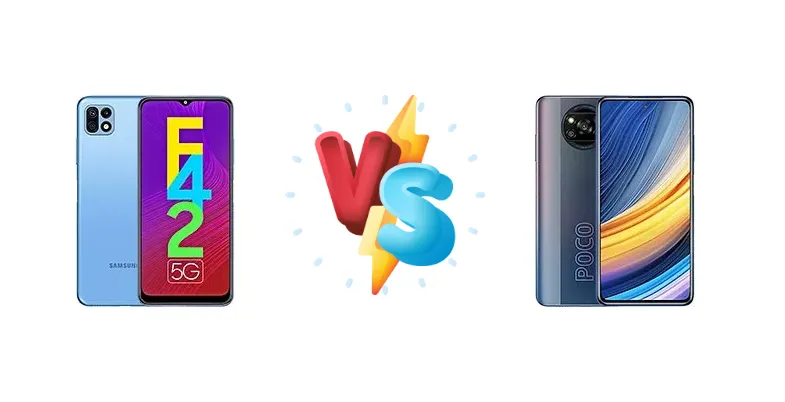
The Xiaomi Poco X3 Pro and Samsung Galaxy F42 5G represent compelling options in the crowded mid-range 5G smartphone market. The Poco X3 Pro aggressively targets gamers with its Snapdragon 860, while the Galaxy F42 5G aims for broader appeal with a more balanced feature set and Samsung’s brand recognition. This comparison dissects their key differences to determine which device offers the best overall experience.
🏆 Quick Verdict
For most users, the Xiaomi Poco X3 Pro emerges as the stronger choice. Its Snapdragon 860 chipset delivers significantly superior performance, particularly in gaming, and its 33W fast charging is a substantial advantage over the F42 5G’s 15W charging. While the F42 5G offers a Samsung ecosystem benefit, the Poco X3 Pro’s raw power justifies the trade-off.
| Network |
|---|
| 2G bands | GSM 850 / 900 / 1800 / 1900 | GSM 850 / 900 / 1800 / 1900 |
| 3G bands | HSDPA 850 / 900 / 1900 / 2100 | HSDPA 850 / 900 / 1700(AWS) / 1900 / 2100 |
| 4G bands | 1, 2, 3, 5, 7, 8, 20, 28, 38, 40, 41 | 1, 2, 3, 4, 5, 7, 8, 20, 28, 38, 40, 41 - International |
| 5G bands | 1, 3, 5, 7, 8, 20, 28, 38, 41, 78, 79 SA/NSA/Sub6 | - |
| Speed | HSPA, LTE, 5G | HSPA, LTE |
| Technology | GSM / HSPA / LTE / 5G | GSM / HSPA / LTE |
| | - | 1, 2, 3, 5, 8, 38, 40, 41 - India |
| Launch |
|---|
| Announced | 2021, September 29 | 2021, March 22 |
| Status | Available. Released 2021, October 03 | Available. Released 2021, March 24 |
| Body |
|---|
| Build | Glass front, plastic frame, plastic back | Glass front (Gorilla Glass 6), plastic back |
| Dimensions | 167.2 x 76.4 x 9 mm (6.58 x 3.01 x 0.35 in) | 165.3 x 76.8 x 9.4 mm (6.51 x 3.02 x 0.37 in) |
| SIM | Nano-SIM + Nano-SIM | Nano-SIM + Nano-SIM |
| Weight | 203 g (7.16 oz) | 215 g (7.58 oz) |
| | - | IP53, dust and splash resistant |
| Display |
|---|
| Protection | - | Corning Gorilla Glass 6 |
| Resolution | 1080 x 2408 pixels, 20:9 ratio (~400 ppi density) | 1080 x 2400 pixels, 20:9 ratio (~395 ppi density) |
| Size | 6.6 inches, 104.9 cm2 (~82.1% screen-to-body ratio) | 6.67 inches, 107.4 cm2 (~84.6% screen-to-body ratio) |
| Type | TFT LCD, 90Hz | IPS LCD, 120Hz, 2404Hz PWM, HDR10, 450 nits (typ) |
| Platform |
|---|
| CPU | Octa-core (2x2.2 GHz Cortex-A76 & 6x2.0 GHz Cortex-A55) | Octa-core (1x2.96 GHz Kryo 485 Gold & 3x2.42 GHz Kryo 485 Gold & 4x1.78 GHz Kryo 485 Silver) |
| Chipset | Mediatek Dimensity 700 (7 nm) | Qualcomm Snapdragon 860 (7 nm) |
| GPU | Mali-G57 MC2 | Adreno 640 |
| OS | Android 11, upgradable to Android 13, One UI core 5 | Android 11, upgradable to Android 12, MIUI 13 for POCO |
| Memory |
|---|
| Card slot | microSDXC (dedicated slot) | microSDXC (uses shared SIM slot) |
| Internal | 128GB 6GB RAM, 128GB 8GB RAM | 128GB 6GB RAM, 128GB 8GB RAM, 256GB 6GB RAM, 256GB 8GB RAM |
| | - | UFS 3.1 |
| Main Camera |
|---|
| Features | LED flash, panorama, HDR | Dual-LED flash, HDR, panorama |
| Quad | - | 48 MP, f/1.8, (wide), 1/2.0", 0.8µm, PDAF
8 MP, f/2.2, 119˚ (ultrawide), 1.0µm
2 MP (macro)
Auxiliary lens |
| Single | - | 20 MP, f/2.2, (wide), 1/3.4", 0.8µm |
| Triple | 64 MP, f/1.8, (wide), PDAF
5 MP, f/2.2, 115˚ (ultrawide), 1/5.0", 1.12µm
Auxiliary lens | - |
| Video | 1152p@30fps | 4K@30fps, 1080p@30/60/120/240fps, 1080p@960fps, gyro-EIS |
| Selfie camera |
|---|
| Features | - | HDR, panorama |
| Single | 8 MP, f/2.0, (wide) | 20 MP, f/2.2, (wide), 1/3.4", 0.8µm |
| Video | 1080p@30fps | 1080p@30fps |
| Sound |
|---|
| 3.5mm jack | Yes | Yes |
| 35mm jack | Yes | Yes |
| Loudspeaker | Yes | Yes, with stereo speakers |
| | - | 24-bit/192kHz audio |
| Comms |
|---|
| Bluetooth | 5.0, A2DP, LE | 5.0, A2DP, LE |
| Infrared port | - | Yes |
| NFC | No | Yes (market/region dependent) |
| Positioning | GPS, GLONASS, GALILEO, BDS | GPS, GLONASS, GALILEO, BDS |
| Radio | FM radio, recording | FM radio, recording |
| USB | USB Type-C 2.0, OTG | USB Type-C 2.0, OTG |
| WLAN | Wi-Fi 802.11 a/b/g/n/ac, dual-band, Wi-Fi Direct | Wi-Fi 802.11 a/b/g/n/ac, dual-band, Wi-Fi Direct |
| Features |
|---|
| Sensors | Fingerprint (side-mounted), accelerometer, gyro, proximity, compass | Fingerprint (side-mounted), accelerometer, gyro, proximity, compass |
| Battery |
|---|
| Charging | 15W wired | 33W wired, 59% in 30 min, 100% in 59 min |
| Type | Li-Po 5000 mAh | Li-Po 5160 mAh |
| Misc |
|---|
| Colors | Matte Aqua, Matte Black | Phantom Black, Frost Blue, Metal Bronze |
| Models | SM-E426B, SM-E426B/DS | M2102J20SG, M2102J20SI |
| Price | About 240 EUR | $ 128.04 / £ 249.99 |
| SAR | 0.47 W/kg (head) | 0.99 W/kg (head) 0.67 W/kg (body) |
| SAR EU | 0.94 W/kg (head) 1.23 W/kg (body) | 0.57 W/kg (head) 0.90 W/kg (body) |
| Tests |
|---|
| Battery life | - |
Endurance rating 112h
|
| Camera | - |
Photo / Video |
| Display | - |
Contrast ratio: 1401:1 (nominal) |
| Loudspeaker | - |
-26.1 LUFS (Good)
|
| Performance | - |
AnTuTu: 453223 (v8)
GeekBench: 2574 (v5.1)
GFXBench: 38fps (ES 3.1 onscreen) |
Samsung Galaxy F42 5G
- Samsung Brand Recognition
- Potential for Samsung Ecosystem Integration
- Reliable 5G Connectivity
- Inferior Processor Performance
- Slow 15W Charging
- Limited Display Information
Xiaomi Poco X3 Pro
- Powerful Snapdragon 860 Processor
- Fast 33W Charging
- 120Hz Display Refresh Rate
- Xiaomi’s MIUI Software (can be polarizing)
- Less Brand Recognition than Samsung
- Camera specs are not detailed
Display Comparison
Both devices share a nominal contrast ratio of 1401:1, suggesting similar visual pop. However, detailed display specs like peak brightness, panel type (IPS vs AMOLED), and refresh rate are missing for the F42 5G. Given the F42 5G’s price point, it likely utilizes a standard IPS LCD, while the Poco X3 Pro’s display is known for its 120Hz refresh rate, offering a smoother scrolling and gaming experience. The absence of detailed display information for the F42 5G makes a direct comparison difficult, but the X3 Pro’s higher refresh rate is a clear advantage for visually demanding users.
Camera Comparison
Both phones feature 'Photo / Video' capabilities, but lack specific details regarding sensor size, aperture, or image processing algorithms. The absence of this data makes a detailed camera comparison impossible. However, given the Poco X3 Pro’s focus on overall performance, it’s reasonable to assume its image processing pipeline is optimized for speed and clarity. The F42 5G’s camera performance is likely more aligned with typical Samsung mid-range offerings, prioritizing color accuracy and dynamic range. Without concrete specs, it’s difficult to declare a clear winner, but the X3 Pro’s processing power could give it an edge in post-processing capabilities.
Performance
The performance gap is the most significant differentiator. The Poco X3 Pro’s Qualcomm Snapdragon 860 (7nm) boasts a prime core clocked at 2.96 GHz, alongside three additional performance cores clocked at 2.42 GHz, and four efficiency cores at 1.78 GHz. This configuration demonstrably outperforms the Samsung Galaxy F42 5G’s MediaTek Dimensity 700 (7nm) with its 2x2.2 GHz Cortex-A76 and 6x2.0 GHz Cortex-A55 cores. The Snapdragon 860’s architecture is optimized for sustained performance, making it ideal for demanding games and applications. While both chips are 7nm, the Snapdragon 860’s superior core configuration and clock speeds translate to a noticeably faster and more responsive user experience.
Battery Life
Both devices achieve an endurance rating of 112 hours, indicating comparable battery life under similar usage conditions. However, the Poco X3 Pro’s 33W wired charging significantly surpasses the Galaxy F42 5G’s 15W charging. The X3 Pro can reach 59% charge in 30 minutes and 100% in 59 minutes, minimizing downtime. The F42 5G’s slower charging speed will require considerably longer to fully replenish the battery, making the X3 Pro the more convenient option for users who prioritize quick top-ups.
Buying Guide
Buy the Samsung Galaxy F42 5G if you prioritize a familiar Samsung user interface, are heavily invested in the Samsung ecosystem, and primarily need a reliable 5G phone for everyday tasks. Buy the Xiaomi Poco X3 Pro if you are a mobile gamer, demand faster charging speeds, and prioritize raw performance over brand loyalty. The X3 Pro is the clear winner for power users.
Frequently Asked Questions
❓ Will the Snapdragon 860 in the Poco X3 Pro overheat during extended gaming sessions?
While the Snapdragon 860 is a powerful chip, Xiaomi has implemented thermal management solutions, including a heat pipe, to mitigate overheating. While some throttling may occur during prolonged, intensive gaming, the X3 Pro is generally well-equipped to handle demanding titles without significant performance degradation.
❓ Is the 15W charging on the Galaxy F42 5G noticeably slower in real-world use?
Yes, the 15W charging on the Galaxy F42 5G is considerably slower than the 33W charging on the Poco X3 Pro. Expect a significantly longer time to fully charge the F42 5G, potentially taking over two hours for a complete recharge from 0%.
❓ Does the Poco X3 Pro support high frame rate gaming like 90fps in PUBG Mobile?
The Poco X3 Pro can achieve high frame rates in PUBG Mobile, but it depends on the graphics settings. While it may not consistently maintain 90fps on the highest settings, it can comfortably run the game at 60fps with smooth graphics, providing a competitive gaming experience.
❓ What are the key differences between the Dimensity 700 and Snapdragon 860 in terms of everyday tasks?
For basic tasks like browsing, social media, and video streaming, both chips are capable. However, the Snapdragon 860 offers a more responsive and fluid experience due to its superior processing power. Apps will launch faster, multitasking will be smoother, and the overall user interface will feel snappier on the Poco X3 Pro.