
OnePlus Nord 2 5G vs Samsung Galaxy F42 5G: A Detailed Comparison
| Phones Images | |||||
|---|---|---|---|---|---|
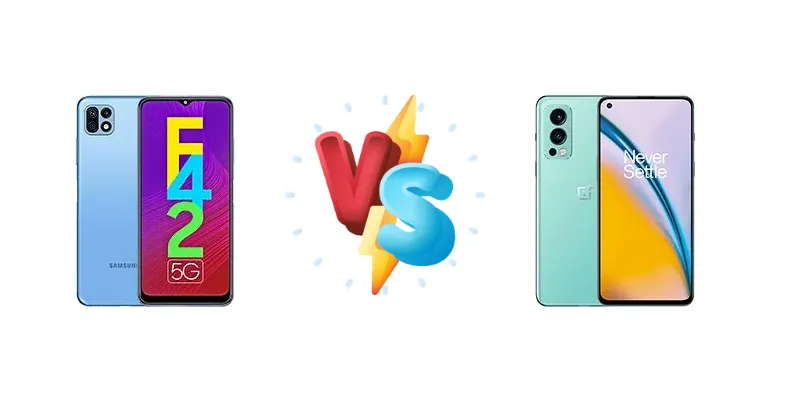
|
🏆 Quick Verdict
For most users, the OnePlus Nord 2 5G is the superior choice. Its Mediatek Dimensity 1200 chipset offers a substantial performance uplift over the F42 5G’s Dimensity 700, and the 65W charging is a game-changer, fully replenishing the battery in just 30 minutes. While the F42 5G provides comparable battery endurance, it can't match the Nord 2's speed.
| PHONES | ||
|---|---|---|
| Phone Names | Samsung Galaxy F42 5G | OnePlus Nord 2 5G |
| Network | ||
|---|---|---|
| 2G bands | GSM 850 / 900 / 1800 / 1900 | GSM 850 / 900 / 1800 / 1900 |
| 3G bands | HSDPA 850 / 900 / 1900 / 2100 | HSDPA 800 / 850 / 900 / 1700(AWS) / 1800 / 1900 / 2100 |
| 4G bands | 1, 2, 3, 5, 7, 8, 20, 28, 38, 40, 41 | 1, 2, 3, 4, 5, 7, 8, 12, 17, 18, 19, 20, 26, 28, 32, 34, 38, 39, 40, 41, 66 - EU |
| 5G bands | 1, 3, 5, 7, 8, 20, 28, 38, 41, 78, 79 SA/NSA/Sub6 | 1, 3, 7, 8, 20, 28, 38, 41, 66, 78 SA/NSA - EU |
| Speed | HSPA, LTE, 5G | HSPA 42.2/5.76 Mbps, LTE Cat18 1200/150 Mbps, 5G |
| Technology | GSM / HSPA / LTE / 5G | GSM / HSPA / LTE / 5G |
| Launch | ||
|---|---|---|
| Announced | 2021, September 29 | 2021, July 22 |
| Status | Available. Released 2021, October 03 | Available. Released 2021, July 28 |
| Body | ||
|---|---|---|
| Build | Glass front, plastic frame, plastic back | Glass front (Gorilla Glass 5), glass back (Gorilla Glass 5), plastic frame |
| Dimensions | 167.2 x 76.4 x 9 mm (6.58 x 3.01 x 0.35 in) | 159.1 x 73.3 x 8.3 mm (6.26 x 2.89 x 0.33 in) |
| SIM | Nano-SIM + Nano-SIM | Nano-SIM + Nano-SIM |
| Weight | 203 g (7.16 oz) | 189 g (6.67 oz) |
| Display | ||
|---|---|---|
| Protection | - | Corning Gorilla Glass 5 |
| Resolution | 1080 x 2408 pixels, 20:9 ratio (~400 ppi density) | 1080 x 2400 pixels, 20:9 ratio (~409 ppi density) |
| Size | 6.6 inches, 104.9 cm2 (~82.1% screen-to-body ratio) | 6.43 inches, 99.8 cm2 (~85.6% screen-to-body ratio) |
| Type | TFT LCD, 90Hz | Fluid AMOLED, 90Hz, HDR10+ |
| Platform | ||
|---|---|---|
| CPU | Octa-core (2x2.2 GHz Cortex-A76 & 6x2.0 GHz Cortex-A55) | Octa-core (1x3.0 GHz Cortex-A78 & 3x2.6 GHz Cortex-A78 & 4x2.0 GHz Cortex-A55) |
| Chipset | Mediatek Dimensity 700 (7 nm) | Mediatek Dimensity 1200 (6 nm) |
| GPU | Mali-G57 MC2 | Mali-G77 MC9 |
| OS | Android 11, upgradable to Android 13, One UI core 5 | Android 11, upgradable to Android 13, OxygenOS 13 |
| Memory | ||
|---|---|---|
| Card slot | microSDXC (dedicated slot) | No |
| Internal | 128GB 6GB RAM, 128GB 8GB RAM | 128GB 6GB RAM, 128GB 8GB RAM, 256GB 8GB RAM, 256GB 12GB RAM |
| Main Camera | ||
|---|---|---|
| Features | LED flash, panorama, HDR | Dual-LED flash, HDR, panorama |
| Triple | 64 MP, f/1.8, (wide), PDAF 5 MP, f/2.2, 115˚ (ultrawide), 1/5.0", 1.12µm Auxiliary lens | 50 MP, f/1.9, 24mm (wide), 1/1.56", 1.0µm, PDAF, OIS 8 MP, f/2.3, 120˚ (ultrawide) Auxiliary lens |
| Video | 1152p@30fps | 4K@30fps, 1080p@30/60/120fps, gyro-EIS |
| Selfie camera | ||
|---|---|---|
| Features | - | Auto HDR |
| Single | 8 MP, f/2.0, (wide) | 32 MP, f/2.5, (wide), 1/2.8", 0.8µm |
| Video | 1080p@30fps | 1080p@30fps, gyro-EIS |
| Sound | ||
|---|---|---|
| 3.5mm jack | Yes | No |
| 35mm jack | Yes | No |
| Loudspeaker | Yes | Yes, with stereo speakers |
| Comms | ||
|---|---|---|
| Bluetooth | 5.0, A2DP, LE | 5.2, A2DP, LE, aptX HD |
| NFC | No | Yes |
| Positioning | GPS, GLONASS, GALILEO, BDS | GPS, GLONASS, GALILEO, BDS, SBAS, NavIC |
| Radio | FM radio, recording | No |
| USB | USB Type-C 2.0, OTG | USB Type-C 2.0, OTG |
| WLAN | Wi-Fi 802.11 a/b/g/n/ac, dual-band, Wi-Fi Direct | Wi-Fi 802.11 a/b/g/n/ac/6, dual-band, Wi-Fi Direct |
| Features | ||
|---|---|---|
| Sensors | Fingerprint (side-mounted), accelerometer, gyro, proximity, compass | Fingerprint (under display, optical), accelerometer, gyro, proximity, compass |
| Battery | ||
|---|---|---|
| Charging | 15W wired | 65W wired, PD, 100% in 30 min |
| Type | Li-Po 5000 mAh | Li-Po 4500 mAh |
| Misc | ||
|---|---|---|
| Colors | Matte Aqua, Matte Black | Gray Sierra, Blue Haze, Green Wood, Pac-Man Edition |
| Models | SM-E426B, SM-E426B/DS | DN2101, DN2103 |
| Price | About 240 EUR | € 189.00 / $ 219.99 / £ 148.00 |
| SAR | 0.47 W/kg (head) | - |
| SAR EU | 0.94 W/kg (head) 1.23 W/kg (body) | - |
| Tests | ||
|---|---|---|
| Battery life | - | Endurance rating 102h |
| Camera | - | Photo / Video |
| Display | - | Contrast ratio: Infinite (nominal) |
| Loudspeaker | - | -24.3 LUFS (Very good) |
| Performance | - | AnTuTu: 512164 (v8) | 598022 (v9) GeekBench: 2792 (v5.1) GFXBench: 38fps (ES 3.1 onscreen) |
Samsung Galaxy F42 5G
- Potentially lower price point
- Comparable battery endurance to Nord 2
- 5G connectivity
- Significantly slower charging (15W)
- Less powerful processor (Dimensity 700)
- Likely less refined camera system
OnePlus Nord 2 5G
- Much faster charging (65W, 30 min full charge)
- More powerful processor (Dimensity 1200)
- Brighter display (633 nits)
- Higher price compared to F42 5G
- Similar battery endurance to F42 5G
- Camera details are unknown
Display Comparison
The OnePlus Nord 2 5G boasts a brighter display, reaching a measured peak brightness of 633 nits, which translates to better visibility outdoors compared to the F42 5G (brightness data unavailable). While both displays feature an 'infinite' contrast ratio (nominal), the Nord 2’s higher brightness is a tangible advantage. The absence of refresh rate data for the F42 5G suggests it likely operates at a standard 60Hz, while the Nord 2’s panel is expected to offer a smoother experience, though the exact refresh rate isn't specified in the provided data.
Camera Comparison
Both phones are listed as having Photo/Video capabilities, but detailed camera specifications are missing. Without sensor size, aperture, or OIS information, a direct comparison is difficult. However, the market positioning of the Nord 2 suggests a more sophisticated camera system, potentially with larger sensors and more advanced image processing algorithms. The F42 5G likely prioritizes affordability over camera prowess. The inclusion of a 2MP macro camera on many devices in this price range is common, but its utility is often limited.
Performance
The performance gap between these two devices is significant. The OnePlus Nord 2 5G’s Mediatek Dimensity 1200 (6nm) is a substantial upgrade over the Samsung Galaxy F42 5G’s Dimensity 700 (7nm). The Dimensity 1200 features a more powerful CPU configuration – a 1x3.0 GHz Cortex-A78 core alongside 3x2.6 GHz Cortex-A78 cores, versus the F42’s 2x2.2 GHz Cortex-A76 and 6x2.0 GHz Cortex-A55. This translates to faster app loading times, smoother multitasking, and improved gaming performance. The 6nm process node of the Dimensity 1200 also contributes to better thermal efficiency, potentially reducing throttling during sustained workloads.
Battery Life
Both the Samsung Galaxy F42 5G and OnePlus Nord 2 5G achieve an endurance rating of 102 hours, indicating comparable battery life under similar usage conditions. However, the charging experience is drastically different. The Nord 2 5G’s 65W wired charging, with PD support, can fully charge the battery in just 30 minutes. In contrast, the F42 5G is limited to 15W wired charging, resulting in a significantly longer charging time. This difference in charging speed is a major convenience factor for Nord 2 5G users.
Buying Guide
Buy the Samsung Galaxy F42 5G if you prioritize a lower upfront cost and are comfortable with slower charging speeds and less demanding tasks. Buy the OnePlus Nord 2 5G if you value a smoother, more responsive user experience, significantly faster charging, and are willing to spend a bit more for a more refined overall package. Gamers and power users will especially benefit from the Nord 2’s superior processing power.