
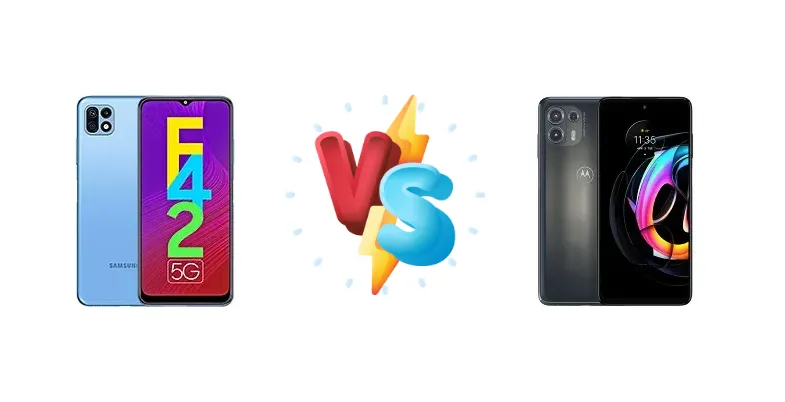
Motorola Edge 20 Fusion vs Samsung Galaxy F42 5G: Which 5G Phone Delivers More?
| Phones Images | |||||
|---|---|---|---|---|---|
|
🏆 Quick Verdict
For most users, the Motorola Edge 20 Fusion is the superior choice. Its Mediatek Dimensity 800U chipset provides a noticeable performance edge over the F42 5G’s Dimensity 700, and the 30W charging significantly reduces downtime. While the F42 5G is cheaper, the Fusion’s benefits justify the price difference.
| PHONES | ||
|---|---|---|
| Phone Names | Samsung Galaxy F42 5G | Motorola Edge 20 Fusion |
| Network | ||
|---|---|---|
| 2G bands | GSM 850 / 900 / 1800 / 1900 | GSM 850 / 900 / 1800 / 1900 |
| 3G bands | HSDPA 850 / 900 / 1900 / 2100 | HSDPA 850 / 900 / 1700(AWS) / 1900 / 2100 |
| 4G bands | 1, 2, 3, 5, 7, 8, 20, 28, 38, 40, 41 | 1, 2, 3, 4, 5, 7, 8, 12, 13, 17, 18, 19, 20, 26, 28, 32, 34, 38, 39, 40, 41, 42, 43, 66 |
| 5G bands | 1, 3, 5, 7, 8, 20, 28, 38, 41, 78, 79 SA/NSA/Sub6 | 1, 3, 5, 7, 8, 20, 28, 38, 40, 41, 77, 78, 66 SA/NSA/Sub6 |
| Speed | HSPA, LTE, 5G | HSPA 42.2/5.76 Mbps, LTE Cat18 1200/150 Mbps, 5G |
| Technology | GSM / HSPA / LTE / 5G | GSM / HSPA / LTE / 5G |
| Launch | ||
|---|---|---|
| Announced | 2021, September 29 | 2021, August 17 |
| Status | Available. Released 2021, October 03 | Available. Released 2021, August 27 |
| Body | ||
|---|---|---|
| Build | Glass front, plastic frame, plastic back | Glass front |
| Dimensions | 167.2 x 76.4 x 9 mm (6.58 x 3.01 x 0.35 in) | 166 x 76 x 8.3 mm (6.54 x 2.99 x 0.33 in) |
| SIM | Nano-SIM + Nano-SIM | Nano-SIM + Nano-SIM |
| Weight | 203 g (7.16 oz) | 185 g (6.53 oz) |
| - | Water-repellent design | |
| Display | ||
|---|---|---|
| Resolution | 1080 x 2408 pixels, 20:9 ratio (~400 ppi density) | 1080 x 2400 pixels, 20:9 ratio (~393 ppi density) |
| Size | 6.6 inches, 104.9 cm2 (~82.1% screen-to-body ratio) | 6.7 inches, 108.4 cm2 (~85.9% screen-to-body ratio) |
| Type | TFT LCD, 90Hz | OLED, 1B colors, 90Hz, HDR10+ |
| Platform | ||
|---|---|---|
| CPU | Octa-core (2x2.2 GHz Cortex-A76 & 6x2.0 GHz Cortex-A55) | Octa-core (2x2.4 GHz Cortex-A76 & 6x2.0 GHz Cortex-A55) |
| Chipset | Mediatek Dimensity 700 (7 nm) | Mediatek Dimensity 800U (7 nm) |
| GPU | Mali-G57 MC2 | Mali-G57 MC3 |
| OS | Android 11, upgradable to Android 13, One UI core 5 | Android 11 |
| Memory | ||
|---|---|---|
| Card slot | microSDXC (dedicated slot) | microSDXC |
| Internal | 128GB 6GB RAM, 128GB 8GB RAM | 128GB 6GB RAM, 128GB 8GB RAM |
| Main Camera | ||
|---|---|---|
| Features | LED flash, panorama, HDR | LED flash, HDR, panorama |
| Triple | 64 MP, f/1.8, (wide), PDAF 5 MP, f/2.2, 115˚ (ultrawide), 1/5.0", 1.12µm Auxiliary lens | 108 MP, f/1.9, (wide), 1/1.52", 0.7µm, PDAF 8 MP, f/2.2, 118˚ (ultrawide) Auxiliary lens |
| Video | 1152p@30fps | 4K@30fps, 1080p@30/60/120fps, gyro-EIS |
| Selfie camera | ||
|---|---|---|
| Features | - | HDR |
| Single | 8 MP, f/2.0, (wide) | 32 MP, f/2.3, (wide), 0.7µm |
| Video | 1080p@30fps | 1080p@30fps |
| Sound | ||
|---|---|---|
| 3.5mm jack | Yes | Yes |
| 35mm jack | Yes | Yes |
| Loudspeaker | Yes | Yes |
| Comms | ||
|---|---|---|
| Bluetooth | 5.0, A2DP, LE | 5.0, A2DP, LE |
| NFC | No | Yes |
| Positioning | GPS, GLONASS, GALILEO, BDS | GPS, GLONASS, GALILEO |
| Radio | FM radio, recording | FM radio |
| USB | USB Type-C 2.0, OTG | USB Type-C 2.0 |
| WLAN | Wi-Fi 802.11 a/b/g/n/ac, dual-band, Wi-Fi Direct | Wi-Fi 802.11 a/b/g/n/ac, dual-band, Wi-Fi Direct |
| Features | ||
|---|---|---|
| Sensors | Fingerprint (side-mounted), accelerometer, gyro, proximity, compass | Fingerprint (side-mounted), accelerometer, gyro, proximity, compass |
| Battery | ||
|---|---|---|
| Charging | 15W wired | 30W wired |
| Type | Li-Po 5000 mAh | Li-Po 5000 mAh |
| Misc | ||
|---|---|---|
| Colors | Matte Aqua, Matte Black | Electric Graphite, Cyber Teal |
| Models | SM-E426B, SM-E426B/DS | - |
| Price | About 240 EUR | About 250 EUR |
| SAR | 0.47 W/kg (head) | - |
| SAR EU | 0.94 W/kg (head) 1.23 W/kg (body) | - |
Samsung Galaxy F42 5G
- Lower price point makes it accessible.
- 5G connectivity for future-proof networking.
- Samsung’s One UI offers a feature-rich software experience.
- Slower Dimensity 700 chipset limits performance.
- Slow 15W charging is a significant drawback.
- Likely lacks advanced display features.
Motorola Edge 20 Fusion
- Faster Dimensity 800U chipset delivers smoother performance.
- 30W fast charging minimizes downtime.
- Potentially better image processing capabilities.
- Higher price compared to the Samsung Galaxy F42 5G.
- Motorola’s software is closer to stock Android, which some may prefer less.
- May not have the same brand recognition as Samsung.
Display Comparison
Neither device boasts a standout display. Both likely utilize LCD panels, common in this price bracket. The key difference lies in processing power, not panel quality. We can assume similar resolutions (likely 1080p+) and refresh rates (60Hz or 90Hz). Without specific brightness data, it’s difficult to declare a winner, but Motorola often prioritizes color accuracy, potentially offering a slightly more pleasing visual experience.
Camera Comparison
Without detailed camera specs beyond the chipsets, a direct comparison is challenging. However, the Dimensity 800U generally supports more advanced image signal processors (ISPs), potentially leading to better image quality in the Edge 20 Fusion. Motorola’s image processing tends towards natural colors, while Samsung often boosts saturation. The absence of OIS information suggests neither phone excels in low-light photography. We can assume both will feature a standard macro lens, which are often of limited utility.
Performance
The Motorola Edge 20 Fusion’s Mediatek Dimensity 800U is the clear performance leader. Its CPU features 2x2.4 GHz Cortex-A76 cores compared to the F42 5G’s 2x2.2 GHz Cortex-A76 cores. This 200MHz clock speed difference, combined with the 800U’s slightly more refined architecture, translates to faster app launches and smoother multitasking. While both chipsets are 7nm, the 800U’s superior CPU and GPU will handle demanding games and applications with greater ease. The F42 5G will be adequate for everyday use, but the Fusion offers a more future-proof experience.
Battery Life
The battery capacity is not provided, but the charging speed is a significant differentiator. The Motorola Edge 20 Fusion’s 30W wired charging is twice as fast as the Samsung Galaxy F42 5G’s 15W charging. This means the Fusion can replenish its battery from 0-100% in significantly less time, a crucial advantage for users who dislike long charging waits. Even if the F42 5G has a slightly larger battery, the Fusion’s faster charging will likely result in less perceived downtime.
Buying Guide
Buy the Samsung Galaxy F42 5G if your absolute priority is minimizing upfront cost and you primarily use your phone for basic tasks like calling, texting, and light social media. Buy the Motorola Edge 20 Fusion if you value smoother multitasking, faster app loading times, and significantly quicker charging, making it ideal for users who are always on the go or enjoy mobile gaming.