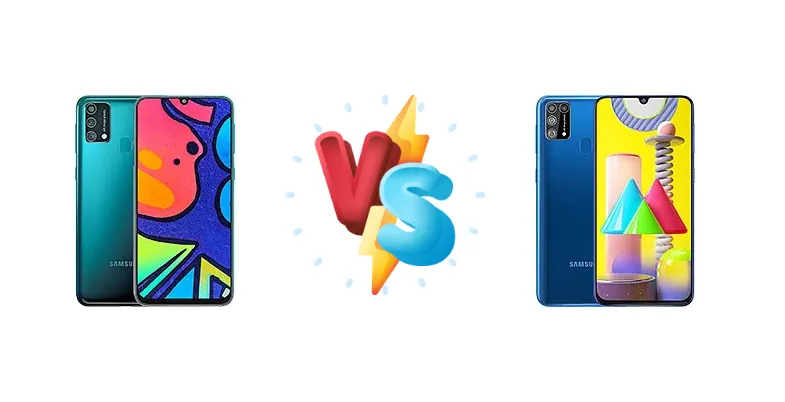
The Samsung Galaxy F41 and M31 Prime represent Samsung's strategy of offering compelling features at competitive price points. However, both devices are remarkably similar, utilizing the same Exynos 9611 chipset. This comparison dissects the nuances between these two models to determine which offers the best value for budget-conscious consumers.
🏆 Quick Verdict
For the average user, the Samsung Galaxy M31 Prime is the slightly better choice, primarily due to its often lower price point. Given the identical core hardware – the Exynos 9611 and 15W charging – the decision hinges on finding the best deal. The F41 doesn't offer any significant performance or feature advantages to justify a price premium.
| Network |
|---|
| 2G bands | GSM 850 / 900 / 1800 / 1900 | GSM 850 / 900 / 1800 / 1900 |
| 3G bands | HSDPA 850 / 900 / 2100 | HSDPA 850 / 900 / 1700(AWS) / 1900 / 2100 |
| 4G bands | 1, 3, 5, 8, 38, 40, 41 | 1, 2, 3, 4, 5, 7, 8, 12, 13, 17, 20, 26, 28, 38, 40, 41, 66 |
| EDGE | - | Yes |
| GPRS | - | Class 10 |
| Speed | HSPA, LTE | HSPA, LTE |
| Technology | GSM / HSPA / LTE | GSM / HSPA / LTE |
| Launch |
|---|
| Announced | 2020, October 08. Released 2020, October 16 | 2020, October 14. Released 2020, October 17 |
| Status | Discontinued | Discontinued |
| Body |
|---|
| Build | Glass front, plastic back, plastic frame | Glass front (Gorilla Glass 3), plastic back, plastic frame |
| Dimensions | 159.2 x 75.1 x 8.9 mm (6.27 x 2.96 x 0.35 in) | 159.2 x 75.1 x 8.9 mm (6.27 x 2.96 x 0.35 in) |
| SIM | Nano-SIM + Nano-SIM | Nano-SIM + Nano-SIM |
| Weight | 191 g (6.74 oz) | 191 g (6.74 oz) |
| Display |
|---|
| Protection | - | Corning Gorilla Glass 3 |
| Resolution | 1080 x 2340 pixels, 19.5:9 ratio (~403 ppi density) | 1080 x 2340 pixels, 19.5:9 ratio (~403 ppi density) |
| Size | 6.4 inches, 100.5 cm2 (~84.1% screen-to-body ratio) | 6.4 inches, 100.5 cm2 (~84.1% screen-to-body ratio) |
| Type | Super AMOLED, 420 nits (peak) | Super AMOLED, 420 nits (peak) |
| Platform |
|---|
| CPU | Octa-core (4x2.3 GHz Cortex-A73 & 4x1.7 GHz Cortex-A53) | Octa-core (4x2.3 GHz Cortex-A73 & 4x1.7 GHz Cortex-A53) |
| Chipset | Exynos 9611 (10 nm) | Exynos 9611 (10 nm) |
| GPU | Mali-G72 MP3 | Mali-G72 MP3 |
| OS | Android 10, upgradable to Android 11, One UI 3.1 | Android 10, One UI 2.0 |
| Memory |
|---|
| Call records | - | Yes |
| Card slot | microSDXC (dedicated slot) | microSDXC (dedicated slot) |
| Internal | 64GB 6GB RAM, 128GB 6GB RAM | 64GB 6GB RAM, 128GB 6GB RAM |
| Phonebook | - | Yes |
| | UFS 2.1 | UFS 2.1 |
| Main Camera |
|---|
| Features | LED flash, panorama, HDR | LED flash, panorama, HDR |
| Quad | - | 64 MP, f/1.8, 26mm (wide), 1/1.72", 0.8µm, PDAF
8 MP, f/2.2, 123˚ (ultrawide), 1/4.0", 1.12µm
5 MP (macro)
Auxiliary lens |
| Single | - | 3.15 MP |
| Triple | 64 MP, f/1.8, 26mm (wide), 1/1.72", 0.8µm, PDAF
8 MP, f/2.2, 123˚ (ultrawide), 1/4.0", 1.12µm
Auxiliary lens | - |
| Video | 4K@30fps, 1080p@30fps, gyro-EIS | 4K@30fps, 1080p@30fps, gyro-EIS |
| Selfie camera |
|---|
| Features | HDR | HDR |
| Single | 32 MP, f/2.0, 26mm (wide), 1/2.8", 0.8µm | 32 MP, f/2.0, 26mm (wide), 1/2.8", 0.8µm |
| Video | 1080p@30fps | 4K@30fps, 1080p@30fps |
| Sound |
|---|
| 3.5mm jack | Yes | Yes |
| 35mm jack | Yes | Yes |
| Loudspeaker | Yes | Yes |
| Comms |
|---|
| Bluetooth | 5.0, A2DP, LE | 5.0, A2DP, LE |
| NFC | No | No |
| Positioning | GPS, GLONASS, GALILEO, BDS | GPS, GLONASS, GALILEO, BDS |
| Radio | FM radio, RDS, recording | FM radio, RDS, recording |
| USB | USB Type-C 2.0 | USB Type-C 2.0 |
| WLAN | Wi-Fi 802.11 a/b/g/n/ac, dual-band, Wi-Fi Direct | Wi-Fi 802.11 a/b/g/n/ac, dual-band, Wi-Fi Direct |
| Features |
|---|
| Games | - | Downloadable |
| Java | - | Yes |
| Messaging | - | SMS, MMS, Email, Push Email, IM |
| Sensors | Fingerprint (rear-mounted), accelerometer, gyro, compass | Fingerprint (rear-mounted), accelerometer, gyro, compass |
| | Virtual proximity sensing | Virtual proximity sensing |
| Battery |
|---|
| Charging | 15W wired | 15W wired |
| Stand-by | - | Up to 150 h |
| Talk time | - | Up to 1 h 30 min |
| Type | Li-Po 6000 mAh | Li-Po 6000 mAh |
| Misc |
|---|
| Colors | Fusion Black, Fusion Blue, Fusion Green | Ocean Blue, Space Black, Iceberg Blue |
| Models | SM-F415F/DS, SM-F415F | SM-M315F/DS |
| Price | About 200 EUR | About 190 EUR |
| SAR | 0.38 W/kg (head) | 0.38 W/kg (head) |
Samsung Galaxy F41
- Identical performance to M31 Prime due to shared Exynos 9611 chipset.
- Large display suitable for media consumption.
- Reliable Samsung brand reputation.
- Often priced higher than the M31 Prime for no tangible benefit.
- 15W charging is relatively slow compared to modern standards.
Samsung Galaxy M31 Prime
- Typically more affordable than the F41.
- Potentially larger battery capacity for extended usage.
- Identical performance to F41.
- 15W charging is relatively slow.
- Camera performance limited by the Exynos 9611 ISP.
Display Comparison
Both the F41 and M31 Prime feature displays that prioritize size over cutting-edge technology. While specific panel details (like peak brightness in nits or color gamut coverage) aren't provided, the shared resolution suggests similar visual fidelity. The absence of high refresh rate technology means neither device will deliver the smoothness found in more premium Samsung models. The focus here is on providing a large viewing area for media consumption, rather than a visually stunning experience.
Camera Comparison
Camera performance will be largely determined by software processing, as both phones likely utilize similar sensor configurations. While details on sensor sizes and apertures are missing, the presence of a multi-camera system suggests versatility. However, the inclusion of 2MP macro and depth sensors is likely more for marketing than substantial image quality improvements. The Exynos 9611's ISP will be the limiting factor, meaning don't expect flagship-level image processing capabilities.
Performance
The heart of both devices is the Exynos 9611, a 10nm chipset featuring an octa-core CPU configuration (4x2.3 GHz Cortex-A73 & 4x1.7 GHz Cortex-A53). This means performance will be virtually identical in day-to-day tasks and even in moderately demanding games. The 10nm process node offers reasonable efficiency, but users should expect some throttling during extended gaming sessions. The lack of information regarding RAM speed (LPDDR4X is likely) prevents a deeper analysis of multitasking capabilities, but both should handle typical app usage adequately.
Battery Life
Both the F41 and M31 Prime support 15W wired charging, indicating similar charging speeds. While the exact battery capacity isn't specified, the M31 Prime is often marketed with a larger battery. This, combined with the power efficiency of the Exynos 9611, suggests the M31 Prime may offer slightly longer battery life in real-world usage. However, the difference is unlikely to be dramatic, and both phones should comfortably last a full day for moderate users.
Buying Guide
Buy the Samsung Galaxy F41 if you find it at a significantly discounted price compared to the M31 Prime, or if a specific color variant is only available on the F41. Buy the Samsung Galaxy M31 Prime if you prioritize getting the most features for your money, as it's typically positioned as the more aggressively priced option. Both are excellent choices for users needing a reliable, everyday smartphone without breaking the bank.
Frequently Asked Questions
❓ Does the Exynos 9611 in these phones struggle with demanding games like PUBG or Call of Duty?
The Exynos 9611 can handle PUBG and Call of Duty at medium settings, but don't expect consistently high frame rates. You may experience occasional frame drops and stuttering, especially during intense action sequences. Lowering graphics settings is recommended for a smoother gaming experience. The chipset's thermal management isn't exceptional, so prolonged gaming may lead to throttling.
❓ Are the 2MP macro and depth cameras on these phones actually useful?
The 2MP macro and depth cameras are largely marketing features. The macro camera typically produces low-resolution images with limited detail, and the depth sensor's impact on portrait mode is minimal. You're better off relying on the main camera and Samsung's software processing for portrait shots.
❓ How long does it take to fully charge the battery on either the F41 or M31 Prime with the included 15W charger?
With the included 15W charger, expect a full charge to take approximately 2.5 to 3 hours. While 15W charging is functional, it's significantly slower than the fast charging technologies found in more expensive smartphones. Consider investing in a faster charger if charging speed is a priority.