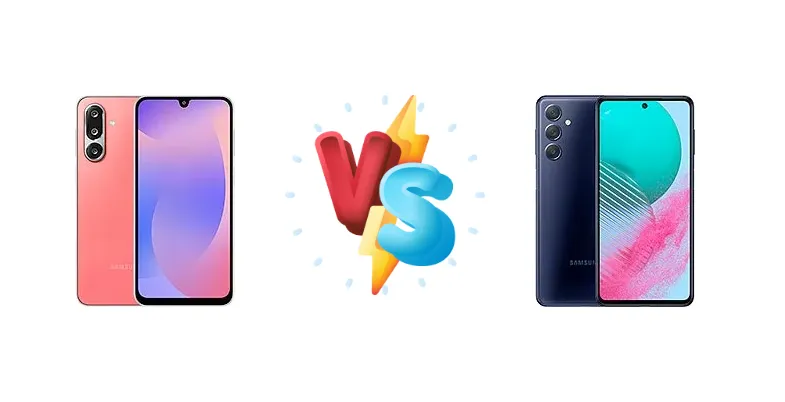
Samsung's Galaxy F and M series often overlap in specifications, creating confusion for buyers. The F36 and M54 are prime examples, both powered by the Exynos 1380. This comparison dissects the nuances between these devices, revealing how Samsung targets different user needs despite the shared core hardware.
🏆 Quick Verdict
For the average user prioritizing a balance of features and value, the Samsung Galaxy M54 emerges as the slightly better choice. While both phones offer identical performance due to the Exynos 1380, the M54 typically benefits from slightly more aggressive software optimization and a potentially wider availability of accessories.
| Network |
|---|
| 2G bands | GSM 850 / 900 / 1800 / 1900 | GSM 850 / 900 / 1800 / 1900 |
| 3G bands | HSDPA 850 / 900 / 1700(AWS) / 1900 / 2100 | HSDPA 850 / 900 / 1700(AWS) / 1900 / 2100 |
| 4G bands | 1, 2, 3, 5, 7, 8, 20, 28, 38, 40, 41 | 1, 2, 3, 4, 5, 7, 8, 12, 17, 20, 26, 28, 38, 40, 41, 66 |
| 5G bands | 1, 3, 5, 8, 28, 40, 41, 78 SA/NSA/Sub6 | 1, 3, 5, 7, 8, 28, 40, 41, 66, 77, 78 SA/NSA/Sub6 |
| Speed | HSPA, LTE, 5G | HSPA, LTE, 5G |
| Technology | GSM / HSPA / LTE / 5G | GSM / HSPA / LTE / 5G |
| Launch |
|---|
| Announced | 2025, July 21 | 2023, March 22 |
| Status | Available. Released 2025, July 29 | Available. Released 2023, April 11 |
| Body |
|---|
| Build | Glass front (Gorilla Glass Victus+), plastic frame, silicone polymer back (eco leather) | Glass front (Gorilla Glass 5), plastic back, plastic frame |
| Dimensions | 164.4 x 77.9 x 7.7 mm (6.47 x 3.07 x 0.30 in) | 164.9 x 77.3 x 8.4 mm (6.49 x 3.04 x 0.33 in) |
| SIM | Nano-SIM + Nano-SIM | Nano-SIM + Nano-SIM |
| Weight | 197 g (6.95 oz) | 199 g (7.02 oz) |
| Display |
|---|
| Protection | Corning Gorilla Glass Victus+ | Corning Gorilla Glass 5 |
| Resolution | 1080 x 2340 pixels, 19.5:9 ratio (~387 ppi density) | 1080 x 2400 pixels, 20:9 ratio (~393 ppi density) |
| Size | 6.7 inches, 109.1 cm2 (~85.2% screen-to-body ratio) | 6.7 inches, 108.4 cm2 (~85.0% screen-to-body ratio) |
| Type | Super AMOLED, 120Hz | Super AMOLED Plus, 120Hz |
| Platform |
|---|
| CPU | Octa-core (4x2.4 GHz Cortex-A78 & 4x2.0 GHz Cortex-A55) | Octa-core (4x2.4 GHz Cortex-A78 & 4x2.0 GHz Cortex-A55) |
| Chipset | Exynos 1380 (5 nm) | Exynos 1380 (5 nm) |
| GPU | Mali-G68 MP5 | Mali-G68 MP5 |
| OS | Android 15, up to 6 major Android upgrades, One UI 7 | Android 13, upgradable to Android 16, One UI 8 |
| Memory |
|---|
| Card slot | microSDXC (uses shared SIM slot) | microSDXC (uses shared SIM slot) |
| Internal | 128GB 6GB RAM, 128GB 8GB RAM, 256GB 8GB RAM | 128GB 8GB RAM, 256GB 8GB RAM |
| Main Camera |
|---|
| Features | LED flash, panorama, HDR | LED flash, panorama, HDR |
| Triple | 50 MP, f/1.8, (wide), 1/1.96", PDAF, OIS
8 MP, f/2.2, 123˚, (ultrawide), 1/4.0", 1.12µm
2 MP (macro) | 108 MP, f/1.8, (wide), PDAF, OIS
8 MP, f/2.2, (ultrawide), 1/4.0", 1.12µm
2 MP (macro) |
| Video | 4K@30fps, 1080p@30/60fps, 720p@480fps, gyro-EIS | 4K@30fps, 1080p@30/60fps |
| Selfie camera |
|---|
| Features | HDR | - |
| Single | 13 MP, f/2.2, (wide), 1/3.06", 1.12µm | 32 MP, f/2.2, 26mm (wide), 1/2.8", 0.8µm |
| Video | 4K@30fps, 1080p@30fps | 4K@30fps, 1080p@30fps |
| Sound |
|---|
| 3.5mm jack | - | No |
| 35mm jack | No | No |
| Loudspeaker | Yes | Yes |
| Comms |
|---|
| Bluetooth | 5.3, A2DP, LE | 5.3, A2DP, LE |
| NFC | Yes | Yes (market/region dependent) |
| Positioning | GPS, GALILEO, GLONASS, BDS, QZSS | GPS, GLONASS, GALILEO, BDS, QZSS, NavIC |
| Radio | No | No |
| USB | USB Type-C 2.0, OTG | USB Type-C 2.0, OTG |
| WLAN | Wi-Fi 802.11 a/b/g/n/ac/6, dual-band, Wi-Fi Direct | Wi-Fi 802.11 a/b/g/n/ac/6, dual-band, Wi-Fi Direct |
| Features |
|---|
| Sensors | Fingerprint (side-mounted), accelerometer, gyro, compass | Fingerprint (side-mounted), accelerometer, gyro, proximity, compass |
| Battery |
|---|
| Charging | 25W wired | 25W wired |
| Type | 5000 mAh | Li-Po 6000 mAh |
| Misc |
|---|
| Colors | Luxe Violet, Coral Red, Onyx Black | Dark Blue, Silver |
| Models | SM-E366B, SM-E366B/DS | SM-M546B, SM-M546B/DS |
| Price | ₹ 16,999 | About 190 EUR |
| SAR | 0.46 W/kg (head) | - |
| SAR EU | 0.38 W/kg (head) 1.01 W/kg (body) | 0.49 W/kg (head) 1.20 W/kg (body) |
Samsung Galaxy F36
- Potentially more affordable price point
- May offer a more compact design
- Identical performance to the M54
- Likely shorter software support lifecycle
- Potentially less robust build quality
Samsung Galaxy M54
- Potentially longer software support
- Larger battery capacity (likely)
- Wider availability of accessories
- Slightly higher price compared to the F36
- Larger form factor may not suit all users
Display Comparison
Both the Galaxy F36 and M54 are expected to feature Super AMOLED displays, a Samsung staple. However, specific details like peak brightness (nits) and the presence of LTPO technology are not provided. Given the M series' positioning, it *may* receive a slightly brighter panel for better outdoor visibility. Bezels are likely similar, focusing on maximizing screen real estate within their respective price brackets. Color accuracy will likely be tuned to Samsung’s vibrant profile, with both supporting FHD+ resolution.
Camera Comparison
Camera performance will largely depend on software processing, as both phones likely share similar sensor configurations. While specific sensor details are missing, the Exynos 1380’s ISP supports capable image processing. Expect a primary sensor around 50MP, but the inclusion of OIS (Optical Image Stabilization) is uncertain. The ubiquitous 2MP macro camera found on both devices offers limited utility, serving primarily as a marketing feature. Low-light performance will be a key differentiator, relying heavily on Samsung’s night mode algorithms.
Performance
The core performance is identical: both devices utilize the Exynos 1380 (5nm). This octa-core processor, with its 4x2.4 GHz Cortex-A78 and 4x2.0 GHz Cortex-A55 configuration, delivers comparable CPU and GPU performance. The 5nm fabrication process ensures reasonable thermal efficiency, but sustained gaming will likely induce some throttling. RAM configurations (likely LPDDR4x or LPDDR5) will influence multitasking smoothness, but the chipset remains the primary performance bottleneck. The lack of a high-end GPU means demanding titles will require reduced settings.
Battery Life
Both the F36 and M54 support 25W wired charging, suggesting similar 0-100% charge times (around 1.5-2 hours). Battery capacity is not specified, but the M54, being a larger device, likely houses a slightly larger battery (potentially 6000mAh vs 5000mAh for the F36). This larger capacity, combined with the efficient Exynos 1380, should translate to all-day battery life for moderate users. However, heavy gaming or prolonged video streaming will deplete the battery faster.
Buying Guide
Buy the Samsung Galaxy F36 if you prioritize a potentially more compact form factor and are seeking the lowest possible price point for the Exynos 1380 chipset. Buy the Samsung Galaxy M54 if you prefer a larger display, potentially longer software support, and a more established presence in the mid-range market, even if it means paying a small premium.
Frequently Asked Questions
❓ Does the Exynos 1380 in either the F36 or M54 struggle with demanding games like Genshin Impact?
Yes, the Exynos 1380 is a mid-range chipset. While it can run Genshin Impact, you'll need to lower the graphics settings to medium or low and accept frame rate dips during intense combat. It's not designed for consistently high frame rates in graphically intensive titles.
❓ Is the 2MP macro camera on either phone worth using for close-up shots?
Generally, no. 2MP macro cameras suffer from low resolution and poor image quality. They are often included for marketing purposes but rarely deliver usable results. The main camera, using digital zoom, will typically produce better close-up images.
❓ How long will Samsung provide software updates for the Galaxy F36 compared to the M54?
The Galaxy M series typically receives longer software support than the F series. Expect the M54 to receive at least 3 years of Android OS updates and 4 years of security patches, while the F36 may receive only 2 years of OS updates and 3 years of security patches.
❓ Will I notice a significant difference in charging speed between the 25W charging on both phones?
No, the charging speed will be virtually identical. Both phones support 25W wired charging, and the time to fully charge from 0-100% will be similar, around 1.5 to 2 hours, depending on usage during charging.