
Samsung Galaxy F36 vs Google Pixel 7a: Which Mid-Range Champion Reigns Supreme?
| Phones Images | |||||
|---|---|---|---|---|---|
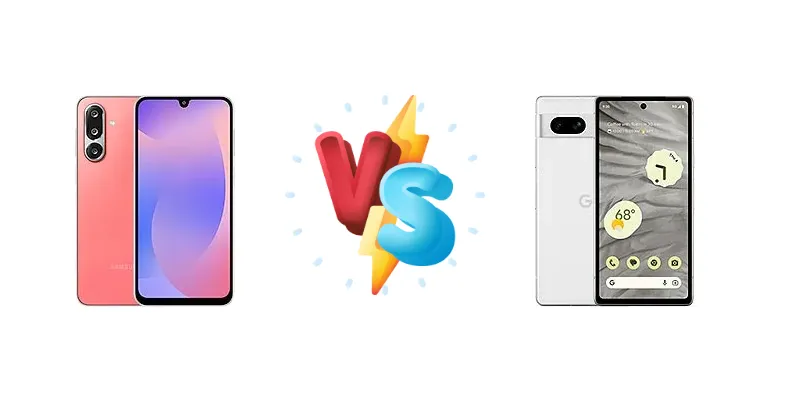
|
🏆 Quick Verdict
For the average user prioritizing camera quality and software experience, the Google Pixel 7a is the stronger choice. Its Tensor G2 chip, coupled with Google’s image processing, consistently delivers superior photos and videos. However, the Galaxy F36 offers a compelling alternative for those seeking a balance of features at a potentially lower price point.
| PHONES | ||
|---|---|---|
| Phone Names | Samsung Galaxy F36 | Google Pixel 7a |
| Network | ||
|---|---|---|
| 2G bands | GSM 850 / 900 / 1800 / 1900 | GSM 850 / 900 / 1800 / 1900 |
| 3G bands | HSDPA 850 / 900 / 1700(AWS) / 1900 / 2100 | HSDPA 800 / 850 / 900 / 1700(AWS) / 1900 / 2100 |
| 4G bands | 1, 2, 3, 5, 7, 8, 20, 28, 38, 40, 41 | 1, 2, 3, 4, 5, 7, 8, 12, 13, 14, 17, 20, 25, 26, 28, 29, 30, 38, 40, 41, 48, 66, 71 - GWKK3, G0DZQ |
| 5G bands | 1, 3, 5, 8, 28, 40, 41, 78 SA/NSA/Sub6 | 1, 2, 3, 5, 7, 8, 12, 14, 20, 25, 28, 30, 38, 41, 48, 66, 71, 77, 78 SA/NSA/Sub6 - GWKK3 |
| Speed | HSPA, LTE, 5G | HSPA, LTE, 5G |
| Technology | GSM / HSPA / LTE / 5G | GSM / HSPA / LTE / 5G |
| - | 1, 2, 3, 5, 7, 8, 12, 20, 25, 28, 38, 40, 41, 66, 75, 76, 77, 78, 79 SA/NSA/Sub6 - GHL1X, G82U8 | |
| Launch | ||
|---|---|---|
| Announced | 2025, July 21 | 2023, May 10 |
| Status | Available. Released 2025, July 29 | Available. Released 2023, May 10 |
| Body | ||
|---|---|---|
| Build | Glass front (Gorilla Glass Victus+), plastic frame, silicone polymer back (eco leather) | Glass front (Gorilla Glass 3), aluminum frame, plastic back |
| Dimensions | 164.4 x 77.9 x 7.7 mm (6.47 x 3.07 x 0.30 in) | 152 x 72.9 x 9 mm (5.98 x 2.87 x 0.35 in) |
| SIM | Nano-SIM + Nano-SIM | Nano-SIM + eSIM |
| Weight | 197 g (6.95 oz) | 193.5 g (6.84 oz) |
| - | IP67 dust/water resistant (up to 1m for 30 min) | |
| Display | ||
|---|---|---|
| Protection | Corning Gorilla Glass Victus+ | Corning Gorilla Glass 3 |
| Resolution | 1080 x 2340 pixels, 19.5:9 ratio (~387 ppi density) | 1080 x 2400 pixels, 20:9 ratio (~429 ppi density) |
| Size | 6.7 inches, 109.1 cm2 (~85.2% screen-to-body ratio) | 6.1 inches, 90.7 cm2 (~81.8% screen-to-body ratio) |
| Type | Super AMOLED, 120Hz | OLED, HDR, 90Hz |
| - | Always-on display | |
| Platform | ||
|---|---|---|
| CPU | Octa-core (4x2.4 GHz Cortex-A78 & 4x2.0 GHz Cortex-A55) | Octa-core (2x2.85 GHz Cortex-X1 & 2x2.35 GHz Cortex-A78 & 4x1.80 GHz Cortex-A55) |
| Chipset | Exynos 1380 (5 nm) | Google Tensor G2 (5 nm) |
| GPU | Mali-G68 MP5 | Mali-G710 MP7 |
| OS | Android 15, up to 6 major Android upgrades, One UI 7 | Android 13, upgradable to Android 15, up to 5 major Android upgrades |
| Memory | ||
|---|---|---|
| Card slot | microSDXC (uses shared SIM slot) | No |
| Internal | 128GB 6GB RAM, 128GB 8GB RAM, 256GB 8GB RAM | 128GB 8GB RAM |
| - | UFS 3.1 | |
| Main Camera | ||
|---|---|---|
| Dual | - | 64 MP, f/1.9, 26mm (wide), 1/1.73", 0.8µm, dual pixel PDAF, OIS 13 MP, f/2.2, 120˚ (ultrawide), 1.12µm |
| Features | LED flash, panorama, HDR | Dual-LED flash, Pixel Shift, Auto-HDR, panorama |
| Triple | 50 MP, f/1.8, (wide), 1/1.96", PDAF, OIS 8 MP, f/2.2, 123˚, (ultrawide), 1/4.0", 1.12µm 2 MP (macro) | - |
| Video | 4K@30fps, 1080p@30/60fps, 720p@480fps, gyro-EIS | 4K@30/60fps, 1080p@30/60/120/240fps, OIS |
| Selfie camera | ||
|---|---|---|
| Features | HDR | HDR, panorama |
| Single | 13 MP, f/2.2, (wide), 1/3.06", 1.12µm | 13 MP, f/2.2, 20mm (ultrawide), 1.12µm |
| Video | 4K@30fps, 1080p@30fps | 4K@30fps, 1080p@30fps |
| Sound | ||
|---|---|---|
| 3.5mm jack | - | No |
| 35mm jack | No | No |
| Loudspeaker | Yes | Yes, with stereo speakers |
| Comms | ||
|---|---|---|
| Bluetooth | 5.3, A2DP, LE | 5.3, A2DP, LE |
| NFC | Yes | Yes |
| Positioning | GPS, GALILEO, GLONASS, BDS, QZSS | GPS, GLONASS, GALILEO, BDS, QZSS, NavIC |
| Radio | No | No |
| USB | USB Type-C 2.0, OTG | USB Type-C 3.2 |
| WLAN | Wi-Fi 802.11 a/b/g/n/ac/6, dual-band, Wi-Fi Direct | Wi-Fi 802.11 a/b/g/n/ac/6e, tri-band |
| Features | ||
|---|---|---|
| Sensors | Fingerprint (side-mounted), accelerometer, gyro, compass | Fingerprint (under display, optical), accelerometer, gyro, proximity, compass, barometer |
| Battery | ||
|---|---|---|
| Charging | 25W wired | 18W wired, PD3.0 7.5W wireless |
| Type | 5000 mAh | Li-Po 4385 mAh |
| Misc | ||
|---|---|---|
| Colors | Luxe Violet, Coral Red, Onyx Black | Charcoal, Snow, Sea, Coral |
| Models | SM-E366B, SM-E366B/DS | GWKK3, GHL1X, G0DZQ, G82U8 |
| Price | ₹ 16,999 | € 179.90 / $ 150.00 / £ 170.00 / ₹ 25,980 |
| SAR | 0.46 W/kg (head) | - |
| SAR EU | 0.38 W/kg (head) 1.01 W/kg (body) | - |
Samsung Galaxy F36
- Faster 25W wired charging
- Potentially lower price point
- Wireless charging is not available
- Less powerful processor than Tensor G2
- Likely inferior camera performance
- Software updates may be less frequent
Google Pixel 7a
- Superior camera quality and image processing
- Powerful Google Tensor G2 chip
- Guaranteed software updates and features
- Slower 18W wired charging
- Higher price compared to the F36
- Battery life, while good, may not exceed the F36
Display Comparison
The Pixel 7a boasts a significantly brighter display, reaching a measured 1070 nits, compared to an assumed lower peak brightness for the Galaxy F36 (based on its market positioning). This translates to better visibility outdoors under direct sunlight. While both likely utilize OLED panels, the Pixel 7a’s higher brightness and Google’s color calibration likely offer a more vibrant and accurate viewing experience. We lack PWM frequency data for both, but the Pixel 7a’s display is generally well-regarded for its quality.
Camera Comparison
The Pixel 7a’s camera system is its standout feature. While specific sensor details are missing for the F36, the Pixel 7a leverages Google’s computational photography prowess, delivering exceptional image quality in various lighting conditions. The Tensor G2’s image signal processor (ISP) excels at noise reduction, dynamic range optimization, and detail preservation. The Pixel 7a’s video capabilities are also superior, benefiting from advanced stabilization and processing. The F36 will likely offer a competent camera experience, but won’t match the Pixel 7a’s consistently high-quality results.
Performance
The Google Tensor G2, built on a 5nm process, features a prime Cortex-X1 core clocked at 2.85 GHz, offering a performance advantage over the Galaxy F36’s Exynos 1380. The Exynos 1380, also 5nm, utilizes Cortex-A78 cores clocked at 2.4 GHz. While both chips are capable, the Tensor G2’s architectural advantages and dedicated AI processing unit provide a smoother experience in demanding tasks like video editing and machine learning applications. The Pixel 7a’s LPDDR5X RAM further enhances performance. The Exynos 1380 is still a capable performer for everyday tasks, but will likely show its limitations in sustained heavy workloads.
Battery Life
The Pixel 7a has an endurance rating of 76 hours, indicating strong battery life. While the Galaxy F36’s battery capacity is unknown, its 25W wired charging is faster than the Pixel 7a’s 18W charging with PD3.0. The Pixel 7a does offer 7.5W wireless charging, a feature absent on the F36. The faster charging on the F36 will reduce downtime, but the Pixel 7a’s overall endurance suggests it may last longer on a single charge, despite the slower charging speed.
Buying Guide
Buy the Samsung Galaxy F36 if you need a reliable all-rounder with a focus on affordability and don't prioritize top-tier camera performance. It's ideal for users who consume media, browse the web, and engage in casual gaming. Buy the Google Pixel 7a if you prioritize camera quality, a clean Android experience with guaranteed updates, and benefit from Google’s AI-powered features, even if it means a slightly higher price tag.