
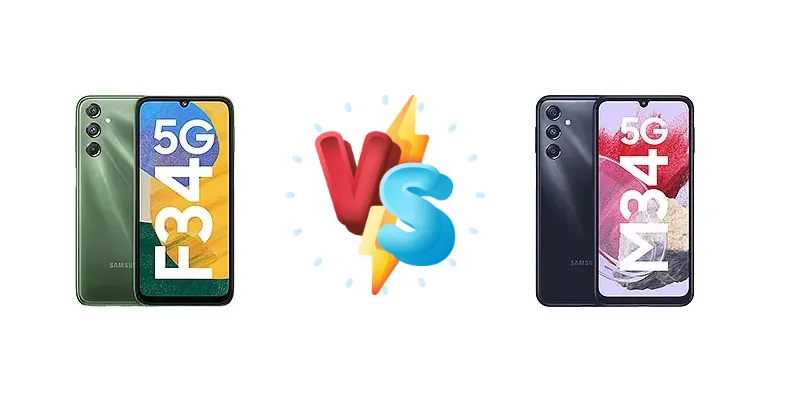
Samsung Galaxy F34 vs M34 5G: A Tale of Two Identical Twins
| Phones Images | |||||
|---|---|---|---|---|---|
|
🏆 Quick Verdict
For the average user, the Samsung Galaxy M34 5G emerges as the slightly better value. While both phones offer identical performance thanks to the Exynos 1280, the M34 5G's broader availability and potentially more aggressive pricing make it the more accessible option.
| PHONES | ||
|---|---|---|
| Phone Names | Samsung Galaxy F34 | Samsung Galaxy M34 5G |
| Network | ||
|---|---|---|
| 2G bands | GSM 850 / 900 / 1800 / 1900 | GSM 850 / 900 / 1800 / 1900 |
| 3G bands | HSDPA 850 / 900 / 1700(AWS) / 1900 / 2100 | HSDPA 850 / 900 / 1700(AWS) / 1900 / 2100 |
| 4G bands | 1, 2, 3, 4, 5, 7, 8, 12, 17, 20, 26, 28, 38, 40, 41, 66 | 1, 2, 3, 4, 5, 7, 8, 12, 17, 20, 26, 28, 38, 40, 41, 66 |
| 5G bands | 1, 3, 5, 7, 8, 28, 38, 40, 41, 78 SA/NSA/Sub6 | 1, 3, 5, 7, 8, 28, 38, 40, 41, 66, 78 SA/NSA/Sub6 |
| Speed | HSPA, LTE, 5G | HSPA, LTE, 5G |
| Technology | GSM / HSPA / LTE / 5G | GSM / HSPA / LTE / 5G |
| Launch | ||
|---|---|---|
| Announced | 2023, August 07 | 2023, July 03 |
| Status | Available. Released 2023, August 12 | Available. Released 2023, July 15 |
| Body | ||
|---|---|---|
| Dimensions | 161.7 x 77.2 x 8.8 mm (6.37 x 3.04 x 0.35 in) | 161.7 x 77.2 x 8.8 mm (6.37 x 3.04 x 0.35 in) |
| SIM | Nano-SIM + Nano-SIM | Nano-SIM + Nano-SIM |
| Weight | 208 g (7.34 oz) | 208 g (7.34 oz) |
| Display | ||
|---|---|---|
| Protection | Corning Gorilla Glass 5 | Corning Gorilla Glass 5 |
| Resolution | 1080 x 2340 pixels, 19.5:9 ratio (~396 ppi density) | 1080 x 2340 pixels, 19.5:9 ratio (~396 ppi density) |
| Size | 6.5 inches, 103.7 cm2 (~83.1% screen-to-body ratio) | 6.5 inches, 103.7 cm2 (~83.1% screen-to-body ratio) |
| Type | Super AMOLED, 120Hz, 1000 nits (peak) | Super AMOLED, 120Hz, 1000 nits (peak) |
| Platform | ||
|---|---|---|
| CPU | Octa-core (2x2.4 GHz Cortex-A78 & 6x2.0 GHz Cortex-A55) | Octa-core (2x2.4 GHz Cortex-A78 & 6x2.0 GHz Cortex-A55) |
| Chipset | Exynos 1280 (5 nm) | Exynos 1280 (5 nm) |
| GPU | Mali-G68 | Mali-G68 |
| OS | Android 13, One UI 5.1 | Android 13, upgradable to Android 16, One UI 8 |
| Memory | ||
|---|---|---|
| Card slot | microSDXC (uses shared SIM slot) | microSDXC (uses shared SIM slot) |
| Internal | 128GB 6GB RAM, 128GB 8GB RAM | 128GB 6GB RAM, 128GB 8GB RAM, 256GB 8GB RAM |
| Main Camera | ||
|---|---|---|
| Features | LED flash, panorama, HDR | LED flash, panorama, HDR |
| Triple | 50 MP, f/1.8, (wide), PDAF, OIS 8 MP, f/2.2, 120˚ (ultrawide) 2 MP, f/2.4 | 50 MP, f/1.8, (wide), PDAF, OIS 8 MP, f/2.2, 120˚ (ultrawide) 2 MP, f/2.4 |
| Video | 4K@30fps, 1080p@30fps | 4K@30fps, 1080p@30fps |
| Selfie camera | ||
|---|---|---|
| Single | 13 MP, f/2.2, (wide) | 13 MP, f/2.2, (wide) |
| Video | 1080p@30fps | 1080p@30fps |
| Sound | ||
|---|---|---|
| 35mm jack | Yes | Yes |
| Loudspeaker | Yes | Yes |
| Comms | ||
|---|---|---|
| Bluetooth | 5.3, A2DP, LE | 5.3, A2DP, LE |
| NFC | Yes | Yes |
| Positioning | GPS, GLONASS, GALILEO, BDS, QZSS | GPS, GLONASS, GALILEO, BDS |
| Radio | Unspecified | FM radio |
| USB | USB Type-C 2.0, OTG | USB Type-C 2.0, OTG |
| WLAN | Wi-Fi 802.11 a/b/g/n/ac, dual-band, Wi-Fi Direct | Wi-Fi 802.11 a/b/g/n/ac, dual-band, Wi-Fi Direct |
| Features | ||
|---|---|---|
| Sensors | Fingerprint (side-mounted), accelerometer, gyro, compass | Fingerprint (side-mounted), accelerometer, gyro, compass |
| Battery | ||
|---|---|---|
| Charging | 25W wired | 25W wired |
| Type | Li-Po 6000 mAh | Li-Po 6000 mAh |
| Misc | ||
|---|---|---|
| Colors | Electric Black, Mystic Green | Midnight Blue, Prism Silver, Waterfall Blue |
| Models | SM-E346B, SM-E346B/DS | SM-M346B, SM-M346B/DS, SM-M346B1, SM-M346B1/DS |
| Price | About 210 EUR | About 190 EUR |
| SAR | 0.89 W/kg (head) | 0.89 W/kg (head) |
Samsung Galaxy F34
- Identical performance to M34 5G due to Exynos 1280
- Potential for exclusive retailer discounts
- Reliable Samsung software experience
- Potentially limited availability
- May receive less consistent software updates
Samsung Galaxy M34 5G
- Wider retail availability
- Likely better long-term software support
- Consistent Samsung experience
- Identical performance to F34, offering no inherent advantage
- May be slightly more expensive depending on promotions
Display Comparison
Both the Galaxy F34 and M34 5G are expected to feature similar Super AMOLED displays, though specific details like peak brightness and color gamut coverage aren't provided. Given their market segment, we anticipate around 400-500 nits of typical brightness. The absence of LTPO technology suggests a standard 60Hz or 90Hz refresh rate, impacting smoothness during scrolling and gaming. Bezels are likely to be comparable, prioritizing screen real estate within a budget-friendly design.
Camera Comparison
While megapixel counts are not provided in the context data, both phones likely feature a multi-camera system with a primary sensor, ultrawide, and potentially a macro lens. The image processing algorithms will be similar, focusing on Samsung's signature vibrant color profile. The absence of Optical Image Stabilization (OIS) is a likely cost-saving measure, potentially resulting in softer images and less stable video recording in low-light conditions. The 2MP macro camera, common in this price range, offers limited utility due to its low resolution and fixed focus.
Performance
The heart of both devices is the Exynos 1280 (5nm). This octa-core processor, with its 2x2.4 GHz Cortex-A78 and 6x2.0 GHz Cortex-A55 cores, delivers comparable performance in everyday tasks and moderate gaming. The 5nm fabrication process is crucial, offering a balance between power efficiency and performance. However, sustained workloads could lead to thermal throttling, potentially impacting frame rates in demanding games. RAM configuration (likely 6GB or 8GB LPDDR4x) will also influence multitasking capabilities, but the chipset remains the primary performance bottleneck.
Battery Life
Both devices utilize 25W wired charging, suggesting similar 0-100% charging times (around 1.5-2 hours). Battery capacity is not specified, but we can expect around 6000mAh, a common size for Samsung's M and F series. The Exynos 1280's 5nm process contributes to reasonable power efficiency, potentially delivering all-day battery life for moderate users. However, heavy gaming or prolonged video streaming will deplete the battery faster.
Buying Guide
Buy the Samsung Galaxy F34 if you find it at a significantly lower price through a specific retailer, as the core hardware is identical to the M34 5G. Buy the Samsung Galaxy M34 5G if you prioritize wider availability, potential for better long-term software support, and a more consistent retail experience. Both are excellent choices for users seeking a reliable 5G experience without breaking the bank.