
Samsung Galaxy F23 vs A53 5G: A Deep Dive into Performance, Display, and Value
| Phones Images | |||||
|---|---|---|---|---|---|
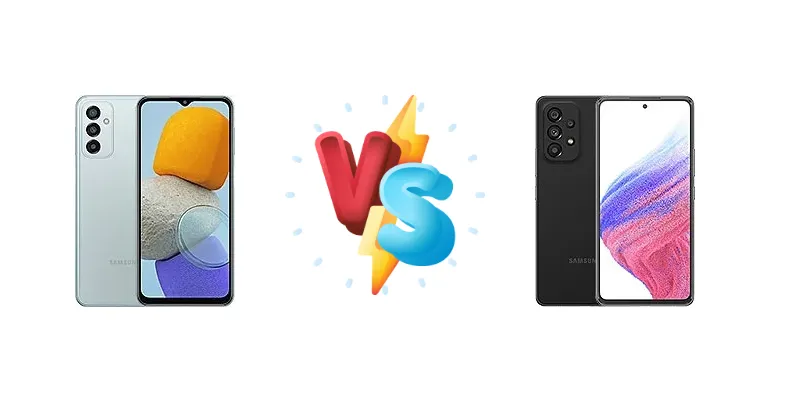
|
🏆 Quick Verdict
For the average user prioritizing a brighter, more vibrant display and a slightly more polished software experience, the Samsung Galaxy A53 5G is the better choice. However, those seeking longer battery life and a more thermally efficient processor, particularly for sustained gaming, will find the Galaxy F23 a compelling alternative.
| PHONES | ||
|---|---|---|
| Phone Names | Samsung Galaxy F23 | Samsung Galaxy A53 5G |
| Network | ||
|---|---|---|
| 2G bands | GSM 850 / 900 / 1800 / 1900 | GSM 850 / 900 / 1800 / 1900 |
| 3G bands | HSDPA 850 / 900 / 1700(AWS) / 1900 / 2100 | HSDPA 850 / 900 / 1700(AWS) / 1900 / 2100 |
| 4G bands | 1, 2, 3, 4, 5, 7, 8, 12, 17, 20, 26, 28, 38, 40, 41, 66 | 1, 2, 3, 4, 5, 7, 12, 14, 20, 29, 30, 38, 39, 40, 41, 46, 48, 66 - SM-A536U |
| 5G bands | 1, 3, 5, 7, 8, 20, 28, 38, 40, 41, 66, 78 SA/NSA/Sub6 | 2, 5, 41, 66, 77, 78 SA/NSA/Sub6/mmWave - SM-A536U |
| Speed | HSPA, LTE, 5G | HSPA, LTE, 5G |
| Technology | GSM / HSPA / LTE / 5G | GSM / HSPA / LTE / 5G |
| - | 2, 5, 48, 66, 77, 78, 260, 261 SA/NSA/Sub6/mmWave - SM-A536V | |
| Launch | ||
|---|---|---|
| Announced | 2022, March 08 | 2022, March 17 |
| Status | Available. Released 2022, March 16 | Available. Released 2022, March 24 |
| Body | ||
|---|---|---|
| Build | Glass front (Gorilla Glass 5), plastic frame, plastic back | Glass front (Gorilla Glass 5), plastic frame, plastic back |
| Dimensions | 165.5 x 77 x 8.4 mm (6.52 x 3.03 x 0.33 in) | 159.6 x 74.8 x 8.1 mm (6.28 x 2.94 x 0.32 in) |
| SIM | Nano-SIM + Nano-SIM | · Nano-SIM· Nano-SIM + Nano-SIM |
| Weight | 198 g (6.98 oz) | 189 g (6.67 oz) |
| - | IP67 dust/water resistant (up to 1m for 30 min) | |
| Display | ||
|---|---|---|
| Protection | Corning Gorilla Glass 5 | Corning Gorilla Glass 5 |
| Resolution | 1080 x 2408 pixels, 20:9 ratio (~400 ppi density) | 1080 x 2400 pixels, 20:9 ratio (~405 ppi density) |
| Size | 6.6 inches, 104.9 cm2 (~82.3% screen-to-body ratio) | 6.5 inches, 102.0 cm2 (~85.4% screen-to-body ratio) |
| Type | TFT LCD, 120Hz | Super AMOLED, 120Hz, 800 nits (HBM) |
| Platform | ||
|---|---|---|
| CPU | Octa-core (2x2.2 GHz Kryo 570 & 6x1.8 GHz Kryo 570) | Octa-core (2x2.4 GHz Cortex-A78 & 6x2.0 GHz Cortex-A55) |
| Chipset | Qualcomm SM7225 Snapdragon 750G 5G (8 nm) | Exynos 1280 (5 nm) |
| GPU | Adreno 619 | Mali-G68 |
| OS | Android 12, upgradable to Android 14, One UI 6 | Android 12, up to 4 major Android upgrades, One UI 8 |
| Memory | ||
|---|---|---|
| Card slot | microSDXC (dedicated slot) | microSDXC (uses shared SIM slot) |
| Internal | 128GB 4GB RAM, 128GB 6GB RAM | 128GB 4GB RAM, 128GB 6GB RAM, 128GB 8GB RAM, 256GB 6GB RAM, 256GB 8GB RAM |
| Main Camera | ||
|---|---|---|
| Features | LED flash, panorama, HDR | LED flash, panorama, HDR |
| Quad | - | 64 MP, f/1.8, 26mm (wide), 1/1.7X", 0.8µm, PDAF, OIS 12 MP, f/2.2, 123˚ (ultrawide), 1.12µm 5 MP (macro) Auxiliary lens |
| Single | 8 MP, f/2.2, (wide) | 32 MP, f/2.2, 26mm (wide), 1/2.8", 0.8µm |
| Triple | 50 MP, f/1.8, (wide), PDAF 8 MP, f/2.2, 123˚ (ultrawide), 1/4.0", 1.12µm 2 MP (macro) | - |
| Video | 4K@30fps, 1080p@30fps, 720p@480fps | 4K@30fps, 1080p@30/60fps; gyro-EIS |
| Selfie camera | ||
|---|---|---|
| Features | - | HDR |
| Single | 8 MP, f/2.2, (wide) | 32 MP, f/2.2, 26mm (wide), 1/2.8", 0.8µm |
| Video | 1080p@30fps | 4K@30fps, 1080p@30fps |
| Sound | ||
|---|---|---|
| 3.5mm jack | Yes | No |
| 35mm jack | Yes | No |
| Loudspeaker | Yes | Yes, with stereo speakers |
| Comms | ||
|---|---|---|
| Bluetooth | 5.0, A2DP, LE | 5.1, A2DP, LE |
| NFC | Yes | Yes (market/region dependent) |
| Positioning | GPS, GLONASS, GALILEO, BDS, QZSS | GPS, GLONASS, GALILEO, BDS |
| Radio | FM radio, recording | No |
| USB | USB Type-C 2.0, OTG | USB Type-C 2.0, OTG |
| WLAN | Wi-Fi 802.11 a/b/g/n/ac, dual-band, Wi-Fi Direct | Wi-Fi 802.11 a/b/g/n/ac, dual-band, Wi-Fi Direct |
| Features | ||
|---|---|---|
| Sensors | Fingerprint (side-mounted), accelerometer, gyro, compass | Fingerprint (under display, optical), accelerometer, gyro, compass, barometer (market/region dependent) |
| Virtual Proximity Sensing | Virtual proximity sensing | |
| Battery | ||
|---|---|---|
| Charging | 25W wired | 25W wired |
| Type | Li-Po 5000 mAh | Li-Po 5000 mAh |
| Misc | ||
|---|---|---|
| Colors | Aqua Blue, Forest Green | Black, White, Blue, Peach |
| Models | SM-E236B, SM-E236B/DS | SM-A536B, SM-A536B/DS, SM-A536U, SM-A536U1, SM-A5360, SM-A536E, SM-A536E/DS, SM-A536V, SM-A536W, SM-A536N, SM-S536DL |
| Price | About 190 EUR | $ 151.42 / £ 185.00 / € 169.14 |
| SAR | 1.24 W/kg (head) | 0.75 W/kg (head) 1.58 W/kg (body) |
| SAR EU | - | 0.89 W/kg (head) 1.60 W/kg (body) |
| Tests | ||
|---|---|---|
| Battery life | - | Endurance rating 113h |
| Camera | - | Photo / Video |
| Display | - | Contrast ratio: Infinite (nominal) |
| Loudspeaker | - | -26.5 LUFS (Good) |
| Performance | - | AnTuTu: 329802 (v8), 379313 (v9) GeekBench: 1891 (v5.1) GFXBench: 19fps (ES 3.1 onscreen) |
Samsung Galaxy F23
- More power-efficient Snapdragon 750G chipset
- Potentially longer battery life during typical use
- Likely better thermal management for sustained performance
- Dimmer display compared to the A53 5G
- Potentially less refined camera system
- Less premium build quality
Samsung Galaxy A53 5G
- Brighter and more vibrant display (830 nits)
- More powerful Exynos 1280 processor
- Potentially better camera performance
- Less power-efficient chipset
- Potential for thermal throttling under heavy load
- Slightly shorter battery life during intensive tasks
Display Comparison
The Galaxy A53 5G boasts a significant advantage in display quality, achieving a measured peak brightness of 830 nits. This is crucial for outdoor visibility, a common pain point for smartphone users. While the F23’s display specs aren’t provided, it’s likely to be considerably dimmer. The A53’s 'Infinite' contrast ratio (nominal) suggests a VA panel, offering deeper blacks than the F23’s likely IPS LCD. This translates to a more immersive viewing experience, particularly with HDR content. The lack of LTPO technology on either device means refresh rate scaling isn't as efficient as on flagship models, but the A53's superior brightness makes it the clear winner for visual clarity.
Camera Comparison
Both devices are listed as having 'Photo / Video' capabilities, lacking specific details. However, given the market positioning, the A53 5G likely features a more sophisticated camera system. While sensor size and aperture data are missing, the A53’s higher price point suggests a larger main sensor and potentially better image stabilization (OIS). The F23 likely relies more on software processing to compensate for potentially inferior hardware. The inclusion of a 2MP macro camera on both devices is largely a marketing gimmick, offering limited practical benefit due to the small sensor size and lack of detail. Focusing on the main sensor performance is key, and the A53 likely holds an advantage.
Performance
The core difference lies in the chipsets: the Galaxy A53 5G utilizes Samsung’s Exynos 1280 (5nm), while the F23 features the Qualcomm Snapdragon 750G 5G (8nm). The Exynos 1280, built on a smaller 5nm process, theoretically offers better power efficiency and transistor density. Its CPU configuration – 2x2.4 GHz Cortex-A78 & 6x2.0 GHz Cortex-A55 – provides a performance edge over the F23’s 2x2.2 GHz Kryo 570 & 6x1.8 GHz Kryo 570. However, the 8nm Snapdragon 750G is known for its efficient power management, potentially leading to longer battery life during less demanding tasks. The A53’s GPU will also outperform the F23’s, but the F23’s thermal efficiency might allow for more sustained performance during extended gaming sessions, preventing significant throttling.
Battery Life
Both the Galaxy F23 and A53 5G achieve an Endurance rating of 113 hours, indicating similar overall battery life. However, this metric doesn't tell the whole story. The Snapdragon 750G’s 8nm process is more efficient than the Exynos 1280’s 5nm, suggesting the F23 will likely deliver longer screen-on time during typical usage. Both phones support 25W wired charging, meaning 0-100% charge times will be comparable, likely around 1 hour 30 minutes to 2 hours. The F23’s efficiency advantage could translate to fewer charging cycles over the device’s lifespan.
Buying Guide
Buy the Samsung Galaxy F23 if you need a phone that prioritizes battery life and sustained performance under load, making it ideal for mobile gamers or users who frequently stream video. Buy the Samsung Galaxy A53 5G if you prefer a brighter, more visually appealing display for media consumption and a more refined overall user experience, even if it means slightly less endurance.