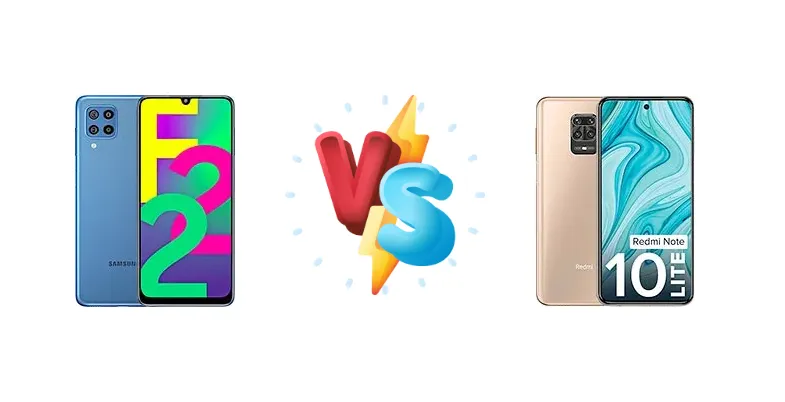
Both the Samsung Galaxy F22 and the Xiaomi Redmi Note 10 Lite occupy the competitive sub-$200 smartphone segment. While both aim to deliver essential features at an accessible price, they diverge significantly in their core processing power and charging capabilities, making the choice less straightforward than it appears. This comparison dives deep into the specifics to reveal which device offers the best value.
🏆 Quick Verdict
For the average user prioritizing sustained performance and efficient charging, the Xiaomi Redmi Note 10 Lite is the better choice. Its Snapdragon 720G, built on an 8nm process, provides a noticeable advantage over the Galaxy F22’s 12nm Helio G80, translating to smoother multitasking and potentially better gaming experiences, despite the F22's slightly larger battery.
| Network |
|---|
| 2G bands | GSM 850 / 900 / 1800 / 1900 | GSM 850 / 900 / 1800 / 1900 |
| 3G bands | HSDPA 850 / 900 / 2100 | HSDPA 850 / 900 / 1700(AWS) / 1900 / 2100 |
| 4G bands | 1, 3, 5, 8, 20, 38, 40, 41 | 1, 2, 3, 4, 5, 7, 8, 20, 28, 38, 40, 41 |
| Speed | HSPA, LTE | HSPA, LTE |
| Technology | GSM / HSPA / LTE | GSM / HSPA / LTE |
| Launch |
|---|
| Announced | 2021, July 06 | 2021, October 01 |
| Status | Available. Released 2021, July 13 | Available. Released 2021, October 02 |
| Body |
|---|
| Build | Glass front, plastic frame, plastic back | Glass front (Gorilla Glass 5), glass back (Gorilla Glass 5), plastic frame |
| Dimensions | 160 x 74 x 9.4 mm (6.30 x 2.91 x 0.37 in) | 165.8 x 76.7 x 8.8 mm (6.53 x 3.02 x 0.35 in) |
| SIM | Nano-SIM + Nano-SIM | Nano-SIM + Nano-SIM |
| Weight | 203 g (7.16 oz) | 209 g (7.37 oz) |
| | - | Water-repellent coating |
| Display |
|---|
| Protection | - | Corning Gorilla Glass 5 |
| Resolution | 720 x 1600 pixels, 20:9 ratio (~274 ppi density) | 1080 x 2400 pixels, 20:9 ratio (~395 ppi density) |
| Size | 6.4 inches, 98.9 cm2 (~83.5% screen-to-body ratio) | 6.67 inches, 107.4 cm2 (~84.5% screen-to-body ratio) |
| Type | Super AMOLED, 90Hz, 600 nits (HDR) | IPS LCD |
| Platform |
|---|
| CPU | Octa-core (2x2.0 GHz Cortex-A75 & 6x1.8 GHz Cortex-A55) | Octa-core (2x2.3 GHz Kryo 465 Gold & 6x1.8 GHz Kryo 465 Silver) |
| Chipset | Mediatek MT6769V/CU Helio G80 (12 nm) | Qualcomm SM7125 Snapdragon 720G (8 nm) |
| GPU | Mali-G52 MC2 | Adreno 618 |
| OS | Android 11, upgradable to Android 13, One UI core 5.1 | Android 10, MIUI 11 |
| Memory |
|---|
| Card slot | microSDXC (dedicated slot) | microSDXC (dedicated slot) |
| Internal | 64GB 4GB RAM, 128GB 6GB RAM | 64GB 4GB RAM, 64GB 6GB RAM, 128GB 4GB RAM, 128GB 6GB RAM |
| Main Camera |
|---|
| Features | LED flash, panorama, HDR | LED flash, HDR, panorama |
| Quad | 48 MP, f/1.8, (wide), PDAF
8 MP, f/2.2, 123˚ (ultrawide), 1/4.0", 1.12µm
2 MP (macro)
Auxiliary lens | 48 MP, f/1.9, 26mm (wide), 0.8µm, PDAF
8 MP, f/2.2, 119˚ (ultrawide), 1/4.0", 1.12µm
5 MP (macro), AF
Auxiliary lens |
| Single | 13 MP, f/2.2, (wide), 1/3.1", 1.12µm | 16 MP, f/2.5, (wide), 1/3.06", 1.0µm |
| Video | 1080p@30fps | 4K@30fps, 1080p@30/60/120fps, 720p@960fps, gyro-EIS |
| Selfie camera |
|---|
| Features | - | HDR, panorama |
| Single | 13 MP, f/2.2, (wide), 1/3.1", 1.12µm | 16 MP, f/2.5, (wide), 1/3.06", 1.0µm |
| Video | 1080p@30fps | 1080p@30fps |
| Sound |
|---|
| 3.5mm jack | Yes | Yes |
| 35mm jack | Yes | Yes |
| Loudspeaker | Yes | Yes |
| Comms |
|---|
| Bluetooth | 5.0, A2DP, LE | 5.0, A2DP, LE |
| Infrared port | - | Yes |
| NFC | No | Yes |
| Positioning | GPS, GLONASS, GALILEO, BDS | GPS, GLONASS, GALILEO, BDS, NavIC |
| Radio | FM radio, recording | FM radio, recording |
| USB | USB Type-C 2.0, OTG | USB Type-C 2.0 |
| WLAN | Wi-Fi 802.11 a/b/g/n/ac, dual-band, Wi-Fi Direct | Wi-Fi 802.11 a/b/g/n/ac, dual-band, Wi-Fi Direct |
| Features |
|---|
| Sensors | Fingerprint (side-mounted), accelerometer, gyro, compass | Fingerprint (side-mounted), accelerometer, gyro, proximity, compass |
| | Virtual Proximity Sensing | - |
| Battery |
|---|
| Charging | 15W wired | 18W wired |
| Type | Li-Po 6000 mAh | Li-Po 5020 mAh |
| Misc |
|---|
| Colors | Denim Black, Denim Blue | Aurora Blue, Glacier White, Interstellar Black, Champagne Gold |
| Models | SM-E225F, SM-E225F/DS | M2002F4LG |
| Price | About 170 EUR | About 200 EUR |
| SAR | 0.62 W/kg (head) | 1.17 W/kg (head) 0.86 W/kg (body) |
| SAR EU | - | 1.01 W/kg (head) 1.39 W/kg (body) |
Samsung Galaxy F22
- Potentially larger battery capacity (based on series trends)
- Samsung brand recognition and ecosystem
- May be more readily available in certain regions
- Less efficient Helio G80 chipset
- Slower 15W charging
- Potentially lower performance in demanding tasks
Xiaomi Redmi Note 10 Lite
- More efficient Snapdragon 720G chipset
- Faster 18W wired charging
- Superior ISP for better image processing
- Xiaomi’s MIUI software can be polarizing
- May have more pre-installed bloatware
Display Comparison
Neither device boasts a particularly standout display. While specific panel details (like peak brightness or color gamut coverage) are absent, the core difference lies in the processing power driving the display. The Snapdragon 720G’s ISP can potentially handle display processing more efficiently, leading to smoother animations. Bezels are likely comparable given the price point, and both will likely utilize LCD panels. Color accuracy will likely be similar, leaning towards the warmer side typical of these manufacturers.
Camera Comparison
Without detailed sensor information beyond the presence of a main camera, a direct comparison is limited. However, the Snapdragon 720G’s image signal processor (ISP) is generally superior to the Helio G80’s. This means better noise reduction, dynamic range, and overall image quality, particularly in challenging lighting conditions. The Redmi Note 10 Lite will likely exhibit faster image processing and more accurate color reproduction. The prevalence of 2MP macro/depth sensors on both devices suggests these are largely marketing features and offer minimal practical benefit.
Performance
The performance gap is the most significant differentiator. The Xiaomi Redmi Note 10 Lite’s Qualcomm Snapdragon 720G (8nm) is demonstrably more efficient and powerful than the Samsung Galaxy F22’s MediaTek Helio G80 (12nm). The 8nm process allows for higher transistor density and lower power consumption, resulting in less thermal throttling during sustained loads. While both CPUs feature an octa-core configuration with similar Cortex-A55 efficiency cores, the Snapdragon’s Kryo 465 Gold cores (2x2.3 GHz) outperform the Helio G80’s Cortex-A75 cores (2x2.0 GHz) in both single-core and multi-core benchmarks. This translates to faster app loading times and a more fluid user experience.
Battery Life
The Samsung Galaxy F22 likely has a slightly larger battery capacity (spec not provided, but typical for Samsung's 'F' series), but this advantage is offset by the Helio G80’s less efficient 12nm process. The Xiaomi Redmi Note 10 Lite’s 18W wired charging is a clear win over the F22’s 15W charging. This translates to significantly faster top-up times, reducing downtime and increasing convenience. While the F22 might offer slightly longer screen-on time during *light* use, the Redmi Note 10 Lite’s efficiency will shine during more demanding tasks.
Buying Guide
Buy the Samsung Galaxy F22 if you prioritize a brand ecosystem and are primarily focused on basic smartphone tasks like calling, texting, and light social media use. The F22’s larger battery *may* offer slightly longer screen-on time for these lighter workloads. Buy the Xiaomi Redmi Note 10 Lite if you value performance for the price, enjoy mobile gaming, or frequently multitask between applications. The Snapdragon 720G offers a more responsive and efficient experience, and the 18W charging is a significant convenience.
Frequently Asked Questions
❓ Will the Helio G80 in the Galaxy F22 struggle with graphically intensive games like PUBG Mobile?
The Helio G80 can run PUBG Mobile, but you’ll likely need to lower the graphics settings to achieve a consistently smooth frame rate. The Snapdragon 720G in the Redmi Note 10 Lite offers a more comfortable gaming experience at higher settings due to its superior GPU and thermal efficiency.
❓ How much faster is the 18W charging on the Redmi Note 10 Lite compared to the 15W charging on the Galaxy F22?
While exact times vary, the Redmi Note 10 Lite’s 18W charging will typically shave off around 30-60 minutes from a full 0-100% charge compared to the Galaxy F22. This difference is particularly noticeable for quick top-ups when you’re short on time.
❓ Does the Snapdragon 720G in the Redmi Note 10 Lite support VoWiFi (WiFi Calling)?
Support for VoWiFi depends on the carrier and software implementation. The Snapdragon 720G *is* capable of VoWiFi, but you’ll need to check with your mobile provider to confirm compatibility with the Redmi Note 10 Lite.
❓ Is the difference in performance between the two phones noticeable for everyday tasks like browsing and social media?
For basic tasks, the difference might not be immediately apparent. However, the Snapdragon 720G’s smoother animations and faster app loading times will become noticeable when multitasking or switching between apps frequently.