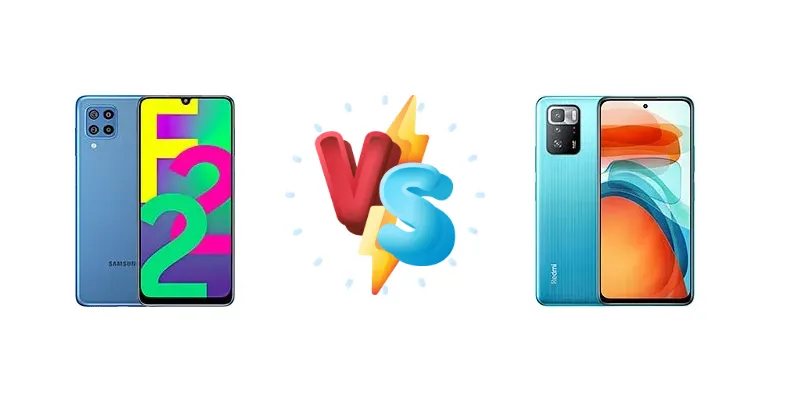
The Xiaomi Poco X3 GT and Samsung Galaxy F22 represent distinct approaches to the mid-range smartphone market. The Poco X3 GT aggressively targets gamers and power users with its Dimensity 1100 chipset and blazing-fast 67W charging, while the Galaxy F22 prioritizes affordability with a more modest Helio G80 and a focus on Samsung’s software ecosystem. This comparison dissects their key differences to help you determine which device best suits your needs.
🏆 Quick Verdict
For most users, the Xiaomi Poco X3 GT is the superior choice. Its Dimensity 1100 chipset offers a substantial performance leap over the Galaxy F22’s Helio G80, and the 67W charging is a game-changer. While the F22 is cheaper, the X3 GT’s benefits justify the price difference for anyone beyond basic smartphone tasks.
| Network |
|---|
| 2G bands | GSM 850 / 900 / 1800 / 1900 | GSM 850 / 900 / 1800 / 1900 |
| 3G bands | HSDPA 850 / 900 / 2100 | HSDPA 850 / 900 / 1700(AWS) / 1900 / 2100 |
| 4G bands | 1, 3, 5, 8, 20, 38, 40, 41 | 1, 2, 3, 4, 5, 7, 8, 18, 19, 26, 28, 38, 40, 41, 42 |
| 5G bands | - | 1, 3, 28, 41, 77, 78 SA/NSA |
| Speed | HSPA, LTE | HSPA, LTE, 5G |
| Technology | GSM / HSPA / LTE | GSM / HSPA / LTE / 5G |
| Launch |
|---|
| Announced | 2021, July 06 | 2021, July 28 |
| Status | Available. Released 2021, July 13 | Available. Released 2021, August 19 |
| Body |
|---|
| Build | Glass front, plastic frame, plastic back | Glass front (Gorilla Glass Victus), plastic back |
| Dimensions | 160 x 74 x 9.4 mm (6.30 x 2.91 x 0.37 in) | 163.3 x 75.9 x 8.9 mm (6.43 x 2.99 x 0.35 in) |
| SIM | Nano-SIM + Nano-SIM | Nano-SIM + Nano-SIM |
| Weight | 203 g (7.16 oz) | 193 g (6.81 oz) |
| | - | IP53, dust and splash resistant |
| Display |
|---|
| Protection | - | Corning Gorilla Glass Victus |
| Resolution | 720 x 1600 pixels, 20:9 ratio (~274 ppi density) | 1080 x 2400 pixels, 20:9 ratio (~399 ppi density) |
| Size | 6.4 inches, 98.9 cm2 (~83.5% screen-to-body ratio) | 6.6 inches, 105.2 cm2 (~84.9% screen-to-body ratio) |
| Type | Super AMOLED, 90Hz, 600 nits (HDR) | IPS LCD, 120Hz, HDR10, 450 nits (typ) |
| Platform |
|---|
| CPU | Octa-core (2x2.0 GHz Cortex-A75 & 6x1.8 GHz Cortex-A55) | Octa-core (4x2.6 GHz Cortex-A78 & 4x2.0 GHz Cortex-A55) |
| Chipset | Mediatek MT6769V/CU Helio G80 (12 nm) | Mediatek Dimensity 1100 (6 nm) |
| GPU | Mali-G52 MC2 | Mali-G77 MC9 |
| OS | Android 11, upgradable to Android 13, One UI core 5.1 | Android 11, MIUI 12.5 for POCO |
| Memory |
|---|
| Card slot | microSDXC (dedicated slot) | No |
| Internal | 64GB 4GB RAM, 128GB 6GB RAM | 128GB 8GB RAM, 256GB 8GB RAM |
| | - | UFS 3.1 |
| Main Camera |
|---|
| Features | LED flash, panorama, HDR | Color spectrum sensor, LED flash, HDR, panorama |
| Quad | 48 MP, f/1.8, (wide), PDAF
8 MP, f/2.2, 123˚ (ultrawide), 1/4.0", 1.12µm
2 MP (macro)
Auxiliary lens | - |
| Single | 13 MP, f/2.2, (wide), 1/3.1", 1.12µm | 16 MP, f/2.5, (wide), 1/3.06", 1.0µm |
| Triple | - | 64 MP, f/1.8, 26mm (wide), 1/1.97", 0.7µm, PDAF
8 MP, f/2.2, 120˚ (ultrawide), 1/4.0", 1.12µm
2 MP (macro) |
| Video | 1080p@30fps | 4K@30fps, 1080p@30/60/120fps |
| Selfie camera |
|---|
| Single | 13 MP, f/2.2, (wide), 1/3.1", 1.12µm | 16 MP, f/2.5, (wide), 1/3.06", 1.0µm |
| Video | 1080p@30fps | 1080p@30fps, 720p@120fps, 960fps |
| Sound |
|---|
| 3.5mm jack | Yes | No |
| 35mm jack | Yes | No |
| Loudspeaker | Yes | Yes, with stereo speakers |
| | - | 24-bit/192kHz audio
Tuned by JBL |
| Comms |
|---|
| Bluetooth | 5.0, A2DP, LE | 5.2, A2DP, LE |
| Infrared port | - | Yes |
| NFC | No | Yes (market/region dependent) |
| Positioning | GPS, GLONASS, GALILEO, BDS | GPS, GLONASS, GALILEO, BDS, QZSS |
| Radio | FM radio, recording | No |
| USB | USB Type-C 2.0, OTG | USB Type-C 2.0 |
| WLAN | Wi-Fi 802.11 a/b/g/n/ac, dual-band, Wi-Fi Direct | Wi-Fi 802.11 a/b/g/n/ac/6, dual-band, Wi-Fi Direct |
| Features |
|---|
| Sensors | Fingerprint (side-mounted), accelerometer, gyro, compass | Fingerprint (side-mounted), accelerometer, gyro, compass |
| | Virtual Proximity Sensing | Virtual proximity sensing |
| Battery |
|---|
| Charging | 15W wired | 67W wired, PD3.0, 100% in 42 min |
| Type | Li-Po 6000 mAh | Li-Po 5000 mAh |
| Misc |
|---|
| Colors | Denim Black, Denim Blue | Stargaze Black, Wave Blue, Cloud White |
| Models | SM-E225F, SM-E225F/DS | 21061110AG |
| Price | About 170 EUR | About 150 EUR |
| SAR | 0.62 W/kg (head) | 1.09 W/kg (head) 1.05 W/kg (body) |
| SAR EU | - | 0.58 W/kg (head) 0.94 W/kg (body) |
| Tests |
|---|
| Battery life | - |
Endurance rating 110h
|
| Camera | - |
Photo / Video |
| Display | - |
Contrast ratio: 1425:1 (nominal) |
| Loudspeaker | - |
-28.5 LUFS (Average)
|
| Performance | - |
AnTuTu: 506800 (v8) | 578505 (v9)
GeekBench: 2310 (v5.1)
GFXBench: 38fps (ES 3.1 onscreen) |
Samsung Galaxy F22
- More affordable price point
- Samsung’s One UI software experience
- Reliable brand reputation
- Significantly weaker performance
- Slow 15W charging
- Likely inferior camera system
Xiaomi Poco X3 GT
- Powerful Dimensity 1100 chipset
- Ultra-fast 67W charging
- Higher display brightness
- Potentially less refined software experience (MIUI)
- Slightly higher price
- May not receive as many software updates as Samsung
Display Comparison
Both phones feature a 1425:1 contrast ratio, suggesting similar visual pop. However, the Poco X3 GT boasts a measured peak brightness of 537 nits, which will translate to better visibility outdoors compared to the F22, whose brightness is not specified. While both likely use IPS LCD panels (given the price points), the X3 GT’s higher brightness is a clear advantage for outdoor use and HDR content viewing. Bezels are likely comparable, but the X3 GT’s overall display experience is enhanced by its brightness.
Camera Comparison
Both phones are listed as having Photo/Video capabilities, but detailed sensor information is missing. Given the market positioning, it’s reasonable to assume the Poco X3 GT has a more capable primary sensor. The X3 GT likely prioritizes image processing for vibrant colors and detail, while the F22 likely aims for a more natural look. The inclusion of a 2MP macro camera on the F22 is unlikely to provide significant value, as image quality from such sensors is typically poor. Without specific sensor details, the X3 GT is presumed to offer a more versatile and higher-quality camera experience.
Performance
The performance gap between these two devices is significant. The Poco X3 GT’s Mediatek Dimensity 1100 (6nm) features four high-performance Cortex-A78 cores clocked at 2.6 GHz, while the Galaxy F22’s Helio G80 (12nm) relies on two Cortex-A75 cores at 2.0 GHz. This architectural difference, coupled with the more efficient 6nm process, gives the X3 GT a substantial edge in CPU-intensive tasks and gaming. The X3 GT will handle demanding games at higher settings with smoother frame rates. The F22’s Helio G80 is adequate for casual gaming and everyday apps, but will struggle with more demanding titles. The X3 GT also benefits from potentially faster RAM speeds, though this isn't specified in the data.
Battery Life
Both phones achieve an endurance rating of 110 hours, suggesting comparable battery life under similar usage conditions. However, the Poco X3 GT’s 67W wired charging with PD3.0 support is a massive advantage. It can charge from 0-100% in just 42 minutes, while the Galaxy F22’s 15W charging is significantly slower. This means the X3 GT can quickly top up its battery, minimizing downtime, even if the overall battery capacity isn’t dramatically different. The convenience of rapid charging is a major benefit for power users.
Buying Guide
Buy the Samsung Galaxy F22 if you need a reliably functional smartphone for everyday tasks like calls, messaging, and light social media use, and prioritize a lower upfront cost. Buy the Xiaomi Poco X3 GT if you prioritize gaming performance, fast charging, and a more responsive user experience, and are willing to spend a bit more for those benefits. The X3 GT is also the better choice for users who frequently transfer large files or edit photos/videos on their phone.
Frequently Asked Questions
❓ Does the Mediatek Dimensity 1100 in the Poco X3 GT get hot during extended gaming sessions?
While the Dimensity 1100 is a powerful chip, its 6nm process and Xiaomi’s cooling solutions (likely including heat pipes) help manage thermals. Some throttling may occur during prolonged, intensive gaming, but it’s unlikely to be severe enough to cause significant performance drops. The F22’s Helio G80 will likely throttle sooner due to its less efficient 12nm process.
❓ Is the 15W charging on the Galaxy F22 slow enough to be a major inconvenience?
Yes, the 15W charging is considerably slower than the 67W charging on the Poco X3 GT. Expect it to take over two hours to fully charge the Galaxy F22 from 0%, whereas the X3 GT can achieve a full charge in around 42 minutes. This difference is significant for users who need to quickly top up their battery.
❓ How does the software experience differ between Samsung's One UI and Xiaomi's MIUI on these phones?
Samsung’s One UI is generally considered more polished and user-friendly, with a cleaner interface and a focus on simplicity. Xiaomi’s MIUI is more customizable and feature-rich, but can sometimes feel cluttered and includes pre-installed bloatware. Software preference is subjective, but One UI is often favored by users seeking a streamlined experience.