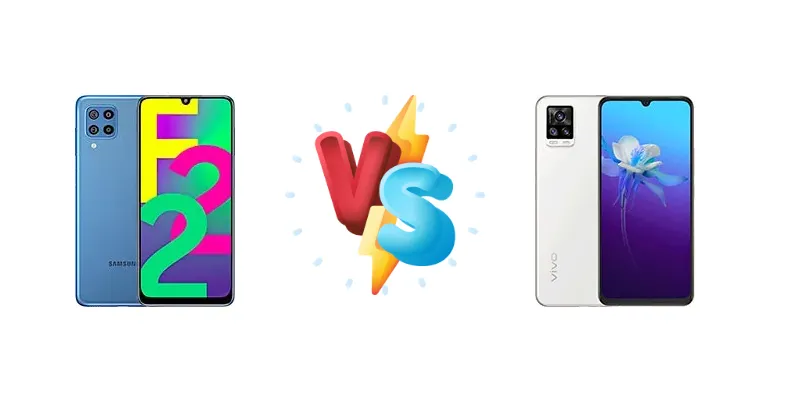
The Samsung Galaxy F22 and vivo V20 2021 represent compelling options in the competitive budget and mid-range smartphone space. While both aim to deliver a solid experience, they take distinctly different approaches to achieving it, primarily through their chipset choices. This comparison dives deep into the core differences to determine which device offers the best value for your money.
🏆 Quick Verdict
For most users, the vivo V20 2021 emerges as the stronger contender. Its Qualcomm Snapdragon 730, built on an 8nm process, provides a noticeable performance uplift over the Galaxy F22’s MediaTek Helio G80, and the 33W fast charging is a significant convenience advantage. While the F22 is more affordable, the V20’s superior processing power justifies the price difference.
| Network |
|---|
| 2G bands | GSM 850 / 900 / 1800 / 1900 | GSM 850 / 900 / 1800 / 1900 |
| 3G bands | HSDPA 850 / 900 / 2100 | HSDPA 850 / 900 / 2100 |
| 4G bands | 1, 3, 5, 8, 20, 38, 40, 41 | 1, 3, 5, 7, 8, 20, 28, 38, 39, 40, 41 |
| Speed | HSPA, LTE | HSPA, LTE |
| Technology | GSM / HSPA / LTE | GSM / HSPA / LTE |
| Launch |
|---|
| Announced | 2021, July 06 | 2020, December 24. Released 2020, December 24 |
| Status | Available. Released 2021, July 13 | Discontinued |
| Body |
|---|
| Build | Glass front, plastic frame, plastic back | Glass front, glass back |
| Dimensions | 160 x 74 x 9.4 mm (6.30 x 2.91 x 0.37 in) | 161.3 x 74.2 x 7.4 mm (6.35 x 2.92 x 0.29 in) |
| SIM | Nano-SIM + Nano-SIM | Nano-SIM + Nano-SIM |
| Weight | 203 g (7.16 oz) | 171 g (6.03 oz) |
| Display |
|---|
| Resolution | 720 x 1600 pixels, 20:9 ratio (~274 ppi density) | 1080 x 2400 pixels, 20:9 ratio (~409 ppi density) |
| Size | 6.4 inches, 98.9 cm2 (~83.5% screen-to-body ratio) | 6.44 inches, 100.1 cm2 (~83.7% screen-to-body ratio) |
| Type | Super AMOLED, 90Hz, 600 nits (HDR) | AMOLED |
| Platform |
|---|
| CPU | Octa-core (2x2.0 GHz Cortex-A75 & 6x1.8 GHz Cortex-A55) | Octa-core (2x2.2 GHz Kryo 470 Gold & 6x1.8 GHz Kryo 470 Silver) |
| Chipset | Mediatek MT6769V/CU Helio G80 (12 nm) | Qualcomm SDM730 Snapdragon 730 (8 nm) |
| GPU | Mali-G52 MC2 | Adreno 618 |
| OS | Android 11, upgradable to Android 13, One UI core 5.1 | Android 11, upgradable to Android 12, Funtouch 12 |
| Memory |
|---|
| Card slot | microSDXC (dedicated slot) | microSDXC (dedicated slot) |
| Internal | 64GB 4GB RAM, 128GB 6GB RAM | 128GB 8GB RAM, 256GB 8GB RAM |
| Main Camera |
|---|
| Features | LED flash, panorama, HDR | Dual-LED dual-tone flash, HDR, panorama |
| Quad | 48 MP, f/1.8, (wide), PDAF
8 MP, f/2.2, 123˚ (ultrawide), 1/4.0", 1.12µm
2 MP (macro)
Auxiliary lens | - |
| Single | 13 MP, f/2.2, (wide), 1/3.1", 1.12µm | - |
| Triple | - | 64 MP, f/1.9, 26mm (wide), 1/1.72", 0.8µm, PDAF
8 MP, f/2.2, 120˚, 16mm (ultrawide), 1/4.0", 1.12µm, AF
Auxiliary lens |
| Video | 1080p@30fps | 4K@30fps, 1080p@30/60fps, gyro-EIS |
| Selfie camera |
|---|
| Features | - | HDR |
| Single | 13 MP, f/2.2, (wide), 1/3.1", 1.12µm | 44 MP, f/2.0, (wide), AF |
| Video | 1080p@30fps | 4K@30fps, 1080p@30fps, gyro-EIS |
| Sound |
|---|
| 3.5mm jack | Yes | Yes |
| 35mm jack | Yes | Yes |
| Loudspeaker | Yes | Yes |
| | - | 24-bit/192kHz audio |
| Comms |
|---|
| Bluetooth | 5.0, A2DP, LE | 5.1, A2DP, LE |
| NFC | No | Yes (market/region dependent) |
| Positioning | GPS, GLONASS, GALILEO, BDS | GPS, GLONASS, GALILEO, BDS |
| Radio | FM radio, recording | FM radio |
| USB | USB Type-C 2.0, OTG | USB Type-C 2.0, OTG |
| WLAN | Wi-Fi 802.11 a/b/g/n/ac, dual-band, Wi-Fi Direct | Wi-Fi 802.11 a/b/g/n/ac, dual-band, Wi-Fi Direct |
| Features |
|---|
| Sensors | Fingerprint (side-mounted), accelerometer, gyro, compass | Fingerprint (under display, optical), accelerometer, gyro, proximity, compass |
| | Virtual Proximity Sensing | - |
| Battery |
|---|
| Charging | 15W wired | 33W wired |
| Type | Li-Po 6000 mAh | 4000 mAh |
| Misc |
|---|
| Colors | Denim Black, Denim Blue | Sunset Melody, Midnight Jazz, Moonlight Sonata |
| Models | SM-E225F, SM-E225F/DS | V2040, V2043_21 |
| Price | About 170 EUR | About 280 EUR |
| SAR | 0.62 W/kg (head) | - |
Samsung Galaxy F22
- More affordable price point
- Sufficient for basic smartphone tasks
- Potentially longer battery life with optimized usage
- Noticeably slower performance
- Slower charging speed
- Less efficient chipset
vivo V20 2021
- Superior performance with Snapdragon 730
- Faster 33W wired charging
- More efficient chipset for better battery life
- Higher price tag
- May not be significantly better for extremely light users
- Potential for slightly more heat under sustained load
Display Comparison
Neither device boasts a particularly standout display. While specific panel details (like peak brightness or color gamut coverage) are unavailable, the core difference lies in the underlying processing power needed to drive them. The Snapdragon 730’s more capable GPU will likely result in smoother animations and potentially better image processing for display output. Bezels are likely comparable given the market segment, and color accuracy will depend on software calibration, a factor not specified in the provided data.
Camera Comparison
Without detailed sensor information, a direct camera comparison is limited. However, the Snapdragon 730’s image signal processor (ISP) is generally more advanced than the Helio G80’s, offering better noise reduction, dynamic range, and overall image quality. The V20 is likely to produce more detailed and vibrant photos, especially in challenging lighting conditions. The presence of OIS (Optical Image Stabilization) on the V20, if equipped (market dependent), would further enhance its low-light capabilities and video recording stability. We can assume both phones will include a standard array of camera modes, but the V20’s processing power will allow for more sophisticated computational photography features.
Performance
The performance gap is the most significant differentiator. The vivo V20 2021’s Qualcomm Snapdragon 730 (8nm) is a clear upgrade over the Samsung Galaxy F22’s MediaTek Helio G80 (12nm). The 8nm process node inherently offers better power efficiency, translating to less heat generation and potentially sustained performance during demanding tasks. The Snapdragon 730’s Kryo 470 Gold cores, clocked at 2.2 GHz, also have a frequency advantage over the Helio G80’s Cortex-A75 cores (2.0 GHz). This translates to faster app loading times, smoother multitasking, and a more enjoyable gaming experience. While both CPUs feature a 6x Cortex-A55 cluster at 1.8 GHz, the Snapdragon’s overall architecture is more refined.
Battery Life
The battery capacity isn’t specified, but the charging speed is a key differentiator. The vivo V20 2021’s 33W wired charging is significantly faster than the Samsung Galaxy F22’s 15W charging. This means the V20 can replenish its battery much more quickly, minimizing downtime. While a larger battery capacity on the F22 might offset the slower charging to some extent, the convenience of 33W charging is a substantial advantage for users who frequently need to top up their phones. The Snapdragon 730’s improved power efficiency also contributes to potentially longer battery life under similar usage scenarios.
Buying Guide
Buy the Samsung Galaxy F22 if you prioritize extreme affordability and are primarily focused on basic smartphone tasks like calling, texting, and light social media use. Its Helio G80 is sufficient for these workloads. Buy the vivo V20 2021 if you value smoother multitasking, a more responsive gaming experience, and significantly faster charging. The Snapdragon 730 offers a tangible improvement in overall performance and efficiency.
Frequently Asked Questions
❓ Will the Helio G80 in the Galaxy F22 struggle with demanding games like PUBG or Call of Duty?
The Helio G80 can run PUBG and Call of Duty, but you’ll likely need to lower the graphics settings to achieve a smooth frame rate. Expect some stuttering and potential overheating during extended gaming sessions. The Snapdragon 730 in the V20 will provide a significantly more consistent and enjoyable gaming experience at higher settings.
❓ How much faster is the 33W charging on the vivo V20 2021 compared to the 15W charging on the Galaxy F22?
The 33W charging on the V20 2021 can potentially charge the phone from 0% to 100% in around 60-75 minutes, depending on battery capacity. The 15W charging on the F22 will likely take over 2 hours to achieve a full charge. This difference is substantial for users who need a quick power boost.
❓ Does the Snapdragon 730 in the V20 2021 offer noticeable improvements in multitasking compared to the Helio G80?
Yes, the Snapdragon 730’s more powerful CPU and efficient architecture allow it to handle multiple apps running simultaneously with greater ease. You’ll experience less lag and smoother transitions between apps when multitasking on the V20 2021.