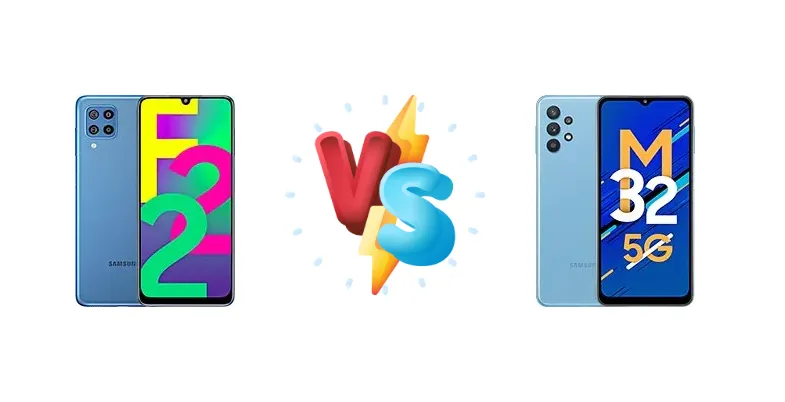
Samsung's F and M series consistently deliver compelling value in the budget smartphone space. The Galaxy F22 and M32 5G represent two distinct approaches within this segment. The F22 prioritizes a streamlined experience with the Helio G80, while the M32 5G aims for broader connectivity and a more powerful processor with the Dimensity 720. This comparison dissects the key differences to determine which device best suits your needs.
🏆 Quick Verdict
For most users, the Samsung Galaxy M32 5G emerges as the better choice. Its Mediatek Dimensity 720, fabricated on a more efficient 7nm process, provides a noticeable performance uplift and improved power efficiency compared to the F22’s Helio G80. While both share 15W charging, the M32 5G’s superior chipset justifies the slight price difference.
| Network |
|---|
| 2G bands | GSM 850 / 900 / 1800 / 1900 | GSM 850 / 900 / 1800 / 1900 |
| 3G bands | HSDPA 850 / 900 / 2100 | HSDPA 850 / 900 / 1700(AWS) / 1900 / 2100 |
| 4G bands | 1, 3, 5, 8, 20, 38, 40, 41 | 1, 2, 3, 4, 5, 7, 8, 12, 17, 20, 26, 28, 38, 40, 41, 66 |
| 5G bands | - | 1, 3, 5, 7, 8, 20, 28, 38, 40, 41, 66, 78 SA/NSA/Sub6 |
| Speed | HSPA, LTE | HSPA, LTE, 5G |
| Technology | GSM / HSPA / LTE | GSM / HSPA / LTE / 5G |
| Launch |
|---|
| Announced | 2021, July 06 | 2021, August 25 |
| Status | Available. Released 2021, July 13 | Available. Released 2021, September 02 |
| Body |
|---|
| Build | Glass front, plastic frame, plastic back | - |
| Dimensions | 160 x 74 x 9.4 mm (6.30 x 2.91 x 0.37 in) | 164.2 x 76.1 x 9.1 mm (6.46 x 3.00 x 0.36 in) |
| SIM | Nano-SIM + Nano-SIM | Nano-SIM + Nano-SIM |
| Weight | 203 g (7.16 oz) | 205 g (7.23 oz) |
| Display |
|---|
| Resolution | 720 x 1600 pixels, 20:9 ratio (~274 ppi density) | 720 x 1600 pixels, 20:9 ratio (~270 ppi density) |
| Size | 6.4 inches, 98.9 cm2 (~83.5% screen-to-body ratio) | 6.5 inches, 102.0 cm2 (~81.6% screen-to-body ratio) |
| Type | Super AMOLED, 90Hz, 600 nits (HDR) | TFT LCD |
| Platform |
|---|
| CPU | Octa-core (2x2.0 GHz Cortex-A75 & 6x1.8 GHz Cortex-A55) | Octa-core (2x2.0 GHz Cortex-A76 & 6x2.0 GHz Cortex-A55) |
| Chipset | Mediatek MT6769V/CU Helio G80 (12 nm) | Mediatek Dimensity 720 (7 nm) |
| GPU | Mali-G52 MC2 | Mali-G57 MC3 |
| OS | Android 11, upgradable to Android 13, One UI core 5.1 | Android 11, upgradable to Android 13, One UI 5 |
| Memory |
|---|
| Card slot | microSDXC (dedicated slot) | microSDXC (uses shared SIM slot) |
| Internal | 64GB 4GB RAM, 128GB 6GB RAM | 128GB 6GB RAM, 128GB 8GB RAM |
| | - | eMMC 5.1 |
| Main Camera |
|---|
| Features | LED flash, panorama, HDR | LED flash, panorama, HDR |
| Quad | 48 MP, f/1.8, (wide), PDAF
8 MP, f/2.2, 123˚ (ultrawide), 1/4.0", 1.12µm
2 MP (macro)
Auxiliary lens | 48 MP, f/1.8, 26mm (wide), PDAF
8 MP, f/2.2, 123˚ (ultrawide)
5 MP (macro)
Auxiliary lens |
| Single | 13 MP, f/2.2, (wide), 1/3.1", 1.12µm | - |
| Video | 1080p@30fps | 4K@30fps, 1080p@30fps |
| Selfie camera |
|---|
| Single | 13 MP, f/2.2, (wide), 1/3.1", 1.12µm | 13 MP, f/2.2, (wide) |
| Video | 1080p@30fps | 1080p@30fps |
| Sound |
|---|
| 3.5mm jack | Yes | Yes |
| 35mm jack | Yes | Yes |
| Loudspeaker | Yes | Yes |
| Comms |
|---|
| Bluetooth | 5.0, A2DP, LE | 5.0, A2DP, LE, aptX |
| NFC | No | Yes |
| Positioning | GPS, GLONASS, GALILEO, BDS | GPS, GLONASS, BDS, GALILEO |
| Radio | FM radio, recording | Unspecified |
| USB | USB Type-C 2.0, OTG | USB Type-C 2.0, OTG |
| WLAN | Wi-Fi 802.11 a/b/g/n/ac, dual-band, Wi-Fi Direct | Wi-Fi 802.11 a/b/g/n/ac, dual-band, Wi-Fi Direct |
| Features |
|---|
| Sensors | Fingerprint (side-mounted), accelerometer, gyro, compass | Fingerprint (side-mounted), accelerometer, gyro, compass |
| | Virtual Proximity Sensing | Virtual proximity sensing |
| Battery |
|---|
| Charging | 15W wired | 15W wired |
| Type | Li-Po 6000 mAh | Li-Ion 5000 mAh |
| Misc |
|---|
| Colors | Denim Black, Denim Blue | Slate Black, Sky Blue |
| Models | SM-E225F, SM-E225F/DS | SM-M326B, SM-M326B/DS |
| Price | About 170 EUR | About 220 EUR |
| SAR | 0.62 W/kg (head) | 0.48 W/kg (head) |
Samsung Galaxy F22
- Potentially lower initial cost.
- Sufficient for basic smartphone tasks.
- Reliable Samsung brand reputation.
- Less powerful processor compared to the M32 5G.
- Less efficient chipset leading to shorter battery life.
- Limited gaming performance.
Samsung Galaxy M32 5G
- More powerful and efficient Mediatek Dimensity 720 chipset.
- 5G connectivity for faster data speeds.
- Improved multitasking and gaming performance.
- Slightly higher price point.
- 15W charging is relatively slow.
- May not be significantly better for extremely basic users.
Display Comparison
Both devices likely feature similar LCD panels, given their market positioning. However, detailed display specs (resolution, brightness) are missing. The core difference lies in the processing power driving them. While panel quality is likely comparable, the Dimensity 720 in the M32 5G will handle graphically intensive content more smoothly, resulting in a better overall visual experience. Bezels are expected to be similar, typical of this price bracket.
Camera Comparison
Without detailed camera sensor information, a direct comparison is limited. However, the chipset plays a crucial role in image processing. The more powerful Dimensity 720 in the M32 5G will likely deliver better image quality, particularly in low-light conditions, due to its superior image signal processor (ISP). While both phones likely include standard features like HDR and scene optimization, the M32 5G’s processing capabilities will allow for more sophisticated algorithms and noise reduction. The presence of a 2MP macro camera on both devices is largely a marketing tactic, offering minimal practical benefit.
Performance
The Mediatek Dimensity 720 in the M32 5G represents a significant upgrade over the Helio G80 in the F22. The 7nm fabrication process of the Dimensity 720 is more efficient than the 12nm process of the Helio G80, leading to lower power consumption and reduced thermal throttling. Furthermore, the M32 5G utilizes Cortex-A76 cores in its CPU, offering a performance advantage over the F22’s Cortex-A75 cores. This translates to faster app loading times, smoother multitasking, and a more responsive user experience. The M32 5G is the clear winner for users who play mobile games or run demanding applications.
Battery Life
Both devices are equipped with 15W wired charging, suggesting similar charging speeds. While battery capacity isn't specified, the Dimensity 720’s superior power efficiency in the M32 5G will likely result in longer battery life despite potentially similar capacity. The 7nm process allows the M32 5G to accomplish more per watt, extending usage time between charges. Users prioritizing all-day battery life will benefit from the M32 5G’s more efficient chipset.
Buying Guide
Buy the Samsung Galaxy F22 if you prioritize a slightly lower initial cost and are primarily focused on basic smartphone tasks like calling, texting, and light social media use. Buy the Samsung Galaxy M32 5G if you value smoother multitasking, occasional gaming, and future-proofing with 5G connectivity. The M32 5G is the better option for users who anticipate heavier workloads or want a device that will remain relevant for longer.
Frequently Asked Questions
❓ Will the Mediatek Dimensity 720 in the M32 5G handle demanding games like PUBG Mobile smoothly?
Yes, the Dimensity 720 is capable of running PUBG Mobile at medium to high settings with stable frame rates. While it's not a flagship-level gaming chip, it offers a significant improvement over the Helio G80 in the F22, providing a much more enjoyable gaming experience.
❓ Does the 15W charging on both phones feel slow in 2024?
Yes, 15W charging is relatively slow compared to the faster charging technologies available on more expensive phones. Expect a full charge to take around 2-3 hours. However, the M32 5G’s more efficient chipset means you’ll likely need to charge it less frequently.
❓ Is the 5G connectivity on the M32 5G actually useful if I don't have widespread 5G coverage in my area?
Even without immediate access to 5G, the M32 5G’s modem supports 4G LTE, and its advanced connectivity features can still improve data speeds and network performance in areas with strong 4G coverage. It also future-proofs the device for when 5G becomes more widely available.