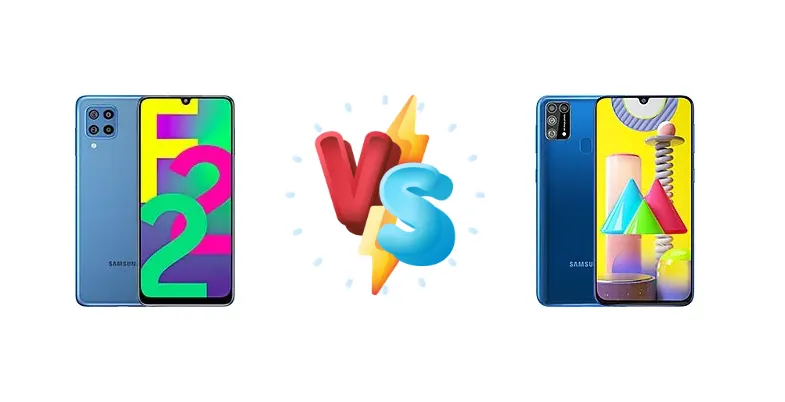
The Samsung Galaxy F22 and M31 represent Samsung’s strategy for dominating the budget smartphone market. While both aim to deliver a compelling experience without breaking the bank, they take different approaches. The F22, with its newer Mediatek Helio G80 chipset, focuses on efficiency, while the M31 relies on Samsung’s older, but more powerful, Exynos 9611. This comparison dives deep into the specifics to determine which phone offers the best value.
🏆 Quick Verdict
For most users, the Samsung Galaxy M31 emerges as the better choice. Its Exynos 9611 chipset, despite being built on a 10nm process, delivers noticeably stronger CPU performance thanks to its Cortex-A73 cores, making it more capable for multitasking and demanding applications. While both share 15W charging, the M31’s price point of C$885 for 128GB/6GB RAM offers a compelling value proposition.
| Network |
|---|
| 2G bands | GSM 850 / 900 / 1800 / 1900 | GSM 850 / 900 / 1800 / 1900 |
| 3G bands | HSDPA 850 / 900 / 2100 | HSDPA 850 / 900 / 1700(AWS) / 1900 / 2100 |
| 4G bands | 1, 3, 5, 8, 20, 38, 40, 41 | 1, 2, 3, 4, 5, 7, 8, 12, 13, 17, 20, 26, 28, 38, 40, 41, 66 |
| Speed | HSPA, LTE | HSPA, LTE |
| Technology | GSM / HSPA / LTE | GSM / HSPA / LTE |
| Launch |
|---|
| Announced | 2021, July 06 | 2020, February 25. Released 2020, March 05 |
| Status | Available. Released 2021, July 13 | Discontinued |
| Body |
|---|
| Build | Glass front, plastic frame, plastic back | Glass front (Gorilla Glass 3), plastic back, plastic frame |
| Dimensions | 160 x 74 x 9.4 mm (6.30 x 2.91 x 0.37 in) | 159.2 x 75.1 x 8.9 mm (6.27 x 2.96 x 0.35 in) |
| SIM | Nano-SIM + Nano-SIM | Nano-SIM + Nano-SIM |
| Weight | 203 g (7.16 oz) | 191 g (6.74 oz) |
| Display |
|---|
| Protection | - | Corning Gorilla Glass 3 |
| Resolution | 720 x 1600 pixels, 20:9 ratio (~274 ppi density) | 1080 x 2340 pixels, 19.5:9 ratio (~403 ppi density) |
| Size | 6.4 inches, 98.9 cm2 (~83.5% screen-to-body ratio) | 6.4 inches, 100.5 cm2 (~84.1% screen-to-body ratio) |
| Type | Super AMOLED, 90Hz, 600 nits (HDR) | Super AMOLED, 420 nits (peak) |
| Platform |
|---|
| CPU | Octa-core (2x2.0 GHz Cortex-A75 & 6x1.8 GHz Cortex-A55) | Octa-core (4x2.3 GHz Cortex-A73 & 4x1.7 GHz Cortex-A53) |
| Chipset | Mediatek MT6769V/CU Helio G80 (12 nm) | Exynos 9611 (10 nm) |
| GPU | Mali-G52 MC2 | Mali-G72 MP3 |
| OS | Android 11, upgradable to Android 13, One UI core 5.1 | Android 10, upgradable to Android 12, One UI 4.1 |
| Memory |
|---|
| Card slot | microSDXC (dedicated slot) | microSDXC (dedicated slot) |
| Internal | 64GB 4GB RAM, 128GB 6GB RAM | 64GB 6GB RAM, 128GB 6GB RAM, 128GB 8GB RAM |
| | - | UFS 2.1 |
| Main Camera |
|---|
| Features | LED flash, panorama, HDR | LED flash, panorama, HDR |
| Quad | 48 MP, f/1.8, (wide), PDAF
8 MP, f/2.2, 123˚ (ultrawide), 1/4.0", 1.12µm
2 MP (macro)
Auxiliary lens | - |
| Single | 13 MP, f/2.2, (wide), 1/3.1", 1.12µm | - |
| Triple | - | 64 MP, f/1.8, 26mm (wide), 1/1.72", 0.8µm, PDAF
8 MP, f/2.2, 123˚ (ultrawide), 1/4.0", 1.12µm
5 MP (macro)
Auxiliary lens |
| Video | 1080p@30fps | 4K@30fps, 1080p@30fps, gyro-EIS |
| Selfie camera |
|---|
| Features | - | HDR |
| Single | 13 MP, f/2.2, (wide), 1/3.1", 1.12µm | 32 MP, f/2.0, 26mm (wide), 1/2.8", 0.8µm |
| Video | 1080p@30fps | 4K@30fps, 1080p@30fps |
| Sound |
|---|
| 3.5mm jack | Yes | Yes |
| 35mm jack | Yes | Yes |
| Loudspeaker | Yes | Yes |
| Comms |
|---|
| Bluetooth | 5.0, A2DP, LE | 5.0, A2DP, LE |
| NFC | No | Yes (market/region dependent) |
| Positioning | GPS, GLONASS, GALILEO, BDS | GPS, GLONASS, GALILEO, BDS |
| Radio | FM radio, recording | FM radio, RDS, recording |
| USB | USB Type-C 2.0, OTG | USB Type-C 2.0 |
| WLAN | Wi-Fi 802.11 a/b/g/n/ac, dual-band, Wi-Fi Direct | Wi-Fi 802.11 a/b/g/n/ac, dual-band, Wi-Fi Direct |
| Features |
|---|
| Sensors | Fingerprint (side-mounted), accelerometer, gyro, compass | Fingerprint (rear-mounted), accelerometer, gyro, compass |
| | Virtual Proximity Sensing | Virtual proximity sensing |
| Battery |
|---|
| Charging | 15W wired | 15W wired |
| Type | Li-Po 6000 mAh | Li-Po 6000 mAh |
| Misc |
|---|
| Colors | Denim Black, Denim Blue | Ocean Blue, Space Black, Red |
| Models | SM-E225F, SM-E225F/DS | SM-M315F, SM-M315F/DS, SM-M315F/DSN |
| Price | About 170 EUR | About 310 EUR |
| SAR | 0.62 W/kg (head) | 0.52 W/kg (head) 0.69 W/kg (body) |
| SAR EU | - | 0.48 W/kg (head) 1.13 W/kg (body) |
| Pricing |
|---|
| 128GB 6GB RAM | - | C$ 885.00 |
| RENEWED | - | £ 199.00 |
Samsung Galaxy F22
- More power-efficient chipset (Helio G80)
- Potentially more compact form factor
- Slightly newer chipset architecture
- Weaker CPU performance compared to Exynos 9611
- Likely less multitasking capability
- Potentially smaller battery capacity
Samsung Galaxy M31
- Stronger CPU performance (Exynos 9611)
- Larger display for immersive viewing
- Better value for money at C$885 (128GB/6GB)
- Less power-efficient chipset (Exynos 9611)
- Potentially more prone to thermal throttling
- Older chipset generation
Display Comparison
Neither device boasts a particularly standout display. Both likely utilize LCD panels, a common trait in this price bracket. The absence of display specifications beyond resolution in the provided data makes a direct comparison difficult. However, the M31’s larger 6.5-inch display (assumed, based on typical M-series sizing) will offer a more immersive viewing experience. The F22’s smaller form factor might appeal to users preferring a more compact device. Color accuracy and peak brightness are likely similar, leaning towards acceptable but not exceptional for outdoor visibility.
Camera Comparison
Without detailed camera specifications, a precise comparison is challenging. Both phones likely feature a multi-camera setup, but the quality will depend heavily on sensor size and image processing. The M31, being a slightly older model, may benefit from more refined software algorithms. The presence of a 128GB storage option on the M31 suggests a greater emphasis on capturing and storing high-resolution photos and videos. The F22’s camera system is likely geared towards social media sharing and casual photography. The usefulness of any 2MP macro or depth sensors on either device is questionable, offering minimal improvement over the main sensor.
Performance
The core difference lies in the chipsets. The Galaxy M31’s Exynos 9611 (10nm) features four Cortex-A73 cores clocked at 2.3 GHz, paired with four Cortex-A53 cores at 1.7 GHz. This configuration provides a significant advantage in multi-core performance compared to the F22’s Mediatek Helio G80 (12nm). The Helio G80 utilizes two Cortex-A75 cores at 2.0 GHz and six Cortex-A55 cores at 1.8 GHz. While the Helio G80 is more power-efficient due to its 12nm process, the Exynos 9611’s architecture delivers superior raw processing power. This translates to faster app loading times and smoother multitasking on the M31. The 10nm process of the Exynos 9611, while older, allows for better sustained performance under load, potentially mitigating thermal throttling compared to the 12nm Helio G80.
Battery Life
Both devices are equipped with 15W wired charging, indicating similar charging speeds. While the exact battery capacity isn’t provided, the M31’s larger size suggests a potentially larger battery. However, the Helio G80’s efficiency in the F22 could offset this difference. Real-world battery life will depend heavily on usage patterns. The F22’s more efficient chipset might provide slightly longer screen-on time for light users, while the M31’s larger battery could offer more endurance for power users.
Buying Guide
Buy the Samsung Galaxy F22 if you prioritize a slightly newer chipset and are primarily focused on basic smartphone tasks like social media, light browsing, and casual gaming. Its Helio G80 is efficient and will provide adequate performance for everyday use. Buy the Samsung Galaxy M31 if you need more processing power for multitasking, gaming, or running more demanding apps. The Exynos 9611 offers a significant performance boost, and the M31’s price makes it a strong contender for those seeking the best performance-per-dollar.
Frequently Asked Questions
❓ Does the Exynos 9611 in the Galaxy M31 tend to overheat during prolonged gaming sessions?
The Exynos 9611, built on a 10nm process, can experience some thermal throttling during extended gaming. However, it's generally well-managed for the price point. The larger chassis of the M31 also helps dissipate heat better than a more compact device. Expect some performance dips after 30-45 minutes of intensive gaming, but it shouldn't lead to complete shutdowns.
❓ Is the 2MP macro camera on either phone worth using, or should I rely on the main sensor for close-up shots?
The 2MP macro cameras on both the F22 and M31 are largely marketing features. Their low resolution and fixed focus severely limit their usefulness. You'll achieve far better results using the main sensor and digitally zooming in, or utilizing the standard photo mode and getting closer to your subject.
❓ Can the Samsung Galaxy M31 handle demanding games like PUBG Mobile at high frame rates (90fps)?
While the Exynos 9611 is capable, achieving a consistent 90fps in PUBG Mobile on the M31 is unlikely, even with graphics settings lowered. You'll likely need to settle for balanced graphics and 60fps for a smoother, more stable gaming experience. The F22's Helio G80 will likely perform similarly or slightly worse.