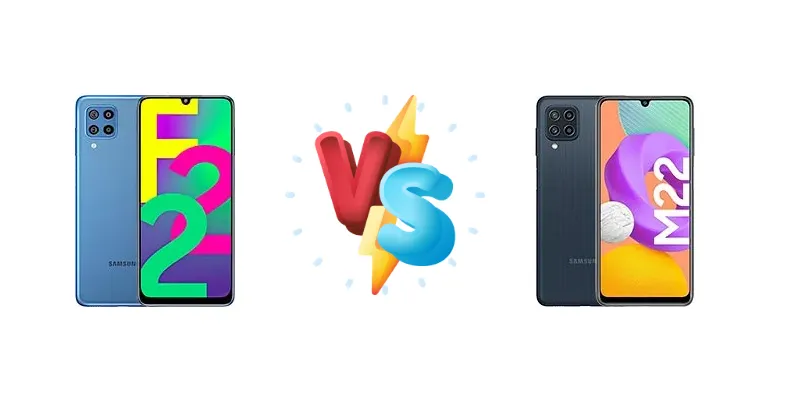
Samsung's F and M series consistently deliver compelling value in the budget smartphone space. The Galaxy F22 and M22 share a core foundation – the Mediatek Helio G80 chipset – but diverge in key areas, most notably charging speed. This comparison dissects these differences to help you determine which device best suits your needs.
🏆 Quick Verdict
For most users, the Samsung Galaxy M22 is the superior choice. While both phones offer identical performance thanks to the Helio G80, the M22’s 25W fast charging significantly reduces downtime, making it ideal for those constantly on the go. The F22 remains a viable option if budget is the absolute primary concern.
| Network |
|---|
| 2G bands | GSM 850 / 900 / 1800 / 1900 | GSM 850 / 900 / 1800 / 1900 |
| 3G bands | HSDPA 850 / 900 / 2100 | HSDPA 850 / 900 / 1700(AWS) / 1900 / 2100 |
| 4G bands | 1, 3, 5, 8, 20, 38, 40, 41 | 1, 2, 3, 4, 5, 7, 8, 12, 17, 20, 26, 28, 38, 40, 41, 66 |
| Speed | HSPA, LTE | HSPA, LTE |
| Technology | GSM / HSPA / LTE | GSM / HSPA / LTE |
| Launch |
|---|
| Announced | 2021, July 06 | 2021, September 14 |
| Status | Available. Released 2021, July 13 | Available. Released 2021, October 13 |
| Body |
|---|
| Build | Glass front, plastic frame, plastic back | Glass front, plastic frame, plastic back |
| Dimensions | 160 x 74 x 9.4 mm (6.30 x 2.91 x 0.37 in) | 159.9 x 74 x 8.4 mm (6.30 x 2.91 x 0.33 in) |
| SIM | Nano-SIM + Nano-SIM | Nano-SIM + Nano-SIM |
| Weight | 203 g (7.16 oz) | 186 g (6.56 oz) |
| Display |
|---|
| Resolution | 720 x 1600 pixels, 20:9 ratio (~274 ppi density) | 720 x 1600 pixels, 20:9 ratio (~274 ppi density) |
| Size | 6.4 inches, 98.9 cm2 (~83.5% screen-to-body ratio) | 6.4 inches, 98.9 cm2 (~83.6% screen-to-body ratio) |
| Type | Super AMOLED, 90Hz, 600 nits (HDR) | Super AMOLED, 90Hz, 600 nits (HDR) |
| Platform |
|---|
| CPU | Octa-core (2x2.0 GHz Cortex-A75 & 6x1.8 GHz Cortex-A55) | Octa-core (2x2.0 GHz Cortex-A75 & 6x1.8 GHz Cortex-A55) |
| Chipset | Mediatek MT6769V/CU Helio G80 (12 nm) | Mediatek MT6769V/CU Helio G80 (12 nm) |
| GPU | Mali-G52 MC2 | Mali-G52 MC2 |
| OS | Android 11, upgradable to Android 13, One UI core 5.1 | Android 11, upgradable to Android 13, One UI Core 5.1 |
| Memory |
|---|
| Card slot | microSDXC (dedicated slot) | microSDXC (dedicated slot) |
| Internal | 64GB 4GB RAM, 128GB 6GB RAM | 64GB 4GB RAM, 128GB 4GB RAM, 128GB 6GB RAM |
| | - | eMMC 5.1 |
| Main Camera |
|---|
| Features | LED flash, panorama, HDR | LED flash, panorama, HDR |
| Quad | 48 MP, f/1.8, (wide), PDAF
8 MP, f/2.2, 123˚ (ultrawide), 1/4.0", 1.12µm
2 MP (macro)
Auxiliary lens | 48 MP, f/2.0, (wide), PDAF, OIS
8 MP, f/2.2, 123˚ (ultrawide), 1/4.0", 1.12µm
2 MP (macro)
Auxiliary lens |
| Single | 13 MP, f/2.2, (wide), 1/3.1", 1.12µm | 13 MP, f/2.2, (wide), 1/3.1", 1.12µm |
| Video | 1080p@30fps | 1080p@30fps |
| Selfie camera |
|---|
| Single | 13 MP, f/2.2, (wide), 1/3.1", 1.12µm | 13 MP, f/2.2, (wide), 1/3.1", 1.12µm |
| Video | 1080p@30fps | 1080p@30fps |
| Sound |
|---|
| 3.5mm jack | Yes | Yes |
| 35mm jack | Yes | Yes |
| Loudspeaker | Yes | Yes |
| Comms |
|---|
| Bluetooth | 5.0, A2DP, LE | 5.0, A2DP, LE |
| NFC | No | Yes |
| Positioning | GPS, GLONASS, GALILEO, BDS | GPS, GLONASS, GALILEO, BDS |
| Radio | FM radio, recording | Unspecified |
| USB | USB Type-C 2.0, OTG | USB Type-C 2.0 |
| WLAN | Wi-Fi 802.11 a/b/g/n/ac, dual-band, Wi-Fi Direct | Wi-Fi 802.11 a/b/g/n/ac, dual-band, Wi-Fi Direct |
| Features |
|---|
| Sensors | Fingerprint (side-mounted), accelerometer, gyro, compass | Fingerprint (side-mounted), unspecified sensors |
| | Virtual Proximity Sensing | - |
| Battery |
|---|
| Charging | 15W wired | 25W wired |
| Type | Li-Po 6000 mAh | Li-Po 5000 mAh |
| Misc |
|---|
| Colors | Denim Black, Denim Blue | Black, White, Light Blue |
| Models | SM-E225F, SM-E225F/DS | SM-M225FV, SM-M225FV/DS |
| Price | About 170 EUR | About 230 EUR |
| SAR | 0.62 W/kg (head) | - |
| SAR EU | - | 0.62 W/kg (head) 1.24 W/kg (body) |
Samsung Galaxy F22
- Potentially lower price point
- Identical CPU performance to M22
- Samsung’s One UI software experience
- Significantly slower 15W charging
- Likely longer charging times
- May have less optimized thermal management
Samsung Galaxy M22
- 25W fast charging for quicker top-ups
- Reduced downtime compared to F22
- Identical CPU performance to F22
- Potentially higher price than F22
- Similar camera performance to F22
- Still utilizes a budget-focused chipset
Display Comparison
Both the Galaxy F22 and M22 are expected to feature similar LCD panels, given their positioning. While specific details like peak brightness and color gamut coverage aren't provided, the LCD technology suggests a focus on affordability over premium display features like OLED or high refresh rates. Bezels are likely comparable, aiming for a modern look without pushing into flagship territory. Color accuracy will likely be tuned for Samsung’s vibrant, saturated profile, common in this price bracket.
Camera Comparison
Camera performance will likely be similar, relying heavily on software processing. Both phones likely feature a similar primary sensor, though exact megapixel counts aren't specified. The inclusion of a 2MP macro camera on both devices is a common, but often underwhelming, feature in this segment. Image quality will depend more on Samsung’s image processing algorithms than raw sensor capabilities. Expect decent results in good lighting conditions, but struggles in low-light scenarios.
Performance
The heart of both devices is the Mediatek Helio G80 (12 nm) chipset, featuring an octa-core CPU configuration with 2x2.0 GHz Cortex-A75 and 6x1.8 GHz Cortex-A55 cores. This means identical CPU performance for everyday tasks and gaming. The GPU performance will also be the same. However, thermal management could differ slightly based on internal design and cooling solutions, though neither phone is expected to exhibit significant throttling under sustained load. RAM configurations are likely similar, impacting multitasking capabilities, but the chipset remains the primary performance bottleneck.
Battery Life
The key differentiator lies in charging speed. The Galaxy F22 supports 15W wired charging, while the M22 boasts 25W wired charging. While battery capacity isn't specified, the faster charging on the M22 translates to significantly reduced charging times. A full 0-100% charge on the F22 could take upwards of 2 hours, whereas the M22 could achieve a full charge in around 1 hour 15 minutes. This difference is crucial for users who prioritize convenience and minimal downtime.
Buying Guide
Buy the Samsung Galaxy F22 if you prioritize the absolute lowest price point and are comfortable with slower charging speeds. It’s a solid choice for users who primarily use their phone for basic tasks and don’t mind topping up overnight. Buy the Samsung Galaxy M22 if you value faster charging and convenience. The 25W charging capability is a significant advantage for users who need to quickly replenish their battery throughout the day, even if it means a slightly higher initial investment.
Frequently Asked Questions
❓ Will the Helio G80 struggle with demanding games like PUBG or Call of Duty?
The Helio G80 is a capable chipset for casual gaming, but demanding titles like PUBG and Call of Duty will likely require reduced graphics settings to maintain a stable frame rate. Expect playable performance at medium settings, but don't anticipate a flagship-level gaming experience.
❓ Is the 2MP macro camera on either phone worth using?
Generally, 2MP macro cameras on budget phones offer limited utility. Image quality is often soft and lacks detail. While it can be fun to experiment with close-up shots, don't expect professional-grade macro photography from either device.
❓ Does the Samsung Galaxy M22 support reverse wireless charging?
Based on the specifications and market positioning of these devices, it's highly unlikely that either the F22 or M22 supports reverse wireless charging. This feature is typically reserved for higher-end Samsung models.
❓ How does the software experience differ between the F22 and M22?
Both phones run Samsung’s One UI, so the software experience will be nearly identical. Expect the same features, interface, and pre-installed apps. Software updates will likely be delivered at a similar pace to both devices.