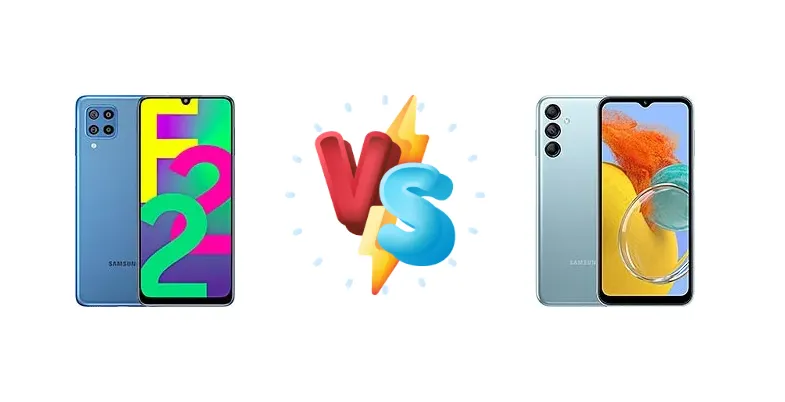
Samsung's Galaxy F and M series cater to the budget-conscious consumer, but offer distinct approaches. The Galaxy F22, released earlier, focuses on providing essential features at a low price point. The newer Galaxy M14, however, introduces a more modern chipset and potentially faster charging, raising the question: is the upgrade worth it for everyday users?
🏆 Quick Verdict
For most users, the Samsung Galaxy M14 is the superior choice. Its Exynos 1330 chipset delivers a noticeable performance boost over the F22’s Helio G80, translating to smoother multitasking and improved gaming. While both offer 15W charging (or 25W in India for the M14), the M14’s efficiency gains make it the better all-around device.
| Network |
|---|
| 2G bands | GSM 850 / 900 / 1800 / 1900 | GSM 850 / 900 / 1800 / 1900 |
| 3G bands | HSDPA 850 / 900 / 2100 | HSDPA 850 / 900 / 1700(AWS) / 1900 / 2100 |
| 4G bands | 1, 3, 5, 8, 20, 38, 40, 41 | 1, 2, 3, 4, 5, 7, 8, 12, 17, 20, 26, 28, 38, 40, 41, 66 |
| 5G bands | - | 1, 3, 5, 7, 8, 20, 28, 38, 40, 41, 66, 77, 78 SA/NSA |
| Speed | HSPA, LTE | HSPA, LTE, 5G |
| Technology | GSM / HSPA / LTE | GSM / HSPA / LTE / 5G |
| Launch |
|---|
| Announced | 2021, July 06 | 2023, March 08 |
| Status | Available. Released 2021, July 13 | Available. Released 2023, March 08 |
| Body |
|---|
| Build | Glass front, plastic frame, plastic back | Glass front (Gorilla Glass 5), plastic back, plastic frame |
| Dimensions | 160 x 74 x 9.4 mm (6.30 x 2.91 x 0.37 in) | 166.8 x 77.2 x 9.4 mm (6.57 x 3.04 x 0.37 in) |
| SIM | Nano-SIM + Nano-SIM | · Nano-SIM· Nano-SIM + Nano-SIM |
| Weight | 203 g (7.16 oz) | 206 g (7.27 oz) |
| Display |
|---|
| Protection | - | Corning Gorilla Glass 5 |
| Resolution | 720 x 1600 pixels, 20:9 ratio (~274 ppi density) | 1080 x 2408 pixels, 20:9 ratio (~400 ppi density) |
| Size | 6.4 inches, 98.9 cm2 (~83.5% screen-to-body ratio) | 6.6 inches, 104.9 cm2 (~81.5% screen-to-body ratio) |
| Type | Super AMOLED, 90Hz, 600 nits (HDR) | PLS LCD, 90Hz |
| Platform |
|---|
| CPU | Octa-core (2x2.0 GHz Cortex-A75 & 6x1.8 GHz Cortex-A55) | Octa-core (2x2.4 GHz Cortex-A78 & 6x2.0 GHz Cortex-A55) |
| Chipset | Mediatek MT6769V/CU Helio G80 (12 nm) | Exynos 1330 (5 nm) |
| GPU | Mali-G52 MC2 | Mali-G68 MP2 |
| OS | Android 11, upgradable to Android 13, One UI core 5.1 | Android 13, One UI core 5.1 |
| Memory |
|---|
| Card slot | microSDXC (dedicated slot) | microSDHC (dedicated slot) |
| Internal | 64GB 4GB RAM, 128GB 6GB RAM | 64GB 4GB RAM, 128GB 4GB RAM, 128GB 6GB RAM |
| Main Camera |
|---|
| Features | LED flash, panorama, HDR | LED flash, panorama, HDR |
| Quad | 48 MP, f/1.8, (wide), PDAF
8 MP, f/2.2, 123˚ (ultrawide), 1/4.0", 1.12µm
2 MP (macro)
Auxiliary lens | - |
| Single | 13 MP, f/2.2, (wide), 1/3.1", 1.12µm | 13 MP, f/2.0, (wide) |
| Triple | - | 50 MP, f/1.8, (wide), PDAF
2 MP (macro)
Auxiliary lens |
| Video | 1080p@30fps | 1080p@30fps |
| Selfie camera |
|---|
| Single | 13 MP, f/2.2, (wide), 1/3.1", 1.12µm | 13 MP, f/2.0, (wide) |
| Video | 1080p@30fps | 1080p@30fps |
| Sound |
|---|
| 3.5mm jack | Yes | Yes |
| 35mm jack | Yes | Yes |
| Loudspeaker | Yes | Yes |
| Comms |
|---|
| Bluetooth | 5.0, A2DP, LE | 5.2, A2DP, LE |
| NFC | No | Yes |
| Positioning | GPS, GLONASS, GALILEO, BDS | GPS, GLONASS, GALILEO, BDS, QZSS, NavIC |
| Radio | FM radio, recording | Unspecified |
| USB | USB Type-C 2.0, OTG | USB Type-C 2.0 |
| WLAN | Wi-Fi 802.11 a/b/g/n/ac, dual-band, Wi-Fi Direct | Wi-Fi 802.11 a/b/g/n/ac, dual-band, Wi-Fi Direct |
| Features |
|---|
| Sensors | Fingerprint (side-mounted), accelerometer, gyro, compass | Fingerprint (side-mounted), accelerometer, gyro, proximity, compass |
| | Virtual Proximity Sensing | - |
| Battery |
|---|
| Charging | 15W wired | 15W wired - international
25W wired - India |
| Type | Li-Po 6000 mAh | Li-Po 6000 mAh |
| Misc |
|---|
| Colors | Denim Black, Denim Blue | Navy Blue, Light Blue, Silver |
| Models | SM-E225F, SM-E225F/DS | SM-M146B, SM-M146B/DS, SM-M146B/DSN |
| Price | About 170 EUR | ₹ 10,990 |
| SAR | 0.62 W/kg (head) | - |
| SAR EU | - | 0.48 W/kg (head) 1.53 W/kg (body) |
Samsung Galaxy F22
- Most affordable option
- Functional for basic tasks
- Reliable Samsung brand
- Outdated Helio G80 chipset
- Less efficient power consumption
- Slower performance
Samsung Galaxy M14
- More powerful Exynos 1330 chipset
- Improved power efficiency
- Potentially faster 25W charging (India)
- Slightly higher price point
- May not offer significant camera improvements
- Still utilizes a budget-focused display
Display Comparison
Neither device boasts a standout display. Both likely utilize LCD panels, a common cost-saving measure in this segment. The focus here isn't on visual fidelity. However, the lack of detailed display specs (resolution, peak brightness) makes a direct comparison difficult. We can assume similar viewing experiences, prioritizing practicality over premium features.
Camera Comparison
Without detailed camera specs beyond the presence of a 2MP macro lens (which is largely irrelevant), a meaningful comparison is limited. We can infer that both phones will offer adequate, but not exceptional, image quality. The larger sensor size, if present in the M14, would be a key advantage, capturing more light and resulting in better low-light performance. Image processing algorithms will also play a role, and Samsung’s software optimizations could potentially bridge the gap between hardware limitations.
Performance
The core difference lies in the chipsets. The Galaxy M14’s Exynos 1330, fabricated on a 5nm process, represents a significant leap over the F22’s 12nm Mediatek Helio G80. The 5nm node allows for greater transistor density and improved power efficiency, meaning the M14 will run cooler and potentially sustain peak performance for longer. The Exynos 1330’s CPU configuration – 2x2.4 GHz Cortex-A78 & 6x2.0 GHz Cortex-A55 – also offers a performance advantage over the F22’s 2x2.0 GHz Cortex-A75 & 6x1.8 GHz Cortex-A55. This translates to faster app loading times, smoother animations, and a more responsive user experience. Gamers will particularly notice the difference, with the M14 capable of handling more demanding titles at higher settings.
Battery Life
Both phones feature 15W wired charging, but the Exynos 1330’s superior power efficiency in the M14 means it will likely achieve a full charge faster, despite potentially having a similar battery capacity. The M14’s 5nm process reduces power consumption during everyday tasks, extending battery life. The availability of 25W charging in India for the M14 further enhances its charging speed advantage, offering a quicker top-up when needed.
Buying Guide
Buy the Samsung Galaxy F22 if you prioritize absolute affordability and only need a phone for basic tasks like calls, messaging, and light social media. It’s a functional device for those on a very tight budget. Buy the Samsung Galaxy M14 if you value performance, future-proofing, and potentially faster charging (depending on your region). The M14 is better suited for users who enjoy mobile gaming, streaming video, or multitasking.
Frequently Asked Questions
❓ Does the Exynos 1330 in the Galaxy M14 tend to overheat during prolonged gaming sessions?
The Exynos 1330's 5nm fabrication process is designed for improved thermal efficiency. While some heat generation is inevitable during intensive gaming, it's significantly less prone to overheating compared to the 12nm Helio G80 in the F22, allowing for more sustained performance.
❓ Is the 2MP macro camera on either phone actually useful for taking detailed close-up photos?
Generally, 2MP macro cameras on budget phones offer limited utility. The low resolution results in images lacking detail and sharpness. They are often included as a marketing feature rather than a genuinely useful photographic tool. Expect soft, grainy results.
❓ Can the Galaxy M14 handle demanding games like PUBG Mobile at high frame rates (90fps)?
The Exynos 1330 is capable of running PUBG Mobile at higher frame rates, but achieving a consistent 90fps will depend on the graphics settings and the specific device configuration. Lowering the graphics settings to 'Smooth' or 'Balanced' should allow for a playable experience at 60fps or higher, and potentially 90fps with optimization.
❓ What is the real-world difference in charging time between the 15W charging on the F22 and the 25W charging on the M14 (India version)?
The 25W charging on the M14 (India) will significantly reduce charging time compared to the F22's 15W charging. Expect a roughly 30-50% faster 0-100% charge time with the M14, making it more convenient for users who need a quick top-up.