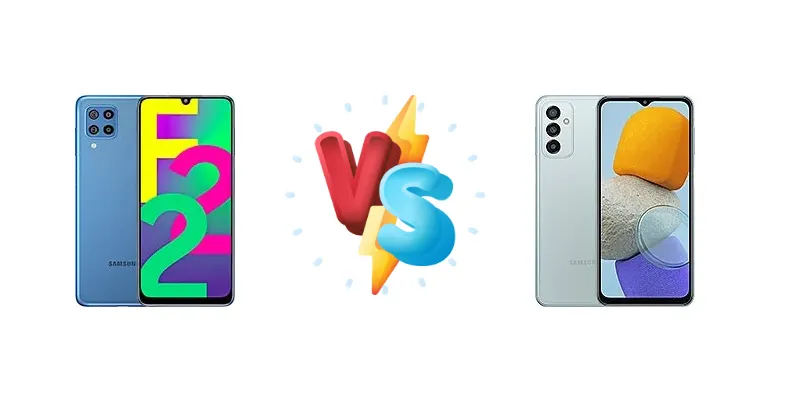
The Samsung Galaxy F22 and F23 represent Samsung's continued push into the competitive budget smartphone market. While both aim to deliver essential features at an accessible price, they diverge significantly in their core hardware. The F23 introduces 5G connectivity and a newer chipset, but does that translate to a meaningfully better experience than the established F22? We dissect the key differences to help you decide.
🏆 Quick Verdict
For most users, the Samsung Galaxy F23 is the superior choice. The Snapdragon 750G offers a noticeable performance uplift over the Helio G80, coupled with the benefit of 5G connectivity and significantly faster 25W charging. While the F22 remains a viable option for basic tasks, the F23 provides a more future-proof and responsive experience.
| Network |
|---|
| 2G bands | GSM 850 / 900 / 1800 / 1900 | GSM 850 / 900 / 1800 / 1900 |
| 3G bands | HSDPA 850 / 900 / 2100 | HSDPA 850 / 900 / 1700(AWS) / 1900 / 2100 |
| 4G bands | 1, 3, 5, 8, 20, 38, 40, 41 | 1, 2, 3, 4, 5, 7, 8, 12, 17, 20, 26, 28, 38, 40, 41, 66 |
| 5G bands | - | 1, 3, 5, 7, 8, 20, 28, 38, 40, 41, 66, 78 SA/NSA/Sub6 |
| Speed | HSPA, LTE | HSPA, LTE, 5G |
| Technology | GSM / HSPA / LTE | GSM / HSPA / LTE / 5G |
| Launch |
|---|
| Announced | 2021, July 06 | 2022, March 08 |
| Status | Available. Released 2021, July 13 | Available. Released 2022, March 16 |
| Body |
|---|
| Build | Glass front, plastic frame, plastic back | Glass front (Gorilla Glass 5), plastic frame, plastic back |
| Dimensions | 160 x 74 x 9.4 mm (6.30 x 2.91 x 0.37 in) | 165.5 x 77 x 8.4 mm (6.52 x 3.03 x 0.33 in) |
| SIM | Nano-SIM + Nano-SIM | Nano-SIM + Nano-SIM |
| Weight | 203 g (7.16 oz) | 198 g (6.98 oz) |
| Display |
|---|
| Protection | - | Corning Gorilla Glass 5 |
| Resolution | 720 x 1600 pixels, 20:9 ratio (~274 ppi density) | 1080 x 2408 pixels, 20:9 ratio (~400 ppi density) |
| Size | 6.4 inches, 98.9 cm2 (~83.5% screen-to-body ratio) | 6.6 inches, 104.9 cm2 (~82.3% screen-to-body ratio) |
| Type | Super AMOLED, 90Hz, 600 nits (HDR) | TFT LCD, 120Hz |
| Platform |
|---|
| CPU | Octa-core (2x2.0 GHz Cortex-A75 & 6x1.8 GHz Cortex-A55) | Octa-core (2x2.2 GHz Kryo 570 & 6x1.8 GHz Kryo 570) |
| Chipset | Mediatek MT6769V/CU Helio G80 (12 nm) | Qualcomm SM7225 Snapdragon 750G 5G (8 nm) |
| GPU | Mali-G52 MC2 | Adreno 619 |
| OS | Android 11, upgradable to Android 13, One UI core 5.1 | Android 12, upgradable to Android 14, One UI 6 |
| Memory |
|---|
| Card slot | microSDXC (dedicated slot) | microSDXC (dedicated slot) |
| Internal | 64GB 4GB RAM, 128GB 6GB RAM | 128GB 4GB RAM, 128GB 6GB RAM |
| Main Camera |
|---|
| Features | LED flash, panorama, HDR | LED flash, panorama, HDR |
| Quad | 48 MP, f/1.8, (wide), PDAF
8 MP, f/2.2, 123˚ (ultrawide), 1/4.0", 1.12µm
2 MP (macro)
Auxiliary lens | - |
| Single | 13 MP, f/2.2, (wide), 1/3.1", 1.12µm | 8 MP, f/2.2, (wide) |
| Triple | - | 50 MP, f/1.8, (wide), PDAF
8 MP, f/2.2, 123˚ (ultrawide), 1/4.0", 1.12µm
2 MP (macro) |
| Video | 1080p@30fps | 4K@30fps, 1080p@30fps, 720p@480fps |
| Selfie camera |
|---|
| Single | 13 MP, f/2.2, (wide), 1/3.1", 1.12µm | 8 MP, f/2.2, (wide) |
| Video | 1080p@30fps | 1080p@30fps |
| Sound |
|---|
| 3.5mm jack | Yes | Yes |
| 35mm jack | Yes | Yes |
| Loudspeaker | Yes | Yes |
| Comms |
|---|
| Bluetooth | 5.0, A2DP, LE | 5.0, A2DP, LE |
| NFC | No | Yes |
| Positioning | GPS, GLONASS, GALILEO, BDS | GPS, GLONASS, GALILEO, BDS, QZSS |
| Radio | FM radio, recording | FM radio, recording |
| USB | USB Type-C 2.0, OTG | USB Type-C 2.0, OTG |
| WLAN | Wi-Fi 802.11 a/b/g/n/ac, dual-band, Wi-Fi Direct | Wi-Fi 802.11 a/b/g/n/ac, dual-band, Wi-Fi Direct |
| Features |
|---|
| Sensors | Fingerprint (side-mounted), accelerometer, gyro, compass | Fingerprint (side-mounted), accelerometer, gyro, compass |
| | Virtual Proximity Sensing | Virtual Proximity Sensing |
| Battery |
|---|
| Charging | 15W wired | 25W wired |
| Type | Li-Po 6000 mAh | Li-Po 5000 mAh |
| Misc |
|---|
| Colors | Denim Black, Denim Blue | Aqua Blue, Forest Green |
| Models | SM-E225F, SM-E225F/DS | SM-E236B, SM-E236B/DS |
| Price | About 170 EUR | About 190 EUR |
| SAR | 0.62 W/kg (head) | 1.24 W/kg (head) |
Samsung Galaxy F22
- More affordable price point
- Sufficient for basic smartphone tasks
- Established reliability within the F series
- Slower processor and graphics performance
- Lacks 5G connectivity
- Significantly slower 15W charging
Samsung Galaxy F23
- Faster and more efficient Snapdragon 750G chipset
- 5G connectivity for faster data speeds
- 25W fast charging for quicker top-ups
- Slightly higher price compared to the F22
- May experience minor thermal throttling under extreme load
- Potentially less readily available in some markets
Display Comparison
Both devices likely feature similar LCD panels, given their market segment. However, the focus here isn't display quality, but the underlying performance that drives the user interface. While specific display specs are unavailable, the more powerful chipset in the F23 will contribute to smoother scrolling and faster app loading, indirectly enhancing the perceived display experience. The F23's processing power will also be more capable of handling graphically intensive content displayed on the screen.
Camera Comparison
Without detailed camera specs beyond the chipsets, it's difficult to make definitive claims. However, the Snapdragon 750G includes a more advanced Image Signal Processor (ISP) than the Helio G80. This ISP is crucial for image processing, noise reduction, and dynamic range. While the sensor quality itself is unknown, the F23 will likely produce better-looking photos, especially in challenging lighting conditions, due to the superior image processing capabilities of the Snapdragon chipset. The F23's ISP will also likely handle video recording more effectively.
Performance
The core difference lies in the chipsets. The Galaxy F23’s Qualcomm Snapdragon 750G (8nm) is a significant upgrade over the F22’s MediaTek Helio G80 (12nm). The 8nm process node inherently offers better power efficiency, translating to less heat generation and potentially less throttling during sustained workloads. The Snapdragon 750G’s Kryo 570 cores, clocked at 2.2 GHz, provide a performance advantage over the Helio G80’s Cortex-A75 cores at 2.0 GHz. This means faster app launches, smoother multitasking, and improved gaming performance on the F23. The F23 is also 5G capable, a feature absent in the F22.
Battery Life
While battery capacity isn't specified, the F23’s 25W wired charging is a substantial improvement over the F22’s 15W charging. This translates to significantly faster charging times – potentially reducing a full charge from over 2 hours on the F22 to around 1 hour 15 minutes on the F23. Even if the F23 has a slightly smaller battery, the faster charging mitigates this concern, providing more usable time throughout the day. The Snapdragon 750G’s improved power efficiency also contributes to better battery life under load.
Buying Guide
Buy the Samsung Galaxy F22 if you prioritize absolute affordability and your usage is limited to basic tasks like calling, texting, and light social media browsing. You'll accept slower performance and lack 5G. Buy the Samsung Galaxy F23 if you want a smoother, more responsive experience, the ability to connect to 5G networks, and faster charging – all for a relatively small price premium. This is the better choice for gamers and power users.
Frequently Asked Questions
❓ Will the Snapdragon 750G in the F23 handle demanding games like PUBG Mobile smoothly?
Yes, the Snapdragon 750G is capable of running PUBG Mobile at medium to high settings with stable frame rates. While it won't match the performance of flagship chipsets, it provides a significantly better gaming experience than the Helio G80 in the F22, offering smoother gameplay and reduced lag.
❓ How much faster is the 25W charging on the F23 compared to the 15W charging on the F22 in real-world use?
Expect a full charge on the Galaxy F23 to take approximately 1 hour and 15 minutes to 1 hour and 30 minutes with the 25W charger. The F22, with its 15W charging, will likely take over 2 hours to reach 100%. This difference is substantial and provides a much more convenient charging experience.
❓ Does the F23's 5G connectivity actually make a noticeable difference in everyday use?
The benefit of 5G depends on network availability in your area. If you have access to a 5G network, you'll experience significantly faster download and upload speeds, resulting in quicker app downloads, smoother streaming, and lower latency for online gaming. However, if you're primarily on 4G, the difference will be less noticeable.